Wednesday, August 17, 2011

Morley Baer and the Shrug of Earth


Morley Baer [1916-1995] was a Bay Area resident and professional photographer for fifty years. I first became aware of his work in the early 1980's. His black and white landscape photographs were being published in monographs, and he had achieved notoriety for his color work in Painted Ladies--San Francisco's Resplendent Victorians [Dutton, 1978], which recorded the garishly repainted late Victorian--post-earthquake--architectural follies, in vivid Kodachrome (or Ektachrome). Baer had begun his professional career as an architectural photographer in the late 1940's. Like Brett Weston, he'd done a turn in the military working as a service documentarian, before finally settling in the Bay area in the early 1950's. Baer eventually established a reputation as one of the top architectural photographers, working with William Wurster, William Turnbull and many other notable regional designers. His images of the built environment are widely published in that field.
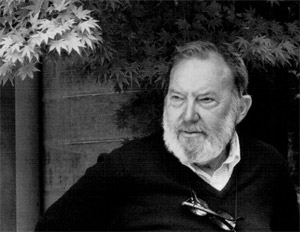

Concurrently with his architectural work, Baer was also interested in landscape imagery. He early connected with Edward Weston, and fell in love with the same West Coast scenery which had inspired the Westons (Brett, Edward and Cole) , and many others during the immediate post-War period. Baer assisted in the printing of the limited original Edward Weston print portfolios. As his interest in artistic landscape work increased, he was drawn to the Central Coast area around Carmel, and in 1965 he moved into a beautiful stone beach mansion on Garrapata Beach--designed for him by Wurster. Baer, using the beach house as a base of operations, lived there until 1979, when he sold it to resume living with his wife at another house in the Carmel Valley, where they lived for the rest of their lives. In his later years, Baer taught workshops, and saw his reputation grow along with the recognition of the West Coast photography movement of which he had been a major figure.


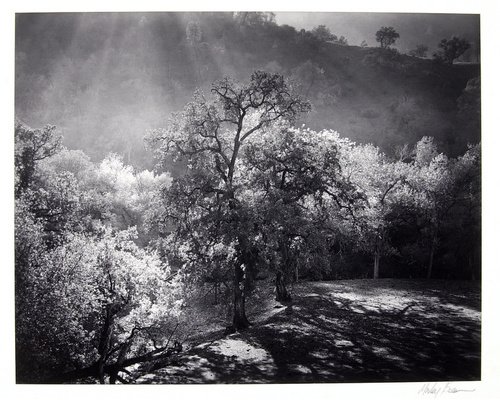
Preferring an 8x10 view camera for most of his serious work, Baer established a personal style that derived in part from Edward Weston's and Ansel Adams's landscape work, but he brought to it a certain elegance and finish that set it apart. Aside from his straight architectural commissions, Baer was interested in the architecture of barns, the rolling oaky hills, and spent time in Spain and Italy working on classical subject matter as well. I've always loved his studies of the coastal foothills, which though not being entirely "heroic" (in the manner of Adams) nevertheless have a dignity and austere picturesque quality I find very attractive.

He also worked in the Southwest, exploring the native pueblo and church architecture, seen here in this gaunt, metaphysical study of an adobe wall and curved ladder arching into an eerily empty sky.
The same kind of aesthetically discrete approach characterizes this study of a Spanish colonial architectural detail of a chimney, door and roof-line. Keeping the roof-line level with the point-of-view allows the composition to be neatly divided between the shadowed wall underneath the overhang, and the slightly darker grey sky above.


There's a sculptural purity about this study of another Southwest structure, the high contrast hard sunlight emphasizing the heavy solidity and mass of the battered stone construction.


One aspect of the dramatic West Coastline is the foam and spray which rise into the atmosphere around the crashing surf and rocky shingle. Baer captures this coastal "fog" or mist interposed against the distance shoulders of land, heightening the effect of the glittering droplets of sparkle and fizz. You can really feel the wet and coolness of the interaction.


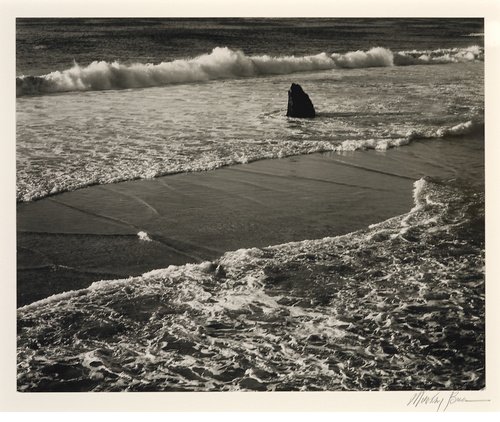
The effect here--of opposing surf waves--possible where a fresh-water stream meets the oncoming waves, creates a christening quality, where the two currents will intersect and merge into one. It's a delicacy for the eye, like sunny lace curtains in the breeze. The rock, meanwhile, anchors the composition. We're looking at a diagonal vantage to the scene, so that rock sets up a perspective definition that keeps the eye level and oriented.

In the course of his architectural work, Baer often ventured into the agricultural valleys and canyons of the coastal mountains. Here he captures a well-known adobe ranch spread, with characteristic preciosity, the whitness of the buildings and drive contrasted against the dark shapes of the mountain ridge.


It's clear that Baer felt a sense of earthly power in the California landscape. Many of his studies have a strong, masculine apprehension of forces implacably set in opposition to man's appropriation, the movement of great forces under the earth, or from the sky, which contend in a scene at once majestic, and somewhat frightening. We stand in awe of the earth's (or nature's) capriciousness, though its movements and adjustments may be as quiet and satisfying as the slow movement in a Bruckner symphony.


Bringing out these senses of scale and awesome range is often what Baer's prints seem to be about. This is achieved through the contrast between a delicately rendered (and perfectly clear) foreground, and a yawning background fortuitously back-lit or highlighted with cloud windows.


This study of rock and water is not an unusual subject--indeed, most of Baer's images aren't about finding the most peculiar or strained vantage from which to view a landscape scene--but its quality is like a brunt or shrug of geologic gesture. The rock flows, while the water seems icy, and still. The interposition of states of matter uses the deceptive contrast between kinds of textures to disorient the eye, and give interest. As with all Baer prints, there's a strong "interlocked" composition, founded and fixed.

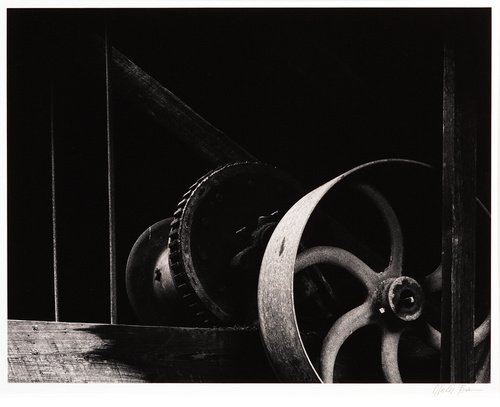
Though most of Baer's work in architecture is straightforward, occasionally he liked to make images of odd dilapidation or decay. The disappearing rural architecture of the West captured his imagination. This storehouse structure has a weird "high-rise" effect which is completely disorienting in the context of its placement and construction. Baer was fond of dark skies, and this one undoubtedly was burned in deliberately to emphasize the heavy, overbearing quality of the ghostly presence.


Baer's work along Garrapata, Big Sur, Carmel, and the Monterey Bay region may be the best examples of this genre. The combination of high contrast blacks with feathery light grey distances, is always used to create drama, and mystery.


These compositions may seem easy and available, but it takes great patience, lots of work in the darkroom, and some luck as well, to make pictures like this. The light and clouds and wind seldom cooperate. Once, photographing along the Garrapata Creek area, I picked up a terrific case of poison oak that plagued me for a month. I'm sure that Baer must have known about this, and taken steps to protect himself. In my case, just handling the spikes at the end of my tripod was enough to infect me from head to toe!

These aren't the usual tourist shots--because the "nature" they portray isn't welcoming and cheerful. They seem to be telling us that this country may be over-run, may be spoiled and defaced and polluted and poisoned, but it will never be tamed. That's the message with a lot of Baer shots: There's an ephemeral fragility which we can see here, but underneath that there are forces and movements which command our respect, as well as our appreciation of their inherent beauty and charm.

Baer's images are contemplative and refined, serious and dry. But despite their classical balance and studied counterpoint, they're hardly reassuring or inert. The dizzying forces and poised relationships they capture are held in place by the shrewd augmentations of his art. You can feel Baer's character in all his images--he manages to define his purpose and convey his program with confidence and fullness of intention.
This power of purpose has metaphysical persuasiveness which I find convincing, though this isn't the only kind of photographic style I admire, or enjoy.
Baer's a "heavy" artist--rather in the manner that Ansel Adams often is. This muscular insistence can be very powerful, visually, like listening to Beethoven. No one likes Beethoven all the time, but we'd be poorer if we'd never known it. Baer's influence is apparent throughout the following two generations of print-makers. We all have our favorites, but there's no question that Baer's approach to landscape has tended to dominate the field. In many ways, he's the fulfillment of the movement which began with the f64 Group in the 1930's, and chronologically he stands in direct descent from that time, to this.
Much of the landscape he's explored no longer exists, and his work thus occupies an elegiac position with respect to the progress of western expansionism and development. The post-cards of yesteryear become the nostalgic flashbacks of the future.


As we use up the remaining unspoiled lands which men first discovered centuries ago, it's important to have records of what was lost in the process, even if the ultimate message is a sad one. This is what you had, and this is what you lost. Shame on you for ruining it. Even if your busy manipulations and "improvements" will someday be swept away by some conflagration or inundation of nature.


___________________

All Photograph(s) seen here by Morley Baer.

©2012 by the Morley Baer Photography Trust, Santa Fe.

All reproduction rights reserved.  Images used by permission.  

Tuesday, August 16, 2011

Buffett's Cautionary Remarks


Warren Buffett [1930- ] is undoubtedly the most famous American investment guru in the last century. I, among the millions of sensible small private investors, have enjoyed his brilliant investment/financial acumen, by investing in his Berkshire Hathaway mutual fund.

Buffett is famously unassuming and modest, depending on his common-sense approach to evaluation of old-fashioned strong dependable-product-oriented companies, to generate returns which have been the standard on Wall Street for three generations. Buffett's personal worth, or assets under his direct control, place him, at any given time, among the top 4 or 5 individuals on the planet.

Buffett would be the last person in the world to expect anyone to take his advice on political matters, but he's never been shy about offering opinions about what might make our domestic economy healthy, or healthier.

On Sunday, the New York Times published Buffett's opinion piece on Federal Tax policy, "Stop Coddling the Super-Rich."

Gore Vidal remarked once that in America, we have welfare for the rich, and laissez-faire capitalism for everyone else. This isn't what we usually hear, of course, since our media has traditionally been controlled by the rich and the corporations. In the old days, "yellow journalism" focused on the peccadillos of the well-to-do, but since World War II, the Fourth Estate has been under the control of capital in this country. If the business of America has been business, the business of media has been to protect the privileges of the wealthy and powerful.

Today, you will seldom see any opinion critical of corporate interests, or of the "super-rich." Let's be fair: Buffett is so rich, he can "afford" to be honest about the corruption of our tax system--even if he were paying ten times what he currently pays, he'd still be making out like a bandit. He's approaching his dotage; he's been responsible for more charity and good works with a flick of his little finger, than 99% of the rest of his countrymen. In short, he has the cred and the privilege to offer an opinion. He's not running for office, and he no longer has a vested interest in protecting his own little corner of the market, even as recreation.

Buffett informs us that he paid a total of $6,938,744 in federal income taxes in 2010. Given that Buffett is worth an amount just south of 100 billion dollars, in rough terms, that means he paid somthing like 2/3's of 1 percent of his total net worth to the Feds. If Buffett had contributed less to charity, he doubtless would have paid more, but how much more would be "fair"? No doubt the libertarians are shivering with discomfort at this point. Why should self-made men of distinction pay one dime of their earnings to support the general governance?

People who "work" for a living, trading their time and energy for fixed or variable rates of remuneration, won't have trouble understanding the inequitable imbalance of this situation. My wife and I pay fully 42% of all our income in taxes--Federal, state, local, fees, licenses, sales, penalties, etc. What this means in real terms, is that as middle-class householders, the claim that government can make on our income is at least 7 times what it can demand from someone in Buffett's situation. It doesn't take a genius to see that any income distribution scheme which dilutes the income generated by our society into proportionately larger segments of the population, would yield a considerably greater tax revenue than is realized through our present tax system. By concentrating the wealth of our economy among the top 1/10th of 1 percent of the population, and taxing them as if they "needed" this income to maintain their well-deserved wealth, is a recipe for a drastic truncation of entitlement.

Most people agree that the promises we've made to ourselves through exaggerated expectations of retirement or pension income cannot be sustained in an atmosphere of a tightening economic outlook. But we also know that the capital presently being held in private hands is unlikely to be invested in America, and even if it is, it's unlikely that it will generate significant increases in solid middle-class jobs (that is, a decent wage, plus health insurance and some modest pension program). Employment may grow, but the loss of real wealth among everyone below the $200,000 annual household income level, will continue, and probably even be accelerated. Our new "service-oriented" economy will mean that 2.3 wage-earners per household will earn less than their grandparents did with a single full-time wage-earning head of household in the 1950's or 1960's. That transformation has occurred in an environment of carping conservative bitchiness which demands more "shared sacrifice" from everyone but the defined well-off upper margins. The super rich today are four times richer than they were in 1990. The real tax burden of the rich (and super rich) has been steadily declining in real (as well as adjusted) terms for five decades. The corporate tax rates today are less than 30% of what they were in 1960.

The old wives' tale about discouraging jobs with higher capital tax rates is cited by Buffett: "I have worked with investors for 60 years and I have yet to see anyone — not even when capital gains rates were 39.9 percent in 1976-77 — shy away from a sensible investment because of the tax rate on the potential gain. People invest to make money, and potential taxes have never scared them off. And to those who argue that higher rates hurt job creation, I would note that a net of nearly 40 million jobs were added between 1980 and 2000. You know what’s happened since then: lower tax rates and far lower job creation."

The Tea Party members of Congress swore that they'd hold the line against any tax "increases"--even if that threatened the full faith and credit of the U.S. Treasury. Putting aside for now the issue of the credit rating assigned by Standard & Poor, it's clear that these wild-eyed young arrivistes, had no real interests in the immediate effect their ideological position could, and will, have on everyone's economic interest. Were they simply stupid, or did they like the idea of staging a tantrum which could have no favorable outcome, for anyone? It's unclear from all the poles we hear about, what Americans actually think about the tax inequities presently in effect. Do they like the idea that our society is becoming increasingly top-heavy, while the rest of us keep losing ground? Statistics prove that the separation between the rich and very rich, and everyone else, is widening at an alarming rate. What this means in real terms is that the distribution of income is steadily driving the middle class into the lower echelons. Families which once could own homes, will now rent. Families which once could afford to buy an automobile on a three year loan, will now have to take out a long term "mortgage" to pay for it, or drive a used one. Aggregate savings balances by Americans continue to sink to all time lows.

Buffett was careful to add that raising the tax rates on the rich and super rich won't by itself solve the deficit problem we've gotten ourselves into. Practical solutions WILL involve shared sacrifice across the economic spectrum. Tax reform will not mean large tax cuts for the middle class, but it will involve addressing the inequities which Buffett, and others in his class, enjoy. Concentrated capital typically exerts an influence far in excess of its human numbers. Our country may never have been truly representative, in the sense that the Boston Tea Party gang originally understood it to mean. Our Congressional proxies in Washington now mostly defend the privileges of capital. We have the best government that money can buy, as the saying goes. Taxation without representation.

But if we continue to sink into further debt, everyone stands to lose, even those coddled rich. "Pay me now, or pay me later." Americans have been pretending for about 30 years that things are getting better, but the figures don't support that. Things have been getting better for the top one percent, despite the fact that inflation has been moderate to insignificant for decades. Given the actual costs of living in America--which includes health care--middle class people are living less well, and have fewer assets, on balance than they did a generation ago. Our schools, our infrastructure, our services are all worse than they were before. We can "afford" to mount expensive foreign wars, and to give the rich and the super rich big tax breaks, but we're less prosperous, as a population, than we were before.

This is the reality which Buffett acknowledges. It's time we all shared the sacrifice. He may be a traitor to his class, but we know in our hearts he's telling the truth.

Sunday, August 14, 2011

Walls


The wall of sound.

The wall of silence.

The wall of darkness.

The wall of sleep.

The wall of glass.

The wall of mirrors.

The wall of the night sky with the Andromeda Galaxy.

The wall of incarceration.

The wall of wanting in.

The wall of wanting out.

The wall around the Warsaw Ghetto.

The wall blocking the Lost Dutchman Mine.

The wall around the self.

The wall of ice.

The wall of fire.

The wall of the endless plain.

The wall of the tallest building.

The wall of confusion.

The wall of fear.

The wall of madness.

The wall of the border between two warring nations.

The wall of barbed wire.

The wall of words.

The wall of water.

The wall of books.

The wall of paper.

The wall of the screen looming above us.

The wall of knowledge.

The wall of resistance.

The Wailing Wall.

The wall of piled stones.

The mausoleum wall.

The curved wall of Hoover Dam.

The wall of grass.

The wall of reflections.

The wall of echoes.

The wall of sand.

The wall of grafitti.

The walls of the maze.

The wall of rubble.

The Chinese Wall.

The Israeli Wall.

The Iron Curtain.

The wall of the sound proof room.

The wall of the interrogation room.

The prison walls.

The wall of the Cave at Altamira.

The wall of the bank punctuated with an ATM.

The wall of the sacred inner city.

The wall of the page.

The wall of information.

The right angled wall at the corner of First and Main Streets.

The moving walls of change.

The wall of blindness.

The wall of feeling in total darkness.

The wall of the doom of outcomes.

The wall of tiles in Pompeii.

The floor you’re standing on.

The floor of Fred Astaire dancing upsidedown.

The door in the wall.

The window.

The hole.

The eye.

The wall of the brain pierced by the eye.

The wall of death.

The wall of the future, continuously receding.

The wall of forgetfulness.

The wall of hope.

The wall of time.

The wall of consciousness.

The wall of six-sided cavities of bees wax.

The wall of gold-leaf.

The wall of ignorance.

The wall of absence.

The wall that is not there.

The wall of wind.

The wall of the tsunami.

The wall of ivy.

The wall of the map of the world.

The security of walls.

The walls of the body.

The wall of carelessness and envy.

The wall of confidence and vanity.

The wall of boredom.

The wall of truth.

The wall of lies.

The immovable wall.

The wall of free association.

The wall of determinism.

The translucent wall of the egg at the moment of conception.

The moment of consciousness.

The black wall of the curtain coming down on the final act.

The rising wall of freedom.

Product Placement in Personal History


Modern personal history is to a large degree the history of technological advances. In the 1950's, when I was growing up, the culture of toys and "fads" tended to overwhelm child consciousness, in much the same way that it did "grown-up" life. Grown-ups (parents, authority figures) condescended to these "crazes" even while they themselves were bemused and delighted by the "mature" toys of a lifetime.

The consumer revolution of the post-War period in America coincided with the rapidly appreciating prosperity of that era. Everyone was swept up the celebration of gadgets and luxuries and labor-saving devices which flowed from the cornucopia of western inventiveness and entrepreneurial fervor. America embraced the new spirit of consumption with a child-like glee bordering on mild hysteria.

In that pre-digital age, word of mouth still functioned as a synergy of promotional awareness, and ambitious tradespeople and press agents figured out shrewd ways to capture the national attention network. Once the general public got wind of a new product craze, the effect on sales and distribution could be enormous. Today, such product placement and promotion is cynically exploited in the media. A sales campaign from a child-movie, say, like the Harry Potter phenomenon, involves billions in advertising, and dozens of spin-offs in varied "markets."

But in the 1950's, what most appealed to people was the relative cheapness of such objects. They enjoyed sharing a mindless extravagance which was delightfully diverting, but didn't cost a lot of money. Americans loved a smart, handy invention for the kitchen, or the workshop, but for their recreations, they desired pure fun. The further away from practicality a thing might be, the better they liked it. Excelsior!

In 1958, the Hula Hoop hit the national consciousness. Like almost every obvious contraption, the Hula Hoop had antecedents from history, but it wasn't until people began to hear about these new plastic doo-dads that sales began to rocket, and it seemed that every kid in America had to have a Hula Hoop.

The business of having to be one of "the group" was sort of invented in the 50's, too. If the "cool" kids were wearing something, everyone else was supposed to follow suit and get with the program. Being "in"--even if that meant only that you wore the uniform, talked and talk and walked the walk--was very important. If you weren't "in" you were "out"--or maybe had opted out of the equation completely. For kids intelligent enough to see through all the hype, that third option was a familiar place. I'm not sure which came first--Hula Hoops or The Twist dance move. In either case, the point was to move your hips back and forth, or in a circle, or both at the same time. In any event, Americans were gyrating around a good deal in those days.


Silly Putty was the symbolic stuff of the 1950's. It was a miracle substance--"better living through chemistry!"--which had been discovered accidentally by scientists working in rubber research at Dow Corning during WWII. Malleable, and flexible, it would bounce like a ball, or could be shaped into anything--though it wouldn't hold that shape, eventually flattening out. Flammable, and generally water-proof--it can be removed from surfaces and fabrics with an alcohol based solvent. It was safe, but I don't know if it was poisonous (probably) to eat. I accidentally took my Silly Putty to bed once, and it streaked all over the sheets, which had to be retired. Silly Putty was sold in a little egg-shaped container, the symbolism of which was not lost, I'm sure, on consumers, since Silly Putty was "born" during the great heyday of scientific optimism, when miracle substances were rolling down the pipeline of technological development.


Any super substance in the 1950's had a very curious appeal. Alec Guinness had starred in a tragi-comic quasi-science fiction movie [
The Man in the White Suit, Ealing Studios, 1951] in which a mad lab technician invents a fabric which resists dirt. Walt Disney produced The Absent-Minded Professor [1961], and Son of Flubber [1963] --two wacky teen comedies based around the invention of miracle substances.


A very young-looking Steve McQueen starred in The Blob [1958], another drive-in B movie in which an alien life form, arriving on an asteroid, begins to consume humans while expanding frighteningly in size. Appearing uncomfortably--or reassuringly, take your pick--like a huge pile of red Jello, it rolls around jiggling and jerking, terrorizing a little town, swallowing bodies, until it's picked up and flown to the North Pole, where it will lie dormant (and harmless)--at least for the time being. The North Pole was also where The Thing [Winchester Pictures, 1951], in which James Arness [the Matt Dillon of Gunsmoke], as the vegetable creature--nicknamed the giant carrot in the film--showed up, where he's discovered near an arctic outpost. When the scientists there plant the amputated hand of the monster (caught in a door), up pop a tray-full of little breathing crocuses! So much for genetic engineering!


A familiar contraption from that decade was the Slinky toy, or "Lazy Spring"--an irresistible invention with no particular use, except as a slightly sophisticated play-thing. Like Silly Putty, the Slinky was invented by scientists, accidentally, who were researching spring devices for ships during the War. The Slinky would "walk" downstairs in a series of "leaps" or transfers, and it was fascinating to watch. Novelty toys had never been so much fun. They were like mechanical worms, expanding and contracting with mathematical (or geometrical) precision and regularity.


In the 1950's, nearly every American boy wanted to be a scientist. Erector sets, chemistry sets--you name it. Science was the pathway to the future, and the future was going to get better and better. Even atomic energy, which had produced The Bomb that had leveled two whole Japanese cities in the flash of a few seconds, was just a down-payment against its probable "peace-time" uses. In 1959, the Soviet Union launched Sputnik, which embarrassed the West by seeming to have advanced scientifically beyond us. The Sputnik phenomenon led to a whole generation of anxiety and ambition, to make American kids smarter, more intellectually ambitious, and devoted to winning the Cold War against the "evil" empire to the East. "We will bury you," remarked Soviet Premier Nikita Kruschev, removing his shoe and pounding the table at the United Nations General Assembly. It was good theatre, and it worked. We were scared.

Yo-yos came into their own in the 1950's. Yo-yos had been around since the Greeks, but had pretty much been forgotten until they made a big comeback in the Fifties. By the time I was in the 5th grade, in 1956, there were school-sponsored yo-yo contests. The star yo-yo champion in our school was a girl, Beverly Smith. I haven't heard of Beverly in at least 50 years--sorry, Bev, for reviving your old rep, if you're still out there in the world. Bev could do the "walk the dog," the "loop-the-loop," the "around-the-world," and could hold a spin for about 30 seconds before jerking it back up to her patient palm. Nowadays, yo-yos are high-tech, with Swedish-engineered ball-bearing models, models in platinum, double-sprung versions, clutched, multiple stringed models. Some new models are even programmable! But in my day, the standard plastic or wooden Duncan@ model worked off a waxed nylon-cotton wind, and the string was twisted as you worked it, so it had to be "unwound" periodically to prevent the loop from seizing up the spin at the end of the throw.


The Rubik's Cube was invented in 1974 by a Hungarian sculptor and architecture professor Emo Rubik. For those in my son's generation (he was born in 1969), it was the smart kid toy. Eventually, Randy was able to "solve" the Cube within about 45 seconds. The Rubik's innovation was its infinitely adjustable tic-tac-do six-sided, nine-squares to a side, grid. The mathematical permutations possible with the Rubik's is great. The memorized sequence of moves that has a desired effect on the Cube is called an algorithm, and the world record for solution of the standard configuration (with all squares aligned by color) is--unbelievably--5.66 seconds, set by some bloke named Feliks Zemdegs at the Melbourne Winter Open 2011. Larger Cubes, with more squares to a side, have been made--so it's anyone's guess how far this puzzle-mania will go.


Each age--each generation--seems to have its symbolic objects. Toys tell us what the preoccupations and ambitions of each era were, and the relationship between the nature of the "play" and the character of the society in which they appeared. The toys of the 1950's weren't particularly practical; indeed it was their impracticality, their pointless indifference to application, which made them appeal.

Two-piece bathing suits had been known as far back as the Third Century AD in Sicily, where they were pictured on wall art. Through the late 1940's and the 1950's, the two-piece versions were progressively shrinking in size. Invented (or designed) by a French automobile body engineer Louis Réard in the mid-1940's, the "bikini" had begun to be popular by the late 1950's. There was a popular 'teen market tune released in 1960 called Itsy Bitsy Teenie Weenie Yellow Polks Dot Bikini, which described the modesty of a girl who wore a yellow bikini but was reluctant to be seen in public in it.


Of course, these photographs are for documentation purposes only. I myself long ago learned to remain completely objective with respect to the probable salacious content of visual imagery, and have established this base-level modesty under truth serum and lie detector tests.


Sexual morés in the 1950's were conservative, at least publicly. But it was also the age of the pin-up. Private men's clubs, mechanics' garages, working-class bars, and urban newsstands were filled with tame pornographic pin-up imagery. In the following decade, the notorious 1960's, a lot of the plain brown wrapper of prudery would come off, liberating a generation of sex-hungry adults, who welcomed the new era of permissiveness and indulgence.


In my youth, I was never much for swimming parties. I was not a great swimmer; I was skinny and pale. The guys with dark tans, body hair, and charming self-confidence got the girls, and consequently had more developed sex-lives in adolescence than guys like me could even dream of. Growing up in California, it was almost expected that you would spend time at the beach. Earlier, I've written here about the tanning craze of the 1950's, a habit which medicine has now determined to be very injurious to one's skin. In all likelihood, wearing little or nothing out in full or even overcast sunlight is not something that anyone should do. We need sunlight, but a little limited exposure is quite enough, thank-you. The supposed healthful effects of "sunning" have been mostly debunked.


Bikinis no longer symbolize fitness, though they may still signify sexiness and a willingness to engage people in a setting of fun-in-the-sun, the insinuation of seduction, the innuendo of willingness. Full-body tans no longer automatically signify good vibes, as they did in the 1950's. Were we men and boys emotionally suppressed in the 1950's? Did we dream of sexual liberation and release into the permission of indulgence and naughty recreation? No doubt.

But few women have figures which permit donning bikinis. The public images of nudity which were so powerfully present (though disdained by the larger public) then, have become, through the sprawling universe of the internet, practically commonplace today. Children today are denied nothing over the web. Every combination, every position, it's all there in living color. Kids today don't need the frank man-to-man birds-&-the-bees talking-to that were a hallmark of the 1950's. Like Reefer Madness [1936], they seem like talismans of a dark age, one in which temptation was regarded as the sign over the door to the entrance to Hell.

As Yogi Berra once said, "Nostalgia ain't what it used to be."

Saturday, August 13, 2011

Why the Giants are Fading in the West


Last year, the San Francisco Giants surprised the major league baseball world by winning the World Series over the Texas Rangers, 4 games to 1.

In many ways that success was a vindication of the managerial philosophy of Brian Sabean, the Giants general manager, who has believed, for some time apparently, that the ideal model for a winning major league team--the formula, if you will--begins with a core of a reliable, talented starting pitching staff, particularly one built out of the home farm minor league system. Sabean's preference was to protect his best pitching prospects. Instead of trading away young starters in their twenties for established veteran position players, to bolster the team in a particular year, or even for part of a year, he's stood by his guns, patiently allowing each man to develop and mature, in the expectation that a good young arm will always yield greater dividends over the long haul, than any expedient trade or transaction.

Position players come and go, and few journeymen players have consistently great years. Second level players may have a couple very good years, and offer encouraging aspects--great speed, good fielding, a healthy body not subject to frequent injury, an ability to play multiple positions, etc. But the best one can usually hope for the non-stars of any team, is that their best years coincide with the better performances of their confederates at the right time. This is exactly what happened to the Giants in 2010.

The Giants, following the 2009 season, had no position All Star players. Pablo Sandoval, in his first full season, had had a great year, hitting 25 homes, with 90 RBI's, and a .330 average. Though a wild, undisciplined hitter, he was clearly a productive batter with a great future ahead of him. But otherwise, the team's main strength was its young pitching staff, including a core of Lincecum, Cain, Sanchez and Wilson. By 2010, these young pitchers--along with the even younger Madison Bumgarner--were on the verge of stardom. Juan Uribe had been acquired prior to the 2009 season; Aaron Rowand in 2008. Before the 2010 season, the team acquired Aubrey Huff, and Edgar Renteria. Meanwhile, Buster Posey had made "arrived" and was living up to his big billing. Freddy Sanchez, Cody Ross and Pat Burrell were acquired during the season. With the possible exception of Rowand, each of these acquisitions turned into gold for the Giants. In 2010, Uribe hit 24 homers with 85 RBI's; Huff his 26 homers, 35 doubles, and .290 average; Sanchez hit .292 with 47 RBI's; Burrell hit 18 homers; Cody Ross hit .288 (finishing his year with 14 homers, 71 runs scored); and Torres hit 16 homers, scored 84 runs, and stole 26 bases. The combined performance of Huff, Uribe, and Torres--each of whom had a career year, matched by the offensive production of Rowand, Burrell, Schierholtz, Ross and Guillen--platooning and trading starts--managed, at least on paper, to produce one of the most efficient batting orders in the majors. Posey, of course, was the most pleasant surprise of all, winning the Rookie-of-the-Year honor in his first full season. Aside from Zito, and Todd Wellemeyer, the pitching squad was among the top two or three in either league, and performed best under pressure.

This year, 2011, the team made only one significant pre-season acquisition, signing Miguel Tejada, to replace the departed Juan Uribe, who cashed in his chips by signing with the Dodgers (where he's returned to mediocre form, and isn't even starting lately). The big developments in 2011, have been the loss of Posey and Sanchez to injury--both season-ending. Posey was on course, when he went down, for a season of numbers similar to 2010. Sanchez--whose career has been somewhat injury-prone--was too. Rather than trade prospects for immediate help, Sabean brought up Brandon Crawford, Chris Steward, Eli Whiteside, and Brandon Belt. None of these players was expected to hit much--they were good-fielding placeholders, at best. Tejada was a wash-out at short, and even Pablo went down for a month and a half with a broken bone in his hand.

But the real disappointment--which one might have predicted, given my earlier surmise about journeymen in general--has been the fall-off of Huff, Torres and Ross, each of whom was expected to hit with greater average and power. Within the last few weeks, perhaps sensing desperation, Sabean went out and obtained Carlos Beltran, Miguel Cabrera and Jeff Keppinger, three talented journeymen who typically hit better than almost anyone on the Giants team--certainly in their respective positions. Beltran is a big-time slugger nearing the end of his career, while Keppinger (at age 31) should have several good years left. But Beltran has gone cold, while Keppinger's actual effect on the team's offense hasn't been great, despite his average (which hovers around .300).

As a team, the Giants' offense is among the weakest of any contending team over the last half century, living on great pitching, "small ball"--the "ground attack"--great relief pitching, and prayers. The team gets very few homers (unlike last year), and almost none with anyone on base. Their team clutch hitting--hitting with "men in scoring position"--is on course to be one of the worst on record. Huff, Rowand, Torres, Ross, Tejada, Burrell, and Belt have all experienced long slumps this year. There is almost no team speed, especially with Torres not getting on base.

No power, no speed, no clutch hitting. It's a recipe for disaster. Beginning two weeks ago, after the Giants took 2 of 3 from the Phillies in their own park, they've performed miserably. Bumgarner, Vogelsong, Zito and Sanchez have all been bombed. The only players on the team, aside from Pablo, who have performed at or above expectations, have been Wilson and Romo.

At catcher, putting together the stats of Posey, Whiteside and Stewart, yields respectable numbers, but Posey's ability to hit in the clutch, and the lengths other teams would go to to avoid him during games--pitching around him--have made his loss a back-breaker.

Posey .284 4 homers 21 RBI's
Whiteside .221 4 homers 14 RBI's
Stewart .221 1 homer 6 RBI's

Total .245 (combined) 9 homers 41 RBI's

These numbers, though "respectable," at the catching position, do not begin to tell the story of Posey's loss. Aside from his handling of the pitchers, an unexpected gift to the team, one might have expected an additional 10 or so homers from him, and perhaps half a dozen game-winning hits, not to speak of the many instances in which he'd have picked up a key RBI or two in important games. He'd almost certainly have been able to generate an additional 20 runs, and 20 RBI's by this point in the season. Those things add up to important wins over the course of a season.

Sanchez's loss has been no less crucial. Comparing his numbers to Brandon Crawford and Mike Fontenot (an early season replacement pick-up from the Cubs) is apples and oranges. Sanchez is a career .300+ hitter, and a potential All Star in any given year. Like Posey, he can hit in the clutch, and is never an automatic out the way Crawford, Stewart, Tejada (and frequently Rowand) have been.

It's been painful, over the last two months, to see the team--over and over again--get two men on base with fewer than two outs, and watch Rowand, Schierholtz, Torres, Huff or Ross repeatedly strike out, or hit into easy double plays. Their combined failure--and Beltran's too--has meant many wasted great pitching performances by Cain, Bumgarner and even Lincecum on occasion.

Sabean's formula depended on all cylinders firing in unison, with journeymen carrying their weight, through good times and bad. Unfortunately, this hasn't occurred. Huff, Rowand, Ross, Tejada, Burrell, Torres--they're all having sub-par years at the same time; none has managed to step up a show leadership. Unless Beltran returns to form, and at least two of these other "regulars" start coming through, the team's chances of repeating seem remote at best. When you lose two of your stars to season-ending injuries, and your once-named "franchise" player (Zito) tanks, you need a little pixie dust. Or a miracle. There's always next year, when we'll have Posey and Sanchez back from injury.