Sunday, September 11, 2011

La Boite a Joujou [1913] and The Children's Corner Suite [1908]


There is a tradition in the history of the keyboard of writing pieces designed to appeal to children, partly as a way of seducing young minds and hearts into the duties and joys of learning to play an instrument, but also as a way of exploiting the adult emulation of childhood and youth by imagining it through music. Sometimes the two overlap, and other times the compositions, designed to capture the spirit of childhood, can only be executed by an adult mind and ability. Thousands upon thousands of keyboard compositions have been created for children to play, but few of them are successful, few last. The pedagogical side of art has a distinguished history. Paul Klee, for instance, designed many of his works to be demonstrations of principles which might be apprehensible to the childhood mind. Faux naif works of art are common in painting, sculpture, theater, even architecture; and of course cartoons and children's literature comprise a significant proportion of the world's textual archive.

What makes successful "children's" art? Is it a shrewd condescension? Is it a simplification of the same aspects which make "serious" or "mature" work? Or is it a discrete dimension, all to itself, with its own laws, its own rules, its own limitations? Whatare children, anyway? Are they just small adults, or a unique kind of human identity (not yet adult), in a special estate reserved for the innocent and unspoiled? Do children feel joy and sadness and fear and exhilaration and emptiness in the same way we do as adults? If not, then in what ways do they experience life differently?

Obviously, different experiences in childhood produce different adults. Children who are read to, instead of being set in front of televisions for hours a day, probably develop a verbal imagination, instead of, or to a greater degree, than those children who have a more exclusively "visual" upbringing, with television or computer screens. As a child in the 1950's, I was among the first generation of children who grew up watching television. The earliest televisions had very small screens, were only black and white, and the picture quality, in retrospect, was incredibly poor compared to contemporary technologies. But their effect was essentially the same. For instance, my education was enhanced by having the opportunity of seeing hundreds of old movies from the 1930's and 1940's, which were routinely shown on daytime television in those years. I remember "two on the aisle" programs, which would show complete, unedited feature films, with few commercials, five days a week on local television. I saw more movies than my parents--who had grown up in the pre-war years--ever could have, going to see them in theaters. When we went as a family to the movies, which wasn't often, it was usually to the Drive-Ins (or "motor movies") with big outdoor screens in front of huge parking lots with little speakers on posts. That was a separate experience which most children growing up today will never know.

Like most middle-class children of my generation, I was put practicing piano--taking weekly or bi-weekly lessons from a teacher. I was expected to spend 30 minutes a day, working on the "exercises" and simplified versions of familiar classical pieces. Progress, as I recall, was slow, and the teacher was often bored or frustrated with me. The pieces I was given to play were usually puerile and stupid sounding, and had naive themes, such as "rowing the boat" or "jumping jack" or "toy soldiers marching"--and were illustrated in a style which would have been contemporary with book illustration circa 1905. It all felt very old-fashioned and mechanical. By the time I was about 13, I had convinced my parents I'd had enough, and these lessons stopped. Later, in my mid-teens, I got interested in jazz, and later still, original classical pieces. I'm not sure my earlier "training" actually did me any good, but I progressed much more rapidly when interested, than when I'd been forced to practice in childhood. It seemed to me at the time that the whole point of learning an instrument was based on the concept that devoting a certain amount of time in childhood, developing coordination and focusing one's attention on a task, was an inherently good thing; the music, in other words, was just a pretext for this good work--of no ultimate value in itself.

I remember my first piano teacher--who was a neighbor and friend of my parents--tried to motivate her students by giving little marble busts of famous composers for the completion of certain thresholds of progress in the teaching course(s). I think I was given my bust of Chopin as a consolation prize, even though I hadn't really earned it. I promptly managed to drop Mr. Chopin, and chipped off the end of his sharp snowy nose--and ever afterward, the little Polish genius sat atop the little spinet in our living room, a casualty of the war between me and my parents over how little I was allowed to spend at the keyboard.

Among the list of famous composers who've created works inspired by, or designed to be played by, children, isn't very long. A few, like Debussy, seem to have felt a special kinship with the childhood imagination. Debussy's oeuvre includes a lot of keyboard work, because that was his instrument. He was a revolutionary composer in his time, but he kept a special place in his heart for works inspired by childhood, prominently among which, are The Children's Corner Suite [1908], and La Boite a Joujou[1913].

The relationship between our childhood musical experiences, and how we experience music later in life, is a diverting question. Children raised by parents for whom the ultimate, exclusive expression of music is rock & roll, or hip-hop (& rap), in whose presence the predominant musical environment is that, must have a very different sense of the world. This is a question of taste, but also the dilemma of the transformation of the public sense of culture which occurred during the 20th Century. It isn't that children no longer have a sense of the history of serious music, but that their sense of history itself may be said to "begin" at about the point that American musical roots were forming, towards the end of the 19th Century. The divergent streams of musical development which occurred at about the time that Debussy was composing these works (about childhood, or "for" childhood), have channeled his music away from the public consciousness into a quiet backwater which few people (or children) are likely to experience. Consequently, these works are now regarded as rather obscure. Nothing unusual about this, of course, but worth noting when talking about them.

The positive values once associated with the teaching of instrumental proficiency--as a good in itself--apart from the inherent quality of the music--have fallen away. Who today, would suggest to a child that they take up the electric guitar as a training device, in the way that parents once were expected to encourage their children to "take up an instrument" for their own good? The tendency to emulate the playing of an instrument, as a way to express a musical interest is something that happens later, in adolescence, out of pure interest. It's also an aspect of the adolescent cultural tradition, something which simply didn't exist prior to the 20th Century (and didn't really gain momentum until after World War II). The notion of a group of kids making a band with guitars often may only be the expression of the fantasy of participating in the teenaged culture, a specific segment of the musical culture, not restricted to adolescence, but certainly concentrated inside it. The spectacle of an aging adolescent musical culture in which players perpetuate their identity into middle, even old, age is one we've just begun to see over the last quarter century. It's a peculiar phenomenon, raising issues about the long term endurance of the adolescent popular culture. Privately, I've wondered for some time about whether popular adolescent musical culture is not in fact stuck in a rut; the rapid-fire, aggressive, frequently provocative (even grimly noxious and coarse) nature of popular contemporary musical expression, has been going on so long!) Is this a sign of some sickness of our society, or just evidence of the strength of a by-now quite mature (or chronically immature or angry) style?

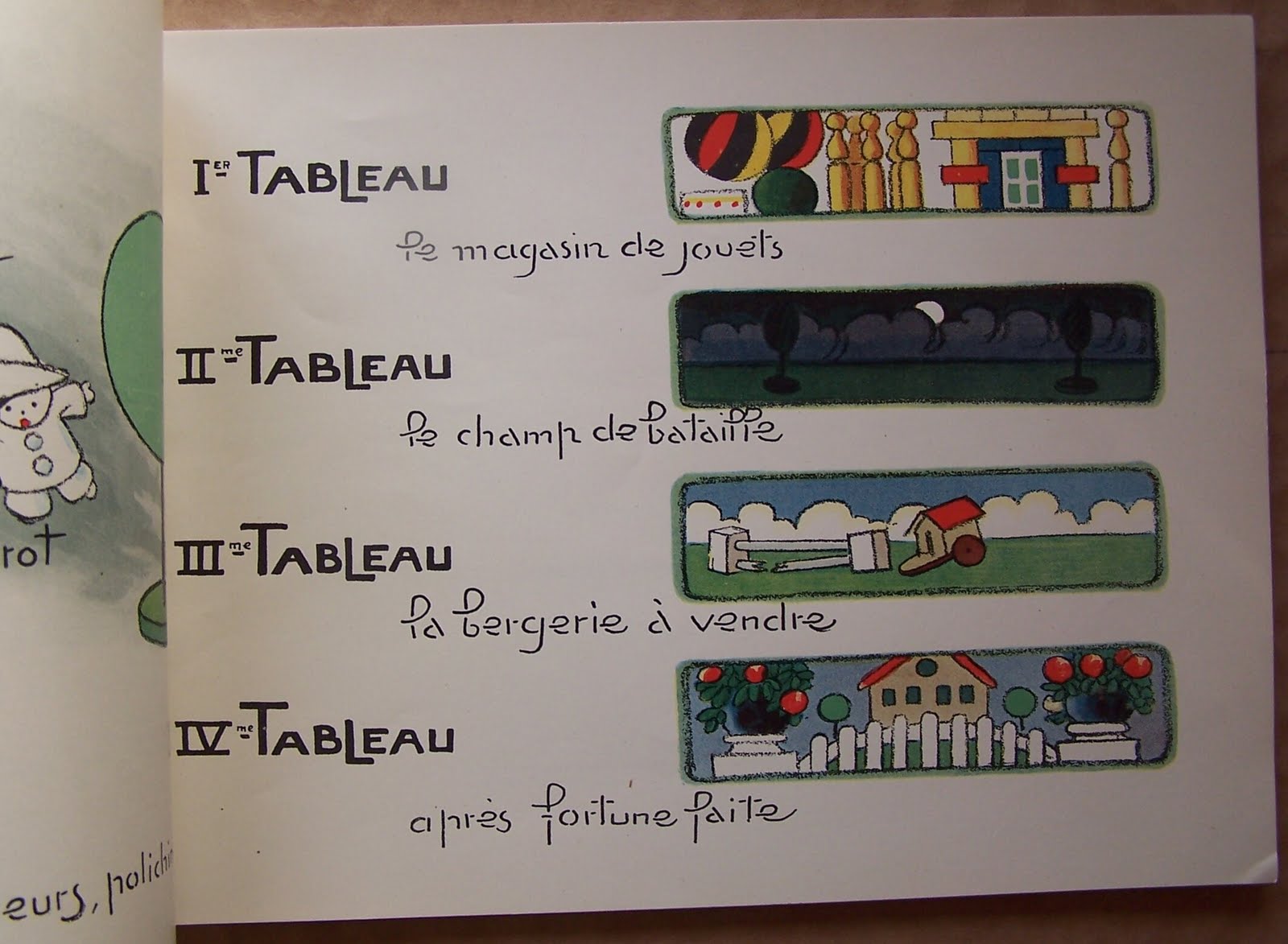
I have no answers for any of these questions. Dwelling on the musical styles of a century ago may just be pure nostalgia by now. Debussy's Children's Corner suite may sound entirely out of step with our hardened, armored, suspicious milieu. Children must be acculturated with the raunchy, lewd and violent realities of our time. Who would spoil them with the stale cream-puffs of yesteryear? In any case, here are, first, a suite of photographs I made from my copy of the original piano reduction (or version) of Debussy's ballet for children, La Boite a Joujou. Though originally intended to be bought for, and owned and appreciated by, children, it's become a collector's item today, its original pochoir (1) color illustrations arresting, and unusual. Like certain earlier kinds of mechanical or handcrafted illustration techniques--photogravure, for instance, or outdated photo-reproduction processes, such as platinum-palladium prints--pochoir produces intense color images which rival most common media visual display of our time.

Joujou is not a great work of art, but its main theme is quite charming (2), which I've reproduced below (#7 in sequence). The others show the original titling and scene illustration. If they seem somewhat less self-consciously "innocent" than what kids are used to today, I would suggest that this is decadence of our cultural time. Disney's cartoon movies today seem intended for very glib adults, filled with sarcasms and bitter ironies and relentless brute provocation, instead of wooden doll figures and stuffed animals. It's true that human society and "nature" are a good deal more competitive, violent and harsh than how we think of childhood. And of course, there is a body of thought which regards children (or the child world) equally as violent, scheming and selfish as the adult world undoubtedly is. Privately, I think that most children tend to imitate what they see in their immediate environment--inside the family. Children who are violent, angry or difficult in other ways, may simply be emulating tendencies they perceive in their parents.




An additional treat is to listen to the piano versions of the Children's Corner suite. YouTube has an excellent set of recordings done by a Czech classical pianist [1930- ]:

Doctor Gradus ad Parnassum
Golliwogg's Cakewalk

The style of Moravec's playing is slightly "delicate"--especially with Golliwogg, which I'd prefer done with a bit more élan, but overall this is a wonderful interpretation, especially the first piece.

Children may respond to adult versions of childhood. There's a reflective quality to all art made for children. Children aren't simply learning to be adults. They're learning to see themselves as we seem them--quite a different thing. Thus, children discern what is expected of them, what they're supposed to want to become. They learn to imitate what they realize we want them to be, rather a different thing than desiring to be something out of original motivation. What do children want? 19th Century writers seemed to think that children delight in being spoiled, frightened and comforted, in about that order. Many religions treat nearly everyone as a child, in order that we might accept what we are told is the correct behavior, the right choices. Perhaps the deeper truth is that we are indeed alone in the world, that there are no fixed answers, and we must determine for ourselves what the best behavior is, and how we should go about building upon past knowledge--both as individuals (from childhood onward), and as a species (humankind).

__________________

1. For Further Reading on Pochoir Books:

National Museum of History and Technology. Pochoir. Washington, D.C.: Smithsonian Institution Press, 1979.

University of California, Santa Barbara. Pochoir: Flowering of the Hand-Color Process in Prints and Illustrated Books, 1910:1935: An Exhibition by Burr Wallen and Stephen Greengard. Santa Barbara, CA: UCSB Art Museum, 1977.

Valotaire, M. “The Pochoir Process of Colour Reproduction.” In The Studio, XCII, 1926, pgs. 236-240.


2. Piano reduction of La Boite a Joujou for piano in five parts: 1, 2, 3, 4, 5.

Thursday, September 8, 2011

BEAT THE DEVIL [1953] - Improvisational Camp Spoof Before its Time


Movies made before World War II may seem very peculiar to contemporary audiences. Working with old style playwrights, and movie sets, with few technical sophistications at their disposal, producers and directors wishing to shake things up or inject a little frisson of surprise or the unexpected were restrained by traditional narrative concepts.

In France, the so-called New Wave film directors, inspired by the Noir tradition in America, began to experiment with plot and sequence. Truffaut, Godard, Rohmer, Resnais--the "auteurs" of a new kind of movie-making. The heroes of this new approach were Jean Renoir, Orson Welles, Alfred Hitchcock, the Marx Brothers and John Huston, among others. The French emphasized a sense of free variation, spontaneity, diversion, unexpected cuts, and tangential elaboration, techniques which thwarted the dictates of plot formulae, and kept audiences off-balance.


The idea that you could make a movie which "didn't make any sense" or which played with or satirized its own genre, was a very new idea in 1953, when Beat the Devil was being made. Huston had already completed many of the films for which he would be revered [The Maltese Falcon (1941), The Treasure of the Sierra Madre (1948), Key Largo (1948), The Asphalt Jungle (1950), The Red Badge of Courage (1951), The African Queen (1951), and Moulin Rouge (1952)]. He was on a roll! For a change of pace, he decided to try his hand at a cinematic spoof, which would satirize the very mode of presentation he'd succeeded at so well during the previous decade. Beat the Devil would go through the motions of a noir picaresque adventure while poking fun at itself the while. Crucial to the idea was the casting of Bogart, and minor character-actor veterans Robert Morley and Peter Lorre (who had performed so admirably in earlier Huston efforts), to give a veneer of legitimacy to the outward stereotype. Feminine interest would be provided by a "blonde" Jennifer Jones--looking as good as ever--and on the "dark side of the force" Gina Lollabrigida.

Though it is not now much remarked, Huston's career in the movies had begun on the writing side. He'd penned several complete screenplays by the beginning of the war, and had a knowledge of literature which rivaled that of most professional movie directors. Huston could be said to have had a fairly "literary" approach to movie-making, so there would be no point in attempting to describe Beat the Devil as an "unconscious" effort, or an unintended mishap, though that appraisal has been a tempting explanation to many critics over the years.

Truman Capote's only previous screenwriting contribution had been some supplementary dialogue on De Sica's Indiscretion of an American Wife [1953]. Huston hired him at $1500 week to collaborate with him on the script, and the two stayed just ahead of the shooting schedule, at times completing the next day's action in the wee hours.* This got to be a joke among the members of the crew, that Huston and Capote were becoming "intimate." It wasn't long before the original story-line had undergone some sweeping changes. Capote had by this time published two novels, and a book of much-admired short stories, so his reputation was well-established.


I'm not familiar with the book upon which the movie is based. Written by Claud Cockburn, under the pseudonym James Helvick, the book is apparently a deliberate attempt to write a straight noir whodunit, nothing like the adaptation which would be made of it here. Cockburn was a Communist journalist of the 1930's, a distant relation of Evelyn Waugh, who was attacked by George Orwell for his Stalinist sympathies. He published his memoirs in the 1950's and '60's. When Huston acquired the rights to the story, did he already have in mind a satiric or "camp" version in mind? Was his hiring of Capote--a notoriously louche gamin--merely a convenience (he was living in Rome at the time--the film would be filmed mostly in Italy), or did he scheme to exploit the witty young novelist's archly ironic turn of mind to convert the straight narrative into a spoof? Perhaps Huston touches on this in his own autobiography.

Claud Cockburn

In any event, what we get in the movie version feels like a half-hearted attempt at serious acting, and a story so silly as to invite derisive guffaws. Was Huston trying to undercut a whole archive of pretentious movie-making history, or did he think of this as some kind of half-serious new comic trope? The movie begins in Italy, in a little seaport town. The local brass band is oompah-ing around the town square as an unlikely foursome of bedraggled looking shady characters is accompanied by the local police to jail. The movie consists of a flashback to the events leading up to this point. Bogart plays a character not unlike the one he portrayed in Casablanca, a sort of down-at-heel soldier-of-fortune-cum-businessman, an exile from ordinary life. He dons the familiar white dinner jacket and black bow-tie from the earlier incarnation, and speaks the same hard-boiled, world-weary cynical talk. As Peterson, one of the four disreputable characters on the make, Robert Morley reprises the Sydney Greenstreet role from Maltese Falcon, dispensing platitudes and scheming away through his quivering jowels, as Ivor Barnard (in his last role, he died the same year the film was made) replicates the Wilmer Cook role (played by Elisha Cook Jr.), the little hot-headed gunman of the previous film. Peter Lorre, mostly playing an older version of himself (as Joel Cairo in Falcon), rolls his eyes coyly and cuts loose with some of Capote's sharpest dialogue: "Time, time, what is time? The Swiss manufacture it. The French hoard it. The Italians squander it. The Americans say it is money. Hindus say it does not exist. You know what I say? I say time is a crook."


The story line itself is so ingeniously simple, it almost doesn't add up. A quartet of small time confidence men find themselves stranded in an Italian seaport waiting for their ship to be made ready for the trip across the Mediterranean to Africa. This gang of oddballs has entered into a partnership with a gold-digging couple--Billy Dannreuther (Bogart) and his wife Marie (Lollabrigida)--in hopes of bidding on a tract of land on the Dark Continent rumored to be rich in uranium deposits.


An English couple, played stiffly by Edward Underdown (as Harry Chelm), and Jennifer Jones (as Mrs.), seem at first to be casual, if somewhat eccentric, tourists befriending the Dannreuthers. Everyone is trying to pretend they're not after what they're really after, so the dialogue has an inherent double-entendre quality, even without the larger frame of burlesque through which the audience sees things. Everyone plays it straight, no matter how absurd everything becomes. The four "desperate characters" plot and scheme with Dannreuther, while Dannreuther and Mrs. Chelm start an open-ended affair.


In due course it is revealed that instead of being a well-heeled British Lord with a landed estate, Chelm is just another measly crook on the make for the uranium deposits. When the gang of four discover this, the plot thickens. At length, the little tramp steamer sails, and the story resumes on shipboard. The major, whom it turns out is an assassin (who's already killed one official in London whom he suspects will blow the whistle on the caper), attempts to stab Chelm while the ship is marooned from a blown engine. Dannreuther prevents this, but Mrs. Chelm betrays her husband by fingering him for attempted murder (of the Major), and the loony captain has him chained in his room. The goofy romance between Bogart (Dannreuther) and Jennifer Jones (Mrs. Chelm) seems on the point of realization, when the ship suddenly begins to sink. Chelm escapes and jumps ship, while the rest of the group makes its escape via life-boat, landing on an African beach. Accosted by Moroccan militiamen on horses, they're captured and taken for interrogation at the local police headquarters. Bribes are tendered, and the motley crew returns to Italy, presumably to reinitiate their plot. But Scotland Yard has sent a man to track down the perpetrator of a certain London case, who arrests the four after a brief interrogation. In the closing scene, Mrs. Chelm receives a cable from British East Africa, revealing that Chelm (who has not drowned as everyone had assumed) has made his way to the uranium mineral site and secured the rights. Mrs. Dannreuther faints. Mrs. Chelm is consumed in blissful tears. Dannreuther (Bogart) reads the cable, and breaks out into hysterical laughter, exclaiming with meaningful irony "this is the end. . .this is the end."


Straight Film Noir, like the hardboiled crime novel genre upon which it is based, nearly always teetered on the brink of absurdity. Artistic license required an exaggeration of the human capacity for larceny and violence, to a degree that usually seemed over the top. The purification of the style which reached its peak from the late 1930's to the late 1950's, may have occurred later, with such sophisticated reinterpretations as Chinatown [1974], Body Heat [1981] or LA Confidential [1997]. But the neo-noir tendency shares with its model an appreciation for the qualities which are endemic, specific to the genre. Conscious parodic reactions are familiar today, but those spawned in Europe, where American cinematic excess was always seen as a kind of cartoon anyway, always seem pale by comparison. But unconscious parody, or the weariness of decadent regard, might see in humor the possibility for a third rail, which Capote (and perhaps Huston himself) interpreted as a form of pop camp. Indeed, this film makes a lot more sense as a comedy--despite the off-stage violence--than any exercise in detection, exotic "intrigue," romantic melodrama, or free-floating suspense. Like most Huston films, the cinematography and pacing are straightforward and no-nonsense; filmed in Italy, it exploits the standard picturesque scenery to full advantage, creating effects which reminded some viewers of some post-War Italian avant-garde B&W movies. Improvisational movie-making (of the kind Capote and Huston must certainly have imagined, laboring away on their shooting-script in their director's tent late into the wee hours), which found its expression in later auteurs (such as Quentin Tarantino), was an approach that few would have thought interesting or fruitful in 1953--which obviously accounts for the misinterpretation(s) the film has been subject to over the decades. The underlying subtext of the overt narrative is the conflict between the minds of its progenitors, and the third-rate material they had to work with. On one level, it's simply the difference between real dramatic action, and the typical whodunit cliché which shrewd producers usually chose to cash in on. Who knows how Huston may have conned his backers into investing in this effort? Had they known, it's unlikely the movie would ever have gotten made. Many, many bad movies are the result of bad decisions based on market analysis and notoriety. In this case, a great director, a great writer, and half a dozen major box office stars conspired to make an anti-classic spoof, something which they probably had no idea would happen at the beginning. But by the end, it was surely plain for all to see. Bogart, who had a nice piece of his own change invested in the production, probably was resigned to failure by the end of production. His slightly hysterical laugh at the end is as much a gesture of surreal resignation, as it is a grateful sigh of relief that the whole affair was over and done with.

Bogart would only have three and a half years more to live, but he still had The Caine Mutiny, Sabrina, The Barefoot Contessa, The Left Hand of God, and The Desperate Hours ahead of him. Huston still had Moby Dick, The Misfits, Adrian Messenger, Fat City, The Man Who Would Be King, Wise Blood, Under the Volcano, Prizzi's Honor, and The Dead to do. Jennifer Jones, who comes off quite well in this farce, didn't have much left in the tank, and for my money, Love Is a Many-Splendored Thing was her last performance of substance.

The ragtag collection of characters almost feels like a circus troupe. As a footnote to that, one might recall that three years later, Gina Lollabrigida would play opposite Tony Curtis and Burt Lancaster in Trapeze, a circus high-wire drama.

Today Beat the Devil can be viewed in its entirety on the following YouTube OpenFlix site, or here onhulu TV.

____________________

*I read just now that Helvick had been hired to collaborate with Huston on the script, but that Helvick split during production, so Huston needed a replacement on short notice; conveniently, Capote was living nearby in Rome, hence the connection. That's an unsubstantiated account, but it could well be true. Though it certainly would be best if I had read the novel itself, I think the point of my post doesn't require it--my interest is in the use Huston/Capote make of the story, not the story basis itself. Movies aren't the books they're made from, but independent artifacts which are often altered and augmented during production. Among the films which one might consider in the improvisatory category, Beat the Devil seems an obvious choice.

Wednesday, September 7, 2011

Creeley's Away -- again and again then


Creeley's Away [1976] comes right at the end of his middle period, which begins with the publication of Pieces in 1968-69, continues with 1234567890 [1971], St. Martin's [1971], A Day Book [1972], Listen [1972], His Idea [1973], and Thirty Things [1974], and concludes with Hello [1976] and Presences [1976]. It was a time of convulsive change in American culture, as it was a time of change for Creeley himself, as his 20 year marriage to Bobbie Louise Hawkins ended that year. The deconstruction of his earlier style (in For Love [1962]), presaged in Words [1967], was complete, the process comprising a record of self-analysis and personal transformation, common to many artists of his generation during the period of the 1960's and '70's.

I've always been moved by a group of poems in Away, iconic works which signify for me the distillate of Creeley's thinking about consciousness, isolation, and the self-reflexive nature of the act of writing. Whereas the poems in St. Martin's, His Idea and Thirty Things seem like recreations or ironic conceptual takes, the poems in Away feel much closer to the bone, necessary invocations of perceptual disorientation and emotional dilemma. As the relationship with Bobbie wound down, there was an exhaustion, a clearing away of presumptions, of shared understandings, leaving him, for the first time perhaps, since the late 1940's, in a position of ultimate loneliness and clarity. It probably wasn't a happy time, but it produced some of his best poems.


The ones I'm thinking of--the four quoted here--share a certain directness and coherence. The emptiness of the "room" of his life now echoes with a resonant attention, allowing him to focus on that isolation as a literal fact of perception.


SOUND

Hearing a car pass--
that insistent distance
from here to there,
sitting here.

Sunlight
shines through the green leaves,
patterns of light and dark,
shimmering.

But so quiet
now the car's gone,
sounds of myself smoking,
my head writing.

The grudging, methodical pressure of the advance of incremental perception, recorded in the simplest terms, is peaceful, but alienating. The emotional desperation of the loss of the Other, a respondent to the nervous, habitual process of speaking, marking event and observation with exaggerated calm, magnifies his emptiness. The subtly private noises, sound of breathing, scratch of pencil on paper, soft swish of automobile tires passing by in street, dappling of leaf-light through window, a measure of distance ("from here to there"), mind taking what's given, nothing left of it.


HERE

No one
else in the room
except you.

.

Mind's a form
of taking
it all.

.

And the room
opens
and closes.


The divisions of the poem's progress, marking the gradual movement of thought watching thought in a contraction of attention, to a vanishing point. The mind as room, opening, closing, measuring its dimension, as of eyes what's seen, of ears what's heard, fingers what's felt, the envelope of consciousness like a definition of what is. The unavoidable. What we're in.


FUNNY

Raining here
in little pieces
of rain.
Wet, brother,

behind the ears.
I love your hands.
And you too,
rain.

You insist on rain
because you are
no less than water,
no more than wet.


The starved self spontaneously conjures sensuality, rain the symbol of a consuming baptism of immersion in a larger "community" of feeling--is wishful thinking. Who is "the brother" we crave? A common humanity? A longed-for attachment.


OUT

Let me walk to you
backwards
down a long street.

.

Here is the rain again.
I hear it
in my ear here.

.

What fun
to be done
if not already
done.

.

We were going
out.


The reversal of intention implied by walking backwards (through time and space) to a place one had been before. But to what point? Like putting a question-mark at the end of a long sentence to emphasize the upturned tone of voice. And once again the rain chills the ear-lobe and returns the mind to its familiar body consciousness, the sphere of its own knowing, consumed by segments of task, worked across a distance, dropping markers. To accomplish what? Finally flipped over into departure, the sardonic flattening of potential, pulling the rug out from under, what fun. Ha ha. To be done with something that long, memorable, finally painful, hurtful, wasted, gone, dead.

Such clarity may be gruesomely intense--but yield up amazing sequences of apprehension. Which is where we came in. Inside these poems are voids of time and space, folded up time saved in little boxes of retention. They will stay there, and be there again, someday. Then we'll read them again, in that time.

Friday, September 2, 2011

Justice's Incident in a Rose Garden


Gardener Sir, I encountered Death
Just now among the roses.
Thin as a scythe he stood there.

I knew him by his pictures.
He had his black coat on,
Black gloves, and a broad black hat.

I think he would have spoken,
Seeing his mouth stood open.
Big it was, with white teeth.

As soon as he beckoned, I ran.
I ran until I found you.
Sir, I am quitting my job.
I want to see my sons
Once more before I die.
I want to see California.

Master Sir, You must be that stranger
Who threatened my gardener.
This is my property, sir.

I welcome only friends here
Death Sir, I knew your father
And we were friends at the end.

As for your gardener,
I did not threaten him.
Old men mistake my gestures.

I only meant to ask him
To show me to his master.
I take it you are he?

--Donald Justice [1925-2004]


This poem by Donald Justice is one of the classics of 20th Century verse. It's like a Medieval mystery play, a simple dramatic action intended to demonstrate a moral lesson. It's one of my favorites. The photo above is of the Berkeley Rose Garden, a public space sited in a small steep ravine in the Berkeley hills. The terraced amphitheater was completed in 1937, under the Works Progress Administration, based on a design suggested by Bernard Maybeck. It's a beautiful place any time of year, but best in the Spring when the roses are in full bloom.


Thursday, September 1, 2011

Posh Nosh for the Nonce


For anyone who's ever sat through a televised cooking show, the experience of seeing the British comic short-slot production Posh Nosh must surely be a treat.

We live well within hailing distance of Berkeley's gourmet ghetto, spreading outward in gently dimpling waves from its geographical center, Chez Panisse Restaurant on Shattuck Avenue. Wife and I can claim honors as being among the earlier customers, back in 1973 (the second year of its life). (Chez Panisse is presently celebrating its 40th year in business--which took place on August 7th at a special presentation meal [1-3pm]). The restaurant proper is now mostly the province of curious or well-healed tourists, while the Chez Panisse Café (upstairs) is where most locals choose to eat.


In any case, Posh Nosh [2003], though being essentially a series of satirical skits, nevertheless has an underlying sub-plot of character development.

British humour has always been unlike American humor. Difficult to describe it with accuracy, except to note that it reflects the different attitudes about social morés. One commenter noted how Minty's accent, being lower middle-class, was intended as swipe at the embarrassment of those aspiring to upper-class life-styles--an aspect likely to elude American audiences.

Arabella Weir as Minty Marchmont

You might expect that the show would exploit the visual mishaps and blunders, but really this isn't the point. It's primarily a verbal satire, augmented by fairly straightforward motions in the couple's spotless country kitchen. You could say that its primary target is the comfy upper class gentry, safely ensconced in its digs, puttering about with confident foppishness, secure in its pretensions and prejudices.

Richard E. Grant as Simon Marchmont

Among its conceits are Simon's undercurrent of sexual innuendo, "like schoolboys, Reislings are best enjoyed young," which Minty does her best to gloss over. Indeed, the subtle tug-of-war between Simon and Minty is the true narrative of the series. Simon is the over-refined sexual predator with exalted ego, Minty the ambitious social climber, hopelessly de-classé, who tries to pass herself off as a cultured matron. She makes repeated references to Simon's late mother, from whom she has inherited her kitchen wares. Simon fancies himself a wine expert, and a tennis buff, but obviously loves his dog (and his old boyfriends), and his privileges, more than he does Minty.

It's unclear what the producers of the show intend about food. Is it just cooking shows that they find so amusing, or the over-refinement about living which they imply? Or is it simply a class conflict, the practical middle skewering the affectations and airs of the rich? Probably both, though it's all in good fun. Or is it?

In America, our lust for political correctness inevitably lands upon regional, ethnic and racial types. The latest iterations, predictably enough, have been focused upon Central and South American cuisine. There are taverns in the Bay Area which can boast over a hundred different tequila choices on their menus. In the 1970's and 1980's, Nouvelle was all the rage, spearheaded by a generation of professional cooks which included Alice Waters, MFK Fisher, Richard Olney, Elizabeth David, etc. French wines, Provencal cooking, simple "country" flavors, clean (whole, holistic), fresh ingredients, unpretentious preparation, Mediterranean flair, down-home honesty. By now, this movement has probably run its course, and once more, the exhausted palates of the well-to-do (and those who lust after the good life) have begun to move on. Peasant food, exotic Asian and Caribbean dishes, sushi and Samarkand.

In any case, this is just a tip for a pleasant evening's amusement. If you want to see Minty "embarrass" some vegetables, or "disappoint" some chestnuts, or "frighten" some mussels, or "butter-waltz" around the bundt pan, by all means do tune into the nine delightful episodes, which you can now view toll-free on YouTube, beginning with episode #1 here (many thanks to faelanae for loading them up).


A True Story


Hemingway

This is a true story. In the Summer of that year, we were coming home from a camping trip. It was late at night, and the sky was awash with the constellations. As we drove on through the mountains, we smelled smoke, and a little further on we saw light on the horizon. Then a fireman in a yellow coat running along the shoulder motioned us to the side of the road. “We’ll have to hold you here for a while until we know that it’s safe to pass,” he said. We pulled over to a point at the edge of a huge drop off. In the distance, we could see the raging red and orange flames silhouetted against the blackness, as the smoke got thicker, acrid and stinging to the nose. My parents turned on the radio to kill time. They were playing a Glenn Miller tune when the announcer suddenly broke in, saying “it was reported today that the American novelist and short story writer Ernest Hemingway was found dead in his home in Ketcham, Idaho.” In my memory, this happened when I was about five years old, but I was 13 on July 2nd, 1961, when Hemingway committed suicide with a shotgun in the mouth. Also, my brother has not yet been born, but this can’t be because he was born on October 16, 1960. The forest fire was real. After an hour or so, the fireman told us to go ahead, the danger had passed because the wind had shifted away from the road. In my mind these events will always be connected, despite the random, meaningless conjunctions between my childhood and the death of a great American writer. I remember my parents, speaking with reverence about it. A small piece of their history had broken off and passed into eternity. I was too young to understand, then, but eventually I would.