Saturday, May 7, 2011

John Koethe's early "New York School" Work


Throughout the latter half of the 1960's and the first half of the 1970's, there seemed to exist a nexus of style and focus which cohered around the work of the so-called First Generation New York School of poetry, whose dominant figures were, of course, Frank O'Hara, John Ashbery, Kenneth Koch, James Schuyler, and occasionally Barbara Guest (as well as a few peripheral figures). These were writers who had gone to college in the 1950's, and were associated with an East Coast urban setting, with the "country" of the surrounding inland Mid-Atlantic region as back-drop. Through their editorial work (Locus Solus, Art and Literature, etc.), their teaching (Koch at Columbia, Ashbery--after a period abroad in the early 1960's--at various posts over the succeeding decades), and their involvement in the New York Art scene (O'Hara's curatorial position at MOMA, and the art criticism which they wrote (Ashbery, Schuyler, O'Hara))--they seemed to constitute something like a coordinated group which sought to redefine the modern lyric and meditative impulse through innovative adaptation of earlier Modernist forms and approaches. The underground literary and social scene which grew up around them in the Sixties spawned a whole generation of imitators and acolytes of their productions, mostly concentrated in New York, though there were active "scenes" in several of the major American cities during the same period--a movement and a period which has been well-documented over the last two decades.

Several of the peripheral figures orbiting around this period seemed to presage a continuation of the trends first acknowledged. Berrigan & Padgett, Berkson, Warsh, Elmslie, Malanga, Ceravolo, Towle, Brownstein, Perreault, Denby, among a host of lesser figures, seemed to share a common purpose of some kind, though their separate work(s) defied the kind of categorical canonization which classic art movements of the past had exhibited.

One figure whom I associated with this movement at the time was John Koethe [1945- ]. Koethe's Blue Vents [Audit/Poetry, 1968] seemed to fit right into the meditative mode which Ashbery had established with his longer efforts in Mountains and Rivers, and The Double Dream of Spring. Koethe seemed to have a clear impression of the complexity of a meditative verse form unfolding as Ashbery's did, and he also appeared to comprehend the ambiguous relationship between the text, the voice, and his own agency as maker, exploiting ironies of tone and identity--something he shared, for instance, with contemporaries such as Brownstein, Crase, Warsh, Laurance Wieder, or Bill Berkson. Koethe's second collection, Domes [Columbia University Press, 1973] won the Frank O'Hara Award. It seemed somewhat less abstract than the poems in Blue Vents, though on closer inspection, proved to be every bit as evasive in its sense of assertion and committed expression, as the earlier book. A philosophy major, Koethe went on to a position at the University of Wisconsin, and to publish several additional volumes of verse, as well as books on thought.

Koethe's poems--rather like Michael Palmer's (another poet whom I have written about here recently)--often seem to be about problems in logic and perception--though their mood and apparent setting usually seem straightforwardly descriptive--

Below the Coast


A clumsy hillock
Unmolded like a cake on the meadow
In the Laguna Mountains. Tough yellow-green grass growing up to a tree
As thick as a tooth. In winter, on the road from San Diego,
Thousands of cars crawl up to the snow
And their passengers get out to investigate it
And then drive, discoursing, back home. And that’s California,
Solemnly discharging its responsibilities.

Meanwhile we breakfast on pancakes the size of a plate
While the console radio goes on the blink.
Miss L’Espagnole looks out from her frame on the wall,
Completely prepared (though for what it is impossible to say).
Her left arm is white and dips into a puddle of fire
Or a pile of cotton on fire. And each thing is severe:
The house hemmed in by pepper trees and Mexico
(This one is white and in Chula Vista), and the paraphernalia
Strewn around home: a few magazines summing up politics,
A matchbox with a lavender automobile on the cover,
And a set of soldiers of several military epochs marching off to war on the raffia rug.
Unless, you’ve grown up amidst palm trees (and buildings that are either unbuilt, or hospitals)
It’s impossible to appreciate a reasonable tree.

I sometimes consider the parrots that live in the zoo
And are sold on the street in Tijuana. Colored like national flags,
Their heads are always cocked to pick up something behind them.

And unless you have lived in a place where the fog
Closes in like a face, it is impossible to be (even temporarily) relieved
When it lifts to expose the freshly painted trim of the city, and it seems
Like a fine day for knowledge: sunlight sleeping on top of the rocks
And lots of white clouds scudding by like clean sheets
Which, when the air in the bedroom is cold, you pull over your head
And let the temperature slowly increase while you breathe.
But California has only a coast in common with this.

The social and intellectual "setting" of many of Koethe's early poems seemed to lack conviction, inasmuch as the observational tone and credulous perspicacity provided the illusion of a firm footing, while constantly shifting from one evasive foot to the other. Superficially like Ashbery's short lyrical meditations, they had a sort of Pop Art surface which seemed intended to disorient and belie rather than to place and confirm. This was their chief innovation. I particularly liked his descriptions of ordinary things--

Copley Square

Up-and-down shafts of light brick
Lift occupants up into prisms or roofs
Of green copper, and then embark on the sky.
12:44 by the Suffolk Franklin Savings Banks's
Clock, 93o outside, inside a cool bed of dimes.
A jet overhead that gets picked up by a pigeon
Gliding by lower down, some more modern banks
And a bank of lanterns set like a row of spears,
A Try Rooti Root Beer truck almost collides
With a spiffy yellow Checker Cab, and flags
Flop in front of the Sheraton Plaza Hotel.
Plenty of seersucker walks by below, or sits
On a deep-heated long granite bench,
Listening to the library,
Half-eating a half-eaten peach,
And bakes in the breeze.


--which seemed obvious enough, except that its lazily receptive passivity seemed more camp-y than joyous.


A Sunday Drive

Two gallons of apple cider.
A jar of pungent, pasty Yankee mustard.
"Two dollars please." Boys on bikes
Are scattered around the entrance to the store.

Cold leaf smoke floats over
A toadstool-proportioned water tank
Perched slightly off to the left of Route 2.

"Are these houses mostly old or new?
I usually can't tell the difference myself."

So we are continuing down the road
Which was like a hallway whose walls were trees
And whose ceiling was open to the sky.

Large birds were browsing in the sky.

"Her character is slightly slummy
But it conceals a kindness of such concentration
Nothing shivers--not even a single leaf--
When she casts her lot where she may."

Hardly any leaves are left on the trees.
The pines, with their eternal, sickly green,
Are stuck like bottle brushes in the rack
Of the other, occasional bloomers.

"Saws Sharpened."
"The First Lutheran Church Welcomes You."

We can't find the way back, but we do.


Poems like this can pass for straightforward pastoral travelogues, but in Koethe's poems they're much less obvious in their implication. Warhol showed how the presentation of two dimensional clichés as infinitely reproducible commodities could become icons of banality--all surface and confidence and presumption. As we recede further and further into the future, the images and impressions of the indestructible past assemble and sort themselves into the congealing mass of cultural memory, as illusionistic as dreams. The sentimental subtext of our own mortality skids along the pavement, as nostalgic as a rollerskate.

Collected Poems

small war on the heels of small / war
Robert Lowell

I think they may be adequate for now,
With summer finally in full swing
As imperceptibly the days begin to shrink.
Each spring I wonder what I'll find
When I return to them again--this year it was a war
That wasn't actually a war, a lie made visible--
And how blind intuitions might be built up into facts
That someone else might think to feel and read.
The signs are everywhere, implicit in the sky,
The trees, the houses on the street I walk along to work
(The walking is the work), when something that I see
Or half-remember gets repeated from inside,
Finds its measure, and in settling inward settles into place.
They're how I wander through a day, wondering at its
Spaciousness, finding in its anonymity
These traces of my name, in its impersonality
These ways to see myself--hearing in the syllables of the
Leaves the lyrics of a song; seeing in the clouds
A human face, another lie made visible.

Word by word and war by war--
What makes one possible sustains the other too:
The urge to change, the power to deceive,
To fabricate a version of the world
Not as it is, but as someone imagines it to be.
The aim is not to say what happened
But to forge a monument by force, deploying
All the subtlety and weapons of the will,
And leaving something broken in its wake: the simple truth
As it appeared in school each day; the simple self
That wrote it down, before it all became a wildnerness
Where what's still left of them still wander,
Looking for each other, through a mutual memory
Of something irrecoverable beneath these
Shifting sands of spoken and unspoken words.
I used to think there was a different way,
A less insistent one, accepting what it finds
Without revising it, without the specious clarity
And authority of art, and its pervasive
Atmosphere of will. But that turned out to be a style too,
A sweeter one perhaps, yet just as artificial in the end.
The point is general, not confined to art: to make
Is to destroy; to act is to replace what would have been
With something signed, that bears a name. What I was a boy
I thought a life just happened, or was there to find.
Wars were aberrations. Poems were another generation's.
I didn't realize you made it up, you made them up,
And that the self was not an object but an act,
A sequence of decisions bound together by a noun
But with the feel of a fact. I wonder where that leaves me--
Hanging on a whim, on what I write? I hope not.
What the urge to dominate the world, the place, the page
Eventually becomes is just a human figures
On a summer afternoon, smiling at what happens,
Anxious for the future and the slope of age.
I think I'm done for now. It remains to save the file,
Close the notebook, and let evening come.


This is a fairly straightforward meditation on the distortion of propaganda, the subtle (or not) impositions of will, and the poet's restless urge to see in everything a sign of the times, a reverberating vision of apocalyptic disintegration, even in the reassuring quietude of an academic suburbia. But Koethe wasn't always so passive in his adjustments. In an earlier poem, from the late 1960's, such as--


Satie's Suits

Orange is the hue of modernity.
Greater than gold, shakey and poetic,
Our century's art has been a gentle surrender
To this color's nonchalant "stance"

Towards hunger and the unknown, and its boldness:
For it has replaced us as the subject of the unknown.
We still like the same things, but today we handle them differently.
Among the signs of occupation in this contemporary war

The twelve identical corduroy suits of Erik Satie
Locate importance in repetition, where it really belongs,
There in the dark, among the lessons that sleep excludes.
I want to emphasize the contribution of each one of us

To a society which has held us back but which has
Allowed love to flourish in this age like a song.
Unable to understand very much,
But prepared to isolate things in a personal way,

The acres of orange paint are a sign
Of the machine that powers our amateur hearts.
The technical has been driven back
By river stages, exposing a vacant lot

Strewn with these tools, food and clothing
Awaiting the inventions of limited strength.
We could begin selling ourselves, but the overture
Brings no response and the connection remains unsketched.

I can see there has been no change.
The body's a form of remote control
And its success is too exact to assist us.
Responding to the ulterior commandment

So much has failed in the abstract.
The phallus hid in the school bell
While the difficult fluid rose in the night.
In the apartment wild horses took you away.


--the camp deconstruction of official language is very similar here to Ashbery's distancing from subject matter. The alienation from a "stance" belongs to a specific strain of surrealism--that feeds off of a disorientation from the quotidian--turning assertion on its head to make language say things it hadn't intended. I.e., "wild horses took you away." Or "I want to emphasize the contribution of each one of us to a society which has held us back but which has
allowed love to flourish in this age like a song." The "hue of modernity" has "replaced us as the subject of the unknown." The inquiry of mind into the unknown "has failed in the abstract." The individual lines don't so much follow each other, as interact, though much more subtly, for instance, than Berrigan's loopy, explosive lines in his Sonnets. The mediation between mind and tool, perception and object, called for by Wittgenstein, stalls in an antechamber of apathy. Things lie strewn about, so we mark them, examining each in turn, putting off until some later time the task of connecting the dots to some cosmology of the provisional. The night sky arches overhead. A consolidation of means already presaged here would overtake the zeitgeist within the next decade, tamping down objections while capital raged in the streets. Koethe's avant gestures never questioned the formalities of the time, and so faded into obscurity. His accessibility assured a smooth transition from the abstract distortions of late Pop, to the moderate ratiocination of middle age, the Middle West, and the unchallenged towers of power in the literary landscape. Mick Jagger is 67.


Friday, May 6, 2011

Latest Water Grab News - "Peripheral Canal" Again on the Table


Back in May 2010, I wrote an extensive blog piece on the latest attempts to divert water from Northern California to urban areas and desert agriculture in the Southern half of the state.(*) For at least three generations, water districts, corporate agriculture, and municipal business factions have been attempting to justify the creation of a so-called peripheral canal, to divert most of the water flowing down the Sacramento River, to points south. Such a canal already exists, or course, in pieces. It's called the California State Water Project, and its main feature is the California Aquaduct, which siphons off millions of acre feet of water each year to Central Valley agriculture and cities and towns south of San Francisco.

The latest attempt was the so-called "Bay Delta Conservation Plan"--certainly an oxymoron if there ever was one!--but the Obama Administration's National Research Council, a group of biologists, hydrologists and engineers, concluded that the Plan was a "post-Hoc" attempt to justify the construction of an underground "tunnel" designed to divert nearly all the fresh water flowing into the California Delta and send it southward. The California voters rejected this idea in 1982, but the water interests have never given up the idea. They want the taxpayers of California to pay for the billion dollar project, and they want increased flows at reduced prices. But with every year that passes, the population growth of the state puts increased pressure on its finite water resources.

It seems safe to say that there will never be enough fresh water to supply all the needs of the Western States. Cadillac Desert by Marc Reisner (1986, revised edition 1993), and the Floyd Dominy section in John McPhee's Encounters With the Archdruid (1971) are good places to begin, to understand the history of water exploitation and misuse in the West.

The authors of the Bay Delta Conservation Plan know perfectly well that the health of the Delta system, the San Francisco Bay, and the Pacific Ocean ecosystems depend crucially on an adequate supply of fresh water flowing into the delta from Sierra Nevada riverine systems. And they know that that baseline flow has already been significantly reduced, to the degree that the Delta is already, literally, on its last legs from a bio-system point of view. Further reducing flows would, in effect, create a huge mud flat north-south between Sacramento and Tracy, and east-west between San Pablo Bay and Stockton, stinking with flies and choked with tules, polluted with heavy metals, pesticide residues and sewage, with rotting dock pilings and marooned garbage hulks. This is what the authors of the Plan know would happen with the creation of their "tunnel." To assert that this would somehow "save" the Delta ecosystem, as proof of its commitment to achieving "ecosystem restoration," constitutes the sort of bald-faced lying which I discussed in yesterday's blog about the fine art of lying.

The Plan is a lie. The people of California know it. The Federal Government's people know it. The authors of the plan know it. It's as obvious as the hair tickling the inside of your nostrils.

Do we want more vast tracts of shoddy suburban "development," more corporate agri-business rip-offs (they already take 85% of the state's water), and more devastation to the state's fisheries and wild habitat? The question remains, and has been asked again and again. The only answer must again be "No!"


__________________

*For readers curious about that previous blog essay, you might be interested to know that proponents of the canal went to the trouble to demand removal of the post by the blog site server. It was probably done at the behest of Judge Wanger, a Bush appointee who supports the agri-business interests in their pursuit of more water allocations. I can send anyone who wants to see it, the text of that blocked essay, privately as an e.mail attachment. The Judge Wangers of the world don't want you to know about what they're doing, and will use any means at their disposal to shield themselves from public view.

Thursday, May 5, 2011

The Fine Art of Lying


In "On the Decay of the Art of Lying" Mark Twain [Samuel Clemens] says that "lying is a sweet and loving art, and should be cultivated. The highest perfection of politeness is only a beautiful edifice, built, from the base to the dome, of graceful and gilded forms of charitable and unselfish lying."

Most of the efficient transactions in the world of commerce ride on falsehood and misrepresentation. It is almost as if we cannot believe in the honesty of a gesture--suspecting or deducing the motivation for selling it--unless it be clothed in phony disguise.

In the realm of law, lying is the very foundation of our justice system, polished and honed to a fine edge. The truth is like a block of stone, which is chiseled and sanded and shaped to suit, so that its original form can no longer be recalled. The blind lady with the scale is duped into believing that the weight of truth can be measured, but she can't see what's being put onto the dishes. Lead is as weighty as gold.


Then there is the brand of lying that is mutually acknowledged in the interests of convenience, or of necessity, or of politeness. When Colin Powell lied about the "evidence" of Saddam Hussein's "nuclear program" at the United Nations in February 2003, not only did he, and everyone in the Bush Administration, the Pentagon, the Department of Defense, the relevant Congressional Committee-members, and the whole of the Western Press, but at least half of the American electorate, knew without a shadow of a doubt that his presentation was a half-baked tissue of lies, promulgated to create a pretext for the United States' determination to conduct a preemptive military strike against the sovereign nation of Iraq. In other words, the whole world accepted the necessity for this lie, as a precondition for the formal justification for the killing of hundreds of thousands of people, to prove that though the King had no clothes, his power and influence were so great, so inviolable, that daring publicly to observe his nakedness would be so repugnant, so embarrassing, as to render such audacity unthinkable.

In the aftermath of this kind of lie, there is almost nothing anyone can say to relieve the tension which it creates in its perpetrators. Powell's political career--as he surely knew--from that point on, was impossible. The cynicism of Bush, Cheney, Rumsfeld and Wolfowitz, to throw Powell under the bus, in order to float a fake excuse for a preemptive strike, is an altogether typical and even routine strategy, in the highest levels of American executive power, to attain ends which are indefensible on the merits. As one of Bush's token "black" choices for his cabinet, Powell could expect to be required to front for otherwise tainted merchandize, to justify indefensible policies, and to trade his authority and integrity in exchange for the notoriety of his appointed position. Once he'd made the bargain, he knew the stakes. And like the honorable, faithful warrior he had always been, he lied with conviction.

There are times in the march of events when lying is useful, valuable, and even necessary. Then there are times when lying is the worst kind of crime against humanity, when a lie may be used to justify the killing of human beings for no other reason than the color of their skin, the tribe they belong to, or the country they inhabit. Powell's lying to the UN was one of these times.

Wednesday, May 4, 2011

The Iberia Suite of Isaac Albeniz


I don't remember how or when I first heard any of Albeniz's keyboard works, but the beginning of my infatuation with his work dates from the day I bought a two disc recording of the complete Iberia Suite, played by the Cuban born pianist Jose Echaniz.*


In my late teens, I'd had a resurgence of interest in the keyboard, though I would never have been sufficiently skilled to play any of the twelve separate pieces of Iberia. My mother had had recordings of Echaniz playing Cuban music in the house when I grew up, so his was a familiar name. By today's standards, Echaniz might not be considered a first line virtuoso, though styles of play (and taste) do change over time, and the recording technologies have improved immeasurably as well in the decades following his death in 1969. His interpretations were popular, romantic and effective. Classically trained Spanish pianists of the Seventies and Eighties and after, have tended to treat the early Modernist works (Albeniz, Granados, Rodrigo, et al) with more severity and reserve, and today I suspect that anyone playing Iberia as I heard it first done by Echaniz in the late 1950's, would be characterized as too "soft" or "slushy." Still, we often hear what we want to hear, and pianists play music they way they "hear" it in their mind(s)--this is what musical interpretation means. There is no one way to play any piece of music, despite the frustration of some composers (such as Stravinsky) who insist that just playing the music "as it's written!" is the best way. And the best music should be complex and inspiring enough to be enacted in various ways without harming or distoring its essential quality.


In order to understand Iberia, one must contextualize it (and Albeniz's aims and inspiration) in terms of the resurgence of Spanish nationalism in the 19th and 20th Centuries. Albeniz was influenced by the teacher/composer/scholar Felipe Pedrell. Pedrell believed that the contemporary Spanish composers should emulate the musical traditions of their own heritage, rather than imitating the French, German or Viennese classical styles of the preceding three centuries.

During the Moorish period of influence in Spain, 8th through 15th Centuries, the character of Spanish culture was decidedly exotic, and was concentrated particularly in the southern region of the country. Gypsy culture incorporated some aspects of the Arabic musical tradition, but transformed them. These elements, together with the court music of the nobility, formed the foundations of Iberian music. Given the rejection of the "infidel" culture of the "Moors" coupled with the condescension of the rest of Europe towards a "backward" unsophisticated country, there were clear reasons why Spanish composers of the late 19th and early 20th Centuries felt an ambivalence to declaring and realizing their own musical heritage.

Nevertheless, the young Albeniz, a keyboard prodigy from early childhood, was drawn in early manhood, as a composer, to the operatic and classical traditions of Paris, Leipzig and Vienna. By his early twenties, he had established a career as a virtuoso classical pianist, and concertized throughout Europe in his late twenties and early thirties, following the late 19th Century tradition. At age 32 he encountered Pedrell, and began to compose works influenced by the Andalusian and Gypsy streams, in dance, ballad or elegy forms. Though he tried his hand at operatic composition, it was his nativist piano pieces that we today consider to be his important contribution. Though he composed primarily for the piano, many of his works are "guitaristic" in setting and style, and are easily adaptable (an early example is the justly famous
Asturias--played here by Segovia) to the Spanish guitar. The works from his middle period--the Suite Espanola--as well as the mature works of his last period--which include Iberia, employ the cante jondo (or "deep song") lyricism, the exotic scales (or "modes") associated with Flamenco. The soulful quality we associate with classical Spanish music derives in large measure from the use of these elements.

Suite Espanola:

Granada (Serenade) - played by Julian Bream
Cataluna (Courante) - played by Wolfgang Lendle
Sevilla (Sevillanas) - played by Julian Bream
Cadiz (Saeta) - piano version (artist unknown - de Larrocha?)
Asturias (Leyenda) - piano version played by Pablo Galdo
Aragon (Fantasia) - version for three guitars
Castilla (Seguidilla) - played by Bream & Williams (guitars)
Cuba (Nocturno) - piano version played by Daniela Novaretto


At the height of his career, living in London, and then in Paris, Albeniz was exposed to the rich musical culture of the
Fin-de-Siécle in Europe, and realized that his earlier compositions lacked the richness and range which characterized the most ambitious music of his age. At the turn of the century (1900) he suffered a number of defeats: He developed kidney disease, his wife became ill as well, and they lost a child.

Between 1905 and 1909, he composed his masterpiece, Iberia, a twelve part suite in four books. Pianistically, it's among the most difficult and challenging pieces in the repertory. But its sophistication, delicacy and elegant inventiveness place it at the highest levels of musical achievement in any time. Influenced by Debussy, Liszt, d'Indy, among others--it is nevertheless so original in its adaptation of Spanish musical elements, that it forms the basic foundation for a nativist Iberian tradition, which continues to inform Spanish composers a hundred years later. Iberia is a synthesis of romantic, impressionist and folk idioms. Deeply evocative, nostalgic and haunting, its melodies are unforgettable. It is impossible to imagine 20th Century Spanish music without it.


Iberia [1905-09].

Suite for piano with 12 pieces in 4 books ("quaderns"):1º quadern: Evocación, El Puerto, El Corpus Christi en Sevilla.2º quadern: Rondeña, Almería, Triana.3º quadern: El Albaicín, El Polo, Lavapiés.4º quadern: Málaga, Jerez, Eritaña.

Evocacion - played by Marc-Andre Hamelin

El Puerto - played by Marc-Andre Hamelin

El Corpus en Sevilla - played by Pedro Carbone

Rondena - played by Marc-Andre Hamelin

Almeria - played by Marc-Andre Hamelin

Triana - played by Marc-Andre Hamelin

El Albaicin - played by Marc-Andre Hamelin

El Polo - played by Marc-Andre Hamelin

Lavapies - played by Marc-Andre Hamelin


Hamelin's interpretations have the most polish and focus of any I've listened to lately. What he lacks in passion and fervor he more than makes up for with his technique. The brightness, the deep lyric, the coordination of crossing themes--all this is accomplished with aplomb.

What critics invariably remark is Iberia's deep emotion "recollected in tranquillity" which it creates in the listener. Though the pieces seem programmatic in quality, their structure is abstract enough to attain a sublimation which makes them universally applicable. Individual visions may follow any diversion, channeled by the seductive courses of the music's tortuous, yet tantalizing pathways. Amusement, stirring pride, passionate affection, loss, resignation and gratitude are born out of each other in a cornucopia of feeling and dream which feels timeless.

When Albeniz was young, he tried to run away several times. The pressure of having to live up to the expectation and promise of the childhood prodigy role was not one he was initially comfortable with. As he matured into the great virtuoso he was destined to be, he may have felt nostalgic for a life he may have imagined he had sacrificed, for artistic devotion. In any case, whatever the source of his inspiration, it rings true.

Toward the end of his life, Albeniz said this about his own musical works: "There are among them a few things that are not completely worthless. The music is a bit infantile, plain, spirited; but in the end, the people, our Spanish people, are something of all that. I believe that the people are right when they continue to be moved by Cordoba, Mallorca, by the copla of the Sevillanas, by the Serenata, and Granada. In all of them I now note that there is less musical science, less of the grand idea, but more color, sunlight, flavor of olives. That music of youth, with its little sins and absurdities that almost point out the sentimental affectation…appears to me like the carvings in the Alhambra, those peculiar arabesques that sway nothing with their turns and shapes, but which are like the air, like the sun, like the blackbirds or like the nightingales of its gardens. They are more valuable than all else of Moorish Spain, which though we may not like it, is the true Spain." One can feel in this Albeniz's own sense of contradictory tendencies, not just in his own nature, but in his sense of his own people's cultural traditions. He accepts the instability and frustration of the Spanish character, and really revels in it.


A fitting send-off is Albeniz's great concert-piece, Navarra, played here by Alicia de Larrocha--the late diminutive virtuoso of Spain. We shall have more to say about Spanish music in later entries--it's an insistent preoccupation.

________________
* (If I were more of an internet detective, I could probably locate a copy of this now undoubtedly rare recording. I'm not sure I have my copy of the album any more.)


Monday, May 2, 2011

Pooh Plex Plaza


[This is Part II of my discussion which began on April 24 ("Crews & the Perplexing Pooh").]


Imagine a world in which only caricatures of real people would exist. Each person would be an exaggerated version of him/her-self, rather in the way that cartoonists stretch aspects of character and appearance, making immediately recognizable potato-heads and cooties out of familiar public figures for our delectation. In fiction, writers are free to make up imaginary characters, composites, or supernatural beings not based on specific people. But with parody, burlesque, or satire, imitation of real people is almost de rigueur. If you wish to poke fun at some aspect of popular culture or respected officialdom, you generally have to call a spade a spade, else your poison-tipped arrows won't find their mark.

When Frederick C. Crews published his crafty little parody of academic critics (and criticism),The Pooh Perplex: A Freshman Casebook [New York: Dutton] in 1963, he had in mind some very specific kinds of targets. Post-War American academic criticism had spawned some very peculiar birds, indeed, whose familiar peccadillos and conceits verily cried out for jeers.


The subtitle of the book, "A Freshman Casebook," placed it well within the context of the undergraduate introductory literary textbook. As most people know, the writing and editing of textbooks is a big business in the academic community (or teaching profession). Traditionally, aspirants to full professorships (promotion to tenured status and increased job security and pay) are expected to "prove" their eminence and worthiness through the placing of serious academic writing in periodicals or books. These may take the form of papers, ongoing studies, or full-length treatments of works or figures in the field, or relevant areas of thought and theory considered useful or previously neglected. Introductory "casebooks" of literature or critical theory may have widespread use, and become influential throughout the educational system. A "casebook" should provide a firm basis for further study, and offer varying points of view in considering an individual author, work, or period of history. In Crews's book, the subject-matter is the notorious academic "types" who write such texts themselves, which become the virtual specimens of their identity. A familiarity with such casebooks is not a requirement for understanding, or appreciating Crews's satire, but it's very familiar territory indeed for anyone who majored in English during the American post-War decades. If the portraits seem a bit exaggerated, it is only because Crews is being kind. Extreme distortion may be the only answer to the claim of cruelty against parody, lest charges of libel or character assassination be leveled against the transgressor. And parodists often publish under a pseudonym, another handy tool for dodging rancor.


Here are the titles from the table of contents:


Paradoxical Persona: The Hierarchy of Heroism in Winnie-the-Pooh by Harvey C. Window.

A Bourgeois Writer's Proletarian Fables by Martin Tempralis.

The Theory and Practice of Bardic Verse Notations on the Hums of Pooh by P.R. Honeycomb.

Poisoned Paradise: The Underside of Pooh by Myron Masterson.

O Felix Culpa! The Sacramental Meaning of Winnie-the-Pooh by C.J.L. Culpepper, D.Litt., Oxon.

Winnie and the Cultural Stream by Murphy A. Sweat.

A la recherche du Pooh perdu by Woodbine Meadowlark.

A Complete Analysis of Winnie-the-Pooh by Duns C. Penwiper.

Another Book to Cross Off Your List by Simon Lacerous.

The Style of Pooh Sources, Analogues, and Influences by Benjamin Thumb.

A.A. Milne's Honey-Balloon-Pit-Gun-Tail-Bathtubcomplex by Karl Anschauung, M.D.

Prolegomena to Any Future Study of Winnie-the-Pooh by Smedley Force.


Each essay in the book includes a preliminary one-page biographical profile, and a "Questions and Study Projects" section at the end. Each portrait/essay describes a distinctive academic stereo-type, and all are male. There is the scornful and scolding old 'Thirties Communist Martin Tempralis, the Oxford Medievalist and Christian dogmatist C.J.L. Culpepper, the propounding majisterial Duns C. Penwiper, securely in possession of the Chicago tools of criticism, the Freudian Karl Anschauung (M.D.), and so on.

Perhaps the most striking theme which emerges from this exercise in parodic lampooning, is that the actual matter under examination is somehow irrelevant to the preoccupations of its readers. It is as if Winnie-the-Pooh is on a par with Proust, Shakespeare, Chaucer, Melville and Faulkner. Indeed, it almost doesn't seem to matter what comes under the scrutiny of these mad-hatters of analysis and exegesis. Under their bespectacled perusal, any work of literature, be it ever so humble or innocent, is fodder for the consuming. Building the collection of parodies around an innocent children's classic also tends to soften the effect of Crews's implied criticism. Crews was, and is, of course, himself a card-carrying member the academy, so any sense that he might be trying disassociate himself from the world he is describing, would have to take into account the fact of his own participation. Ultimately, it isn't the industry of textual criticism itself that Crews is really attacking, but the failures and pretenders and clowns who insinuate themselves into the cozy world of college teaching, whose private or partisan agendas, unsupported by legitimate scholarship or inspired insights and discoveries, represent the worst aspects of the institutions of higher learning. Or--to take a lighter tack--we might simply observe that Crews's academic caricatures signify nothing more than a desire to find amusement in what is routinely a very dry field of endeavor indeed. By fostering an atmosphere of resilient levity, Crews offers students and professors an alternative to high church probity, in judging the world they inhabit, incidentally throwing some much needed frigid well water on the preposterous, the pompous and the puerile.

Because of the limitations of space, we shall have to content ourselves with a sampling (of four) of the "bio" notes to the essays, since a full-scale deconstruction of the parodies themselves would involve at least as long a book, as the original text itself [149pp].

"MARTIN TEMPRALIS wrote the following piece ("A Bourgeois Writer's Proletarian Fables") in 1939 for the New Reporter. It is, as recent graduates of American high schools will recognize, an essay rather strictly governed by the application of a certain political dogma to literary questions. Your editor reprints it here (not without some misgivings) because it represents a particular style of criticism that was once in fashion. We live in a free society where virtually any opinion may be defended, including those of Mr. Tempralis in 1939. Your editor would like only to reassure all readers that he in no way subscribes to, supports, or, as it were, travels along with the views expressed in this essay. Naturally it is for each class, or rather for each student individually, freely to make up his mind about the merit of Mr. Tempralis's argument. Teachers may, if they so choose, accompany this selction with an extra-credit, outside-reading assignment of Mr. J. Edgar Hoover's Masters of Deceit. Mr. Tempralis, formerly a New York journalist, returned to his native Jackson, Mississippi in 1946 and retired from the public eye for several years. He is now both publisher and editor of the Jackson White Democrat. In 1956 he was commended by a Committee of the U.S. Senate for turning over his address book from the 1930's."

"WOODBINE MEADOWLARK describes himself frankly as "a perpetual graduate student." Though his face and name have become legendary in Harvard Yard over the years, and though he is praised by all his teachers, he has never bothered to present himself for his doctor's orals. "I love literature too deeply to put up with the botanizing that is done upon it in graduate work," he explains. " I attend some classes here and there, but I insist upon remaining a free spirit, unfettered by academic routing. Literature is the very breath of my life; and, as I happen to have an independent income, I can afford to live exactly as the caprices of my whimsy dictate." The following essay, which once circulated in manuscript among Mr. Meadowlark's most intimate friends, is said to have found its way to an editor's desk by sheerest accident, without the author's knowledge. Since its first appearance, however, it has been reprinted several times."

"SIMON LACEROUS is perhaps the most feared and respected critic in England. An implacable foe of sentimentality, flabby aestheticism, and inflated reputations, he has made English authors tremble since the publication of his first volume, Assassinations, thirty years ago. Though he is a Fellow of Magdalen College, Oxford, he despises the entire English University system. Of his fellow Fellows he has said: "They can all go to hell. Of course, some should go before others. One has a responsibility to make discriminations." He and his wife, Trixie, were the guiding spirits behind the now defunct but extremely influential quarterly, Thumbscrew. Several of the younger critics who have taken up the battle against sentimentality, flabby aestheticism, and inflated reputations owe their start and their moral guidance to Dr. Lacerous."

"KARL ANSCHAUUNG, M.D., one of the last survivors of Freud's original circle of Viennese followers in the first decade of this century, died in 1960 after an extremely active career as an analyst. In an autobiographical memoir written just before the end, he declared that "I have never swerved one inch from the basic teachings of Freud. Never, never, never. Not one inch. I have remained faithful to Freud through thick and thin. This is the justification of all my work." In the last years of his life Dr. Anschauung turned his attention to literary problems, "in the hope," he wrote, "of clearing up one or two matters on which the Master left us incomplete formulations." One happy result was the following article, here reprinted from the journal Lustprinzip and translated into English by Dr. B.B. Braille. Dr. Braille, incidentally, wants your editor to mention that he was among the first and best translators of Freud, and commends your attention especially to the original jokes he substituted for Freud's in translating Wit and Its Relation to the Unconscious."

Thus endeth the lesson.

Sunday, May 1, 2011

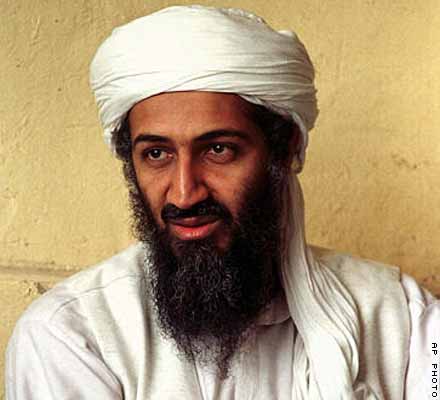
Death of Osama bin Laden


Approximately one hour ago, news broke worldwide of the death of Osama bin Laden, confirmed by a special announcement by U.S. President Obama from the White House. According to the President, intelligence following a strong lead dating from last August (2010) finally confirmed that the Al Qaeda leader had been located in a private house in a community in Northwest Pakistan west of Islamabad, and a special forces unit was sent in. Following a brief fire-fight, bin Laden was killed, and his body taken into custody.


The location of the capture/killing apparently was in a private residence, right "under the noses" of a Pakistani military outpost. There has been speculation for a long time that the Pakistani government, its military and intelligence community, was not being straight with America--that it in fact knew bin Laden's whereabouts, and was deliberately concealing this information from us, while it strenuously objected to all American military actions within its own borders. It had been assumed for the better part of a decade that bin Laden was hiding in the rough, remote mountainous terrain along the Afghanistan-Pakistan border, but increasingly, it was deduced that he was being protected by friendly factions inside Pakistan. The raid and consequent killing confirms all these conjectures.

Whatever the "fallout" from this development, it represents a momentous occasion in the "war on terror" (a phrase--and a policy--coined during the Bush II Administration). Without bin Laden's inspired leadership (and rumored wealth) driving Al Qaeda, it remains now to be seen how powerful that underground, secret organization will remain on the world stage.

Bin Laden was a fanatical leader who created a sense of awesome commitment among his followers. Driven by a fierce anti-American, anti-Western fervor, he sought nothing less than the removal of American and European influence from the Middle and Far East territories. Through his actions, he set into motion events which have so far led directly to two protracted wars (in Iraq and Afghanistan), causing deaths in the hundreds of thousands, with the displacement of hundreds of thousands more.

What kind of a man was Osama bin Laden? He was not a strutting dictator, or a crude tribal chieftain, but a shrewd schemer, convinced of his rectitude, the son of a well-connected--and well-to-do--Saudi Arabian family. As his fanaticism grew, he became devoted to a "jihad" or holy crusade against America and its interests, which he believed had corrupted and compromised his country, and the rest of the Muslim world. Like many fanatical Muslims, he saw Western traditions as a secular profanity, a scourge which he thought must be effaced from history. Though not representative of the majority of peaceful worshippers of Islam, the power of his determination and that of his followers continues to present a severe danger to American interests both here and abroad.

Without its leader, how dangerous will Al Qaeda continue to be? It's a question we won't be able to answer for several more years; but now, at last, we can at least ask it.