Wednesday, August 10, 2011

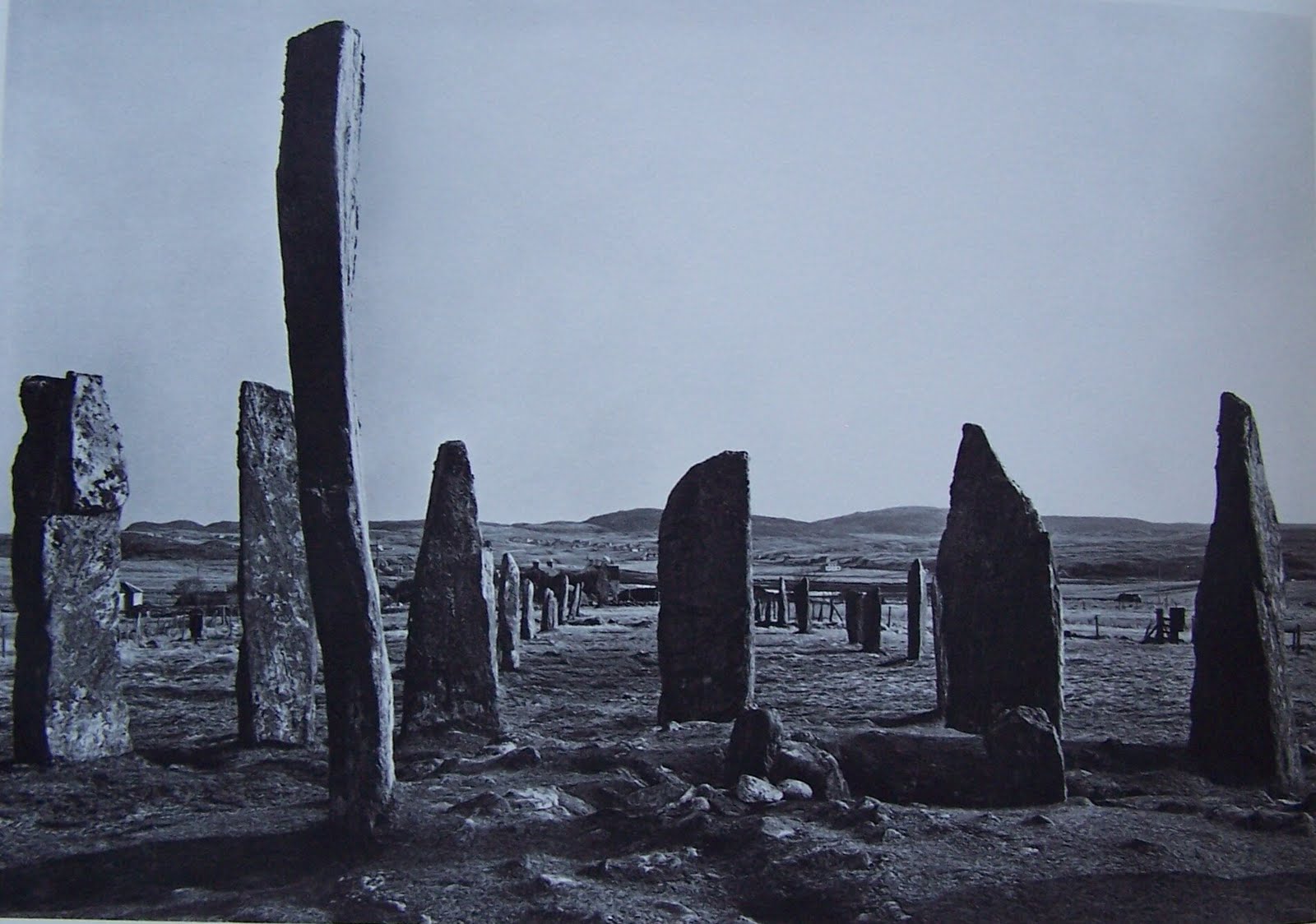
Caponigro's MEGALITHS - The Illusion of Immanence


Paul Caponigro's book length monograph Megaliths was published in 1986 [Boston: New York Graphic Society/Little, Brown and Company]. The images were printed matte, rather than on glossy stock, a temperamental choice which had been employed with Caponigro's earlier selected images book, The Wise Silence [Boston: New York Graphic Society/Little, Brown and Company, 1983]. This choice of presentation involves complex issues which I don't want to address here, but it remains controversial in some quarters.

Any discussion of megalithic (or "large stone") imagery involves aesthetic questions which range far from photographic adaptations. The megaliths which Caponigro addresses in this book are all in the British Isles. Archeological interpretations of the meaning of these sites and structures are changing all the time, but what seems most obvious about them, initially, is the ambition which must have accompanied their construction. Their prehistoric origin is shrouded in mystery, from before written records, so we have no firm reports of their purpose or meaning. Our fascination with the surviving physical evidence of our ancestors' monument building is not merely historical, or even scientific, but involves our curiosity about their religious significance. As examples of "pagan" or pre-Christian practice and phenomenology, they may suggest certain rituals and belief-systems which existed for long periods of time.

Immanence refers to the inhering quality of divine presence, which may be manifested in objects of the material world--specifically, in the mystical power of arrangements of earth, stones, or in natural totemic presences, like trees, or animal deities. Research and opinion favors an interpretation of the pre-historic British megaliths as representing immanent structures or objects (earthen mounds, caves; or stones erected or placed in positions or arrangements) intended to evoke or symbolize holy or sacred connections, sites, or religious technologies (such as astronomical devices). These aren't haphazard piles of rocks and soil; they're deliberate attempts to create lasting monuments to powerful pagan systems of worship.


From the perspective of photographic documentation, these sites present few problems. They come down to us pretty much in their original form, though occasionally concealed under the detritus of time and residue. For the purposes of archeological research, straightforward images can be done, and, since the advent of aviation, we are also able to see, and record, their larger shapes on the land with aerial photographs. All these sites have been measured and studied, and as much as can be deduced from the rock art, their positions and arrangements, at least in a preliminary or provisional way, has been accomplished.

Their potential as "artistic" subject matter is a different question. Visually, most of the sites are difficult. The "standing stones" for instance, have a certain obvious visual aspect which makes photographing them an exercise in monotony. The first question that naturally occurs is how pre-historic peoples, with technologies we know almost nothing about, were able to transport, and move such huge, massive stones around, and mount them into upright or stacked arrangements. Aside from the great difficulty in doing so--which in some cases rivals the construction of the great Egyptian monuments--with which some of them are roughly contemporary--there is the question of motivation. Simply scratching out a livelihood from the soil of Britain would have required considerable ingenuity. Organizing a primitive society into the complex tasks of moving great stones around would have required skill and planning on a scale that seems almost unimaginable to us. Time and effort. Commitment and dedication. Perhaps generations of drudgery. We know, for instance, from Mayan cultural artifacts in Central America, that rigid political and religious institutions were required for the mounting of such huge, glowering civic or religious projects.

Clearly, for a photographer of Caponigro's persuasion, mere documentation is not the priority. His work follows clearly in the tradition of the mystical expression of image-making initiated by Minor White, whose own images, and those he typically published in the periodical he co-founded, and edited for over 20 years, Aperture [1952-] are intended to express directly his ideas about transcendence and immanence--though Caponigro later repudiated this influence in his work by rejecting some of the New Age textuality which motivated White's efforts. Nevertheless, Caponigro's work on megaliths, as well as his Southwestern and Japanese explorations, have had a profoundly quasi-mystical or religious feeling about them. Preferring to characterize this as a purely personal process of the magical interaction of eye and object, does not vacate the essential spiritual focus of his inspiration.


There's a tension, then, in Caponigro's megalithic imagery, between concepts of the picturesque, and immanence, where the initial subject--say, a stone placed over a cave opening, or an arrangement of standing stones in a circular or semi-circular design--has minimal pictorial interest, but may simply serve as the occasion of a wide-field rural landscape study, as in these first five images. One might--certainly could have--made almost identically satisfying images, without including, in the foreground, the megalithic constructions which are their ostensible justification. The mute stones as documentation presences are in tension with the distraction of the wider, largely unspoiled country landscapes. Were the stones in the middle of a housing project, the potentialities for picturesque expression would of course be impossible. There's a romantic, almost 19th Century bias built into these kinds of big landscape shots, which no amount of talk about "mysterious power" or immanence is likely to trump.


Ultimately, big stones, especially when they aren't carved or inscribed, can't tell us much beyond our appraisal of how they may have come into the positions in which we find them. Any extra-rational appropriations are gratuitous at best, though we may be entertained by the aura of mystery they inspire. Is
mystery itself a basis for the imputation of power and significance in mere objects? Such questions may seem beside the point, except when aesthetic questions regarding the value of certain kinds of subject matter arise. In what sense do Caponigro's megalithic prints trade in this mystical hermetic/orphic/cryptic matter?

The best images in the book, it seems to me, derive their quality from the same landscape values we admire in non-immanent scenes: long, delicate grey-scale, heroic skies filled with operatic cloud formations, carefully focused fore-grounds contrasted against inspiring long horizon-lines, diverting shapes and angles, an "awesome" combination of elements in a natural setting.


Other photographers, such as Brett Weston, or Wynn Bullock exploit the same kind of qualities in "non-specific" scenes, to express a symbiotic relationship between effective or "responsive" subject matter, and the viewer (or photographer). The pretext of archeological or quasi-mystical sites seems an opportunistic application of the larger problem of making images that speak.


If I see the same qualities at work in these images, as I do in otherwise casual matter, I'm obliged to credit (or "privilege") the skill of the photographer, rather than some magical transmission occurring through the sacred presence of pre-historic deities, which in any case I don't believe in rationally. The record of man's presence on the earth through the deliberate creation of monuments or burials or garbage heaps, does not in any specific way determine the quality of imagery we may make out of media like painting, or sculpture or photography. We may have religious or quasi-religious feelings about life or the universe, and these are perfectly consistent with the evidence we have of our ancestors' passage through time. But as a basis for measuring the effectiveness of photographic imagery, they aren't of much help.


The stones have been here before us, and will doubtless be here after us. What does that tell us about stones? What does piling them up or lining the walls of caves with them tell us? Is the force of that effort a measure of the seriousness or intensity of our feelings and thoughts? We've been able through our modern technology to carve up the surface of the earth with considerably greater efficiency than our ancestors could have done. In fact, we've done so much harm to the planet, that we're in danger of destroying it as a home.


Though the stone monuments of our ancestors don't have much specific to tell us, we can see that they believed themselves to be a part of something much larger. The density and brittleness of the stones, as carriers of that mute message, contain the basic information. The book of the universe can be read, with difficulty. Higher physics penetrates to the farthest limits of our understanding about matter, and the riddle of existence. The further we go along the progression of knowledge and inquiry, the more we realize how big the riddle is.


In an image such as that above, the dialogue between the grasping intent of the sucker plant upon the big tree trunk, and the "closed" fist (or "smiling") rock seems to set up a timeless dialectic. Trees are alive. Amer-indian myth suggests that everything is alive, even rocks. Higher physics now tells us that everything is "light"--that all matter is "arrested light"--or light in some ephemeral disguise. All time is relative. A life happens in a split second, and may be replicated infinitely. Or it may take eons to occur. The flexibility between both senses of existence gives us pause. Why aren't things simple, and clear? Why all the mystery?


The forces which "hold" the matter of stone together in a crystalline stasis, the forces of gravity which hold the stones down, the shapes and seams and angles of the stones express forces which were the defining purposes of their formation. There's nothing accidental about any of this. Things may seem simply to happen. But the way a tree grows, the fascinating we have with certain arrangements may not be casual, or accidental, at all.


As descendants of beings who mutated from one form to another, we are the consequence of a process of selection whose laws may follow a larger formal design. The names we give to such designs may be expedient. But we also sense that some such riddle does govern the overall outcome. Our presence here is temporary. Whatever has caused us to appear, does not intend that we should be permanent additions to the universe. We are not eternal. But we have the privilege to wonder about it.

Thursday, August 4, 2011

Meaning & The Structure of Rhyme - Part IV - A Sensible Reply to Scarriet


The traitor in our midst. What is in the eye of the beholder? Shall we call it beauty, or some amalgam of traits all can agree upon? Thomas Graves this week launches a formal response to my previous three-part post on the failure of rhyme, as a method of verse composition, to inspire genius, since the end of the last century. What would happen, you ask, had Modernism as we know it, never occurred? If Ezra and T.S. and Wallace and Marianne and Hilda and J.J. and Gerty and the denizen of Oxford, Mississippi never been born?


Would we, today, still be writing polite, ginger, balanced rhyming quatrains? Could the developments in physics, astronomy, genetics, psychology, philosophy, aesthetics, archeology, philology, medicine, anthropology, linguistics have happened, without exerting some secondary influence upon the vagaries of prosody? The explosion of knowledge and information which has occurred since then would suggest an equivalent convulsion in the arts, and that's precisely what has happened.

Tradition is generally something which we transmit from generation to generation as training. Once upon a time, there was no such thing as rhyme, just as there was no such thing as poetry. The history of "poetry" is the history of inventions, the accretion of stylistic presentations, codified into numerical, visual and aural convention(s). Each successive progression of poetic practice was accomplished through a deliberate (or accidental) augmentation of the original conception (form). Academies, by their nature, base their curricula upon the accomplishments and residuum of the past. The accumulation of knowledge in the arts is, by way of its examples, the record of artifacts tuned to a certain resonance. It may be that there is no literal "progress" in the arts, but the progression we see as the chronology of man's efforts through time lends some credence to the notion that hierarchies of value and syntheses of meaning should be attained. T.S. Eliot once said that we can "change the past," that is, we can alter our sense of the meaning--even the actual events--of the past, simply by changing our attitude about what it means, and--through archeology, for instance--verify or de-mystify certain assumptions we may have previously held. History, in the time of early Greek civilization, was the most "persuasive" interpretation of events in the past; truth, or what actually may have taken place, was not a value to them. Often, the illusions we have about the past are based on half-truths, or partisan "interpretations" of events or artifacts. In other words, how something actually came to be, or was fashioned, may be different than what/how we prefer to believe.

For at least the last fifteen centuries, in the English speaking countries, at least on the evidence of what survived the ravages of time, culture accepted the idea that rhyme was a necessary component of poetry, that rhythmic lines that didn't rhyme, lacked some crucial quality--were not, in fact, what we might "call" "poetry." The story of how this happened is shrouded in obscurity, but we do know that important poems were written, under the assumption of this concept, as far back as the late Middle Ages. In other words, it may be said that the concept of poetry as a sequence of fixed intervals, marked by variations of end-rhyme schemes, had already become a cliché by the 14th Century. Why?

The concept of the "echo" of tangent syllabic sounds, emphasized by being placed at the end of a line of fixed length, strikes me as a novelty. What proof might be brought forward to support the "inevitability" of rhyme as a natural occurrence in the development of poetic forms? The frequency of such tangent sounds as a quantity of linguistic occurrence is variable with respect to the potential for clear meaning in any sequence of language.

Meaning usually seems at odds with any artificially imposed system of arrangements of abstract sound patterns. There's a natural tension between the need to express meaning through the precision of the signified (the right words in the right order), and the requirements of the formal artificial order of rhyme-schemes. Why should the ability to appropriate ornamental (rhymed) words be accounted as superior to the precise use of meaning (sans rhyme)?

For at least that last 20 generations, poetry has been taught as a phenomenon whose chief characteristics are rhythmic lineation and end-stop rhyme. Granting that there's a fairly primitive and simplistic tendency to appreciate the chiming recurrence of sounds, it might be remarked that the inculcation of rhyme-habit to students of the art--particularly children--might be adjudged a form of brain-washing, as intentional as the memorization of multiplication tables. But mathematics and music, which use principles and languages which have none of the signification that words embody, are much better suited to the rote inculcation of laws, rules and formulae than language ever is.

In one sense, the alteration which I'm suggesting here has already happened. Modernism triumphed over the traditional approach to the composition of verse circa 1920, and never looked back. And yet, the divisions in literary doctrine have continued to contend across the spectrum of possible approaches, and poetry of the pre-Modernist sort has continued to exert an attraction to practitioners of the art. This may be attributable to the reactionary continuity of regard, or--as I am suggesting--the predisposition towards a form which informs our training of the immature mind (i.e., nursery rhymes, standard religious texts, and the "established canon of literary archetypes.")

Meanwhile, Tom Graves over at the Scarriet website has mounted a broadside against my assertion regarding the obsolescence of rhyme. This disagreement is in good cheer, and we welcome the compliment of honest opposition. Tom seems most concerned about the connection between rhythm and rhyme:

Let’s cut right to the chase: Faville singles out rhyme as an object of contempt without taking rhythm into account--even after I pointed out in my first response to his essay that to rhyme nicely one must use rhythm nicely.

Let's ask what is the relationship between rhythm, as the scansion of any given line, or set of lines in a poetic sequence, and the frequency of rhyme, either "internal" or end-rhyme? Is it not possible to have a perfectly symmetrical syllabic measure without having any rhyme at all? Or, to put it differently, what is it about rhyme that even involves us in the question of rhythm? An iambic line, for instance, doesn't require an end-rhyme to fulfill its measure. In what sense is a rhymed end-word more meaningful than an unrhymed one? Aside from the congruent echo--between two words whose relationship may have no other evident connection--of similar sound--what, exactly, does the echo-sound achieve that the rhythmic performance doesn't? I simply fail to understand this point.

Arguments have been brought forward to suggest that the artificial requirement of strict formal structure is a way of forcing invention, and there is no doubt that making oneself choose or find words which rhyme, in preference to words which are undoubtedly better suited in terms of the meaning of a particular sentence (assertion) may enable the creation of different or ingenious employments. But setting up such artificial barriers to the perfection of statement or assertion seems a particularly synthetic test of the perfection of expression which is the greatest value we place on language. Powerful expression is a combination of precision of usage, combined with happy (inspired) invention. This happiness suggests unlikely, or previously non-existent coinages. Chance and originality. A seizure of inspiration.

The value we place on the potential of language does not in any way support a whole dismissal of either the monuments of rhymed poetic convention, nor does it suggest that any tool we might employ to exploit the various potentialities of language (including tangent, coincident sound), is no longer of any further use.

"Verse depends on rhythm, line, meter, stanza, an undercurrent of meaning, and even more fundamental things like unity, limit, duration, and variety."

This sounds reasonable enough, unless you're willing to accept that "verse" might be comprised of other combinations of use (and definition). Why is it that verse should "depend on" rhyme? How broad must our definition of poetry--or writing, or composition--be, to fully comprehend all the kinds of invention which the last 100 years have seen?

"Rhyme is the icing on the cake, or the percussion in a symphony orchestra, or the glint in a beautiful eye. To weigh against rhyme is the mark of a dour theorist, indeed. Shall we censor what can make language charming?"

"Faville, with single-minded, modernist glee, having no understanding of the rationale or the history of what he dismisses—”traditional forms”—pursues the general, well-worn path of loosening our collective mental grip on “the poem,” towards any number of holy grails: freedom, realism, social justice, prose-variety, prose-insight, prose-seriousness, prose-acrobatics, prose-morality, and prose-dignity. But what the modernists have done, starting with the exceedingly clever R.W. Emerson, was not to chuck “the poem,” but to transfer its properties (and more) in a mysterious manner to whatever prose-pursuit happened to be going on at the time, whether it was Yvor Winters yapping about “moral form,” or the Imagistes’ slightly Westernized haiku, or Eliot’s morose pastiches with footnotes, or the Iowa Workshop’s “the poem is my diary!” or Ashbery’s Dr. Seuss-for-grownups-minus-the-rhyme."

Aside from the fact that none of this is quite true, including the charge that I have no understanding, I have never advocated the "prose-fication" of "the poem"--and in fact have attacked concepts of prose-poem as being cannibalizations of what the rigors of poetry ordinarily require. (Reference my discussion of Silliman's The Alphabet for verification.) Or, to my supposed preference for Ashbery's latest animadversions (reference my The King of Camp's New Clothes, Stupid!). Nor have I been a defender of the Iowa Writers' Workshop; in fact, I have attacked the principle of the workshop system, in Lewis Turco & The Workshop System - A Test.

"You’ll sound like Shelley which means you’ll sound old-fashioned, so stop is the philosophy in a nutshell."

Well, really, Tom. My point was never that rhyme is old-fashioned--which, of course, it undoubtedly is, without any doubt--or that rhyme should not be employed--which is rather like inveighing against engaging in games of chance. The larger elephant in the room, I would offer, is the desirability (or not) of repeating what Pope and Tennyson accomplished within this very tradition. There is nothing about Pope's or Shelley's or Tennyson's accomplishments which would suggest either that they failed in their attempts to exploit rhyme, or that we should disabuse those attempts, or stop reading them, or not, if we choose, attempt to imitate them--though with the full realization that imitation is not a fully creative act.

"What modernists like Faville need to understand is that “the Poem” requires a length, and that mere fact brings us to the question of how we divide that length, which inevitably encompasses issues like the line, rhythm, meter, stanza, and finally, rhyme—mundane material considerations whichgood poets bother with and bad poets do not."

The question thus raised is how "that length" might be "divided." So my question is, fully logical, in what way does "division" necessarily imply anything about the number of lines, the number of syllables (and their variance), and the possible use of assonance, onomatopoeia, rhyme, etc.? Which form of such "issues" might take precedence, or be interpreted in a way that more nearly fits your preconception of them?

In what sense does an appreciation of the values of rhymed verse suggest that more examples of it should be essayed? Poe's The Raven has been done. Should we attempt to make another? What is it about The Raven that makes it an interesting poem? Is The Raven a good poem, then, and if so, why? Finally, if The Raven is indeed a work of genius, is that genius a prompt to imitation or emulation? Ultimately, privileging the technique of Poe's The Raven, as if these were THE ultimate, and crucial components of ALL POEMS, NOW AND FOREVER, seems a quite narrow application of the potentials of ANY future poetry.

Pound said that poetry should be "at least as well written as prose." What that means, or should be understood to mean, is that a poetry which inconveniences itself to the degree that it sacrifices eloquence and good sense, in order to fulfill the narrow requirements of a novelty known as rhyme, or numerical arrangements of syllables or numbers of lines (stanzas), does not deserve to be called truly creative. A subservience to predetermined arrangements of any form signifies an obsequious capitulation to expedient, false "problems" which are nothing more than trite games--such as juggling, memorizing lists, solving square roots on the fly, walking on your hands--or any other similar mental or physical "feat" of daring or derring-do. Some will have the knack, while others will not. The ability in and of itself neither signifies a value in the conventional sense, nor suggests that it can facilitate effective writing.

Rhyme is okay. Rhyme is just fine. But let's put it in its place. Would there ever be--on any terms you might like to posit--a reason to entertain another Alexander Pope? I've offered that Louis Zukofsky could certainly have been a poetic genius "in any time." I have no doubt that LZ could have written couplets as dignified and inspired as those by Pope. But to have done so AFTER Pope had done so, really begs the question. There's only one Pope, and only one Zukofsky.


____________________


Addendum [8/7/11]:

Tom Graves sends us a lengthy response to our post in the comment box, which I've broken up for inter-linear rejoinders here:

"Ezra Pound may be one of the worst prose writers of all time; The jingle-jangle of Byron in his long poems is better "prose" than Pound's "prose;" nor was Pound by any means the first to ask that poetry be a well-written as prose---but it's absurd that Pound even gets to ask it---"

Well, ask it he did, or, rather, command it. The statement is useful, irrespective of who said it. Pound's having done so doesn't detract from its meaning, or its persuasiveness. English prose had fallen into a sorry state by the end of the 19th Century. Henry James's sentences had become unreadable. Fin-de-siecle over-ripe decadence. French naturalism. The novels of Dreiser. Proust. The names of the poets of that day are lost to us now, because their work was too horrible for posterity to contemplate. Harriet Monroe, the editor of Poetry, was publishing doilies and dingbats. Pound wrote to her to try to bring her to her senses. Ezra himself had yet to achieve much of consequence, but he knew bad writing when he saw it. He looked to the immediate past: Browning, Tennyson, Swinburne; Whittier, Lowell, Longfellow. He didn't much like what he saw. How could a new tradition be started? He looked to the Continent, and to earlier eras. The rest, as they say, is history.

What I think Ezra was saying was that--to paraphrase myself from above--a poetry which inconveniences itself to the degree that it sacrifices eloquence and good sense, in order to fulfill the narrow requirements of crabbed schemes of formal arrangement (& rhyme), does not deserve to be called truly creative. Awkward phrasing, trite assertion, "decorative" effects, don't deserve the name of poetry. Though you may disagree about the extent to which he achieved success in his own work, you can hardly disagree about how awful "poesy" had become in America by 1910.

"Modernism was in fact a pretentious dumbing-down; this idea that everything changed around 1910, or 1920, and Pound and Eliot were inevitable revolutionary cogs in a scientific movement' is fatuous."

Actually, I didn't say anything like this. Someone--was it you?--remarked that Eliot, though writing what would be come to be seen as one of the crucial examples of Modernism (The Waste Land), was himself actually very traditional in his taste and poetic principles. As far as either of these figures being "inevitable" that is a question which is beyond the scope of my essay. Convulsions were occurring throughout the arts. Some of them would prove important, others would quickly die out. But neither Pound nor Eliot could be accused of having argued against the poetic masterpieces of the past--both privileged examples of past practice, against the "excesses" of late Victorian verse (its over-refinement, its effete airs).

The Raven was just one of many things Poe produced, and Poe anticipates the loosening of verse in his Essays (see my reply to Conrad at Scarriet for just one example)."

I probably wouldn't even have mentioned Poe, except that you brought him up. Poe argued for the narrative epic as the highest form of verse expression. Where did that lead? Clearly, Poe would have preferred to write an epic poem, but he seems to have been incapable of doing so. He may have died before he had the chance. If you believe Poe's The Raven to have been an example either of success, or a demonstration of one of his principles, it might help if you made that clear.

"Invention builds on the Past because the Past discovered something timeless;"

Here we have a clear disagreement. The mere use of the word "timeless" suggests a massive wall of presumption which had better be deconstructed, prior to its application in any sensible argument. The Past doesn't acquire an inviolability simply through age. What happens "makes the world" (Creeley) but we have no higher obligation than to decide for ourselves what to keep, and what to ignore, what to appreciate, what to disdain. The Past is not sacred. We must discriminate amongst the artifacts left to us, and not accept them all as "timeless" masterpieces. Time as a value is meaningless.

"Invention doesn't always dicard the Past"

We can't "discard" the past in any case. It won't go away. We don't have that power.

"in the case of Modernism, Eliot & Pound discarded the genius Poe (and the Romantics)."

Let us say, for the sake of argument, that neither one found the Romantics sturdy enough for their taste. The tug-of-war between classic and romantic has been going on for a good long while. I think Pound and Eliot, in their separate ways, were attempting to draw attention to what they felt had been unjustly neglected (in the case of Eliot, for instance, Donne and the Metaphysicals--or in the case of Pound, the Troubadours, the Chinese, and Cavalcanti).

"As for rhyme, it's a wonderful way to define a line for the ear;"

Again, I'm unclear on what you mean by "define." How does a rhyme define a line? It's a potentially interesting assertion, but it needs some explanation. If you mean emphasis, or familiarity, or congruence...? Also your use of the phrase "a wonderful way" leaves me breathless with anticipation; I could quote you tens of thousands of "wonderful" unrhymed sentences (or "lines"). What does this prove, either way? Perhaps we should define wonderful.

"I happened to catch Barbara Streisand singing a really slow semi-standard with a jazz trio and the repetition of the rhyme-sound took so long to land...well, let's just say I was thankful, and I had a 'they don't write songs like that anymore!' moment."

It might help to know who the lyricist was. I've commented before about the dangers of comparing music and poetry, and this is probably a perfect example. We all admire songs of various kinds. Poetry set to music does not in any way legitimate or validate the characteristics of what I've been discussing. A poem set to music doesn't improve the writing. The clearest proof of that is to read pure song-lyrics without the notes, and see what works and what doesn't, apart from the settings. Noel Coward wrote hundreds of song lyrics; is any of that great poetry? Mad dogs and Englishmen, go out in the mid-day sun.

"Look at Pope---a jingle-jangler, and yet one of the most quoted poets for his 'meaning.' "

Is Pope's success at appropriating meaning to rhyme--which I will for the purposes of argument here, agree about--a necessary proof of the superiority of rhyme as a medium for expression? Or could it be an application of a verbal skill and acumen to a formal trick (or feat)? Understand that I in no way denigrate Pope's skill, or his success, by asking this question.

"nothing said [by Poe] about [verse] since [1848] has been an advance, unless you count 'let's write prose and call it poetry' or 'let's visualize prose and call it poetry' but this has nothing to do with verse and rhyme, does it?"

You've jammed a number of assumptions here into a couple of sentences, and I'm not quite sure what you mean, but I believe that Poe, like Pound, wanted to erect a standard of practice which would yield better products. He called what he thought of as bad poetry "Quietist"--which implies a certain lack of spleen, of effect, of force. Silliman appropriated this term, a century and a half later--somewhat inappropriately, in my view--to characterize what he considers the lesser efforts of 20th Century traditional poetries in America and the English-speaking countries.

With hindsight, we can understand Pound's frustration. Eliot's preferences are another matter entirely, and should not be conflated with Pound's provocations. Eliot's poetry, as a demonstration of Modernist principles, is certainly easy to accept, but his critical positions and interests (including religion) are harder to integrate. In many ways he seems a throwback. I think if you look at the main force of both men's writing about literature--rather than politics or religion or history etc.--you'll end up with a rather "anti-" modernist point of view. Is that ironic, or what??

Monday, August 1, 2011

End Near for Zito


One of the hardest things in life is to admit failure. Not the little incremental, temporary, provisional shortcomings or stumbles that even the great experience, but a total, all-encompassing loss of competence or ability, in some area of your life where it really matters.

As with most athletes who have professional careers, Barry Zito's early performance was impressive. He had a superior college and minor league career, and came to the Bigs with the Oakland Athletics in 2000.


In retrospect, it probably would be useful to try to understand how a pitcher with Zito's apparent skills could decline so quickly. But the larger question is, could the Giants management have seen his potential more clearly. Between 2000 and 2006, with Oakland, Zito had a 102-63 won lost record. Most of his numbers looked good, even superior. In his Cy Young year (2002), he started 35 games, and pitched 229 innings.

But look at the graph of his progress. In the subsequent four years, his record looked like this:

14-12
11-11
14-13
16-10

These, rather than supporting the notion of a dominant star pitcher, suggest a competent journeyman, the sort of pitcher who "gives you innings"--not the ace of the staff, or even a pitcher who can win you pennants. A kind of "fifth starter" who will pitch very well every 10th start, but otherwise is good for 5 1/3 innings, enough to "keep you in the ballgame" assuming the opponent's hurler isn't pitching very well.

Perhaps Sabean, the Giants GM, was experiencing wishful thinking--had convinced himself that Zito was a top flight pitcher, whose declining numbers were not indicative of his true worth. Prior to the 2007 season, the Giants signed Zito to a 126 million, 7 year contract, in effect designating Zito as the team's key star player, the baseball equivalent of pro football's "franchise" player.

But a closer look at Zito's performance prior to 2007 is revealing. Despite his winning record, the numbers are skewed. Take out his one great season in 2002 (23-5), and his won-lost record is pretty mediocre (79-58)--not exactly Hall of Fame numbers. Never a great strike-out or overpoweringly fast pitcher, Zito relied on getting players out in other ways.

What have been Zito's problems since he came to the Giants? Why have his numbers looked so poor, and his performance so uneven? How did he go from being the anointed "ace of the staff" to the "sixth starter" in the rotation?

There are a number of theories, and all of them have legs. Despite periods of success--say, 4 or 5 game stretches when he seems able to get hitters out efficiently--he's consistently shown a lack of control, walking too many batters, falling behind most of them; he's lost velocity on his fastball (which in the major leagues, is a serious problem, since pitchers who don't succeed with speed, usually must compensate with great control or a great alternate "out" pitch, such as a knuckleball), and even a competent fastball--say, in the 88 to 90 mph range--naturally "sets up" other kinds of (slower) pitches; and, finally, he seems to lose focus or concentration in tight spots, such as walking pitchers, or walking batters with the bases loaded.

Among the peculiar extenuations of this case, are 1) the fact that Zito seems altogether a sensible, intelligent, even sensitive man, aware of the complexities of his job--not the kind to "think" himself into a quandary; and 2) he's so far been relatively free of the injuries which plague so many pitchers--he seems not to suffer, for instance, from a sore arm, and physically he always appears fit; he has the ideal long, loose build of the classic pitching body (rather like Randy Johnson), and his motion never seems to tax him. Stamina doesn't seem to be an issue with him. 

Despite his volubility and equanimity in interviews and on talk shows, however, he seems a bit uneven emotionally. Though he seldom shows frustration on the mound, bad calls or bad luck seem to tug at him more than they do with less intelligent players. 

Pitching in the major leagues is undoubtedly one of the most difficult things in all of sports to do well. It requires strength, accuracy, concentration, and what people today call "athleticism"--or, neuro-musculo-skeletal coordination of a high order. The ability to throw different kinds of pitches to spots, consistently, is usually what separates the better pitchers from the failures. Emotional imperturbability is very important, too. In front of tens of thousands of boisterous fans, the eyes of both teams, and the watchful umpires, one must be able to block all this "static" out to focus on the matter at hand. 

Though Zito was never considered a "power" pitcher, since his fastball has never risen above 90 miles per hour, he hasn't been considered much of a "finesse" guy either. Beside his "fastball"--usually in the 84 mph range, he has a change-up, and a big round-house curve which breaks as much as 2-3 feet. With this limited repertoire, and frustrating (and mysterious) loss of velocity over the last 5 years, his lack of control has caused his performance to deteriorate steadily over time. 

In 2010, his later season outings were so poor, that the team de-activated him for the play-offs, and he was relegated to sitting on the bench through the National League play-offs, and the World Series. This can't have been comfortable for Zito, but he kept his peace and put on a good cheerleader's face. 

Were it not for his enormous overhanging contract--two years left at $16,000,000 per--the team would undoubtedly have released or traded him by now. After injuring his foot early this season, the team brought in Ryan Vogelsong--who hadn't pitched in the majors since 2006 (with Pittsburgh). Vogelsong  proceeded to pitch himself into the regular rotation, going 8-1 to date, with a 2.23 ERA, and earning a place on the NL All Star squad. There were many fans--and probably Giants management as well--who secretly wished that Zito's injury could have kept him from returning indefinitely! Since returning, he had three so-so starts, not bad, then returned to his former inglorious self, getting bombed early in his last two outings. 

What seems perplexing is that, despite being very hip to consequences, Zito rarely seems to get upset with his lack of success. He never seems to get down on himself, but if he does, he doesn't show it. He's known for being into Zen, for meditating, and maintaining a sense of proportion about the challenges of the public life he lives on the field. He lives in Southern California, and dates actresses. 

The Giants have what may be the best all-around pitching staff in the majors. The Phillies have Lee and Halladay and Hamels and Oswalt, but the Giants have Lincecum, Cain, Vogelsong, Bumgarner, Sanchez, and the best bull-pen in the game (with Wilson, Romo, Lopez and Affeldt). The question on everyone's mind now is: How can Zito fit into this strong, young rotation? With two years left on his contract, no other team is likely to want any part of him, even for mop-up duty (long relief in games already decided by the 3-5th innings). At his current level of performance, he'd probably be ignored, even without a contract.

The options aren't pretty. The team could send Zito back to the minors again, but that would be as good as admitting total defeat. Buying time at this point seems futile--Zito's at the physical high-point of his potential. He doesn't need seasoning. What does he need?

Perhaps strength training. Unable to throw a fastball above 88 mph is probably a career-ender for a pitcher of his style. Hitters can sit on his slow fastball, and ignore the curve, particularly when he's unable to keep the ball down or manage his control. Pitching "behind" on counts with a slow fast-ball is a recipe for disaster. If Zito is physically challenged to the extent that no matter what he does, his performance can't be improved, his playing days are probably numbered. 

The other part of it is emotional, of course. No team wants to punish a player. Major leaguers are grown-ups. But professional athletes function off of optimism and confidence. Tearing down a player's ego doesn't help. Zito's heard the boos, and he's probably been read the riot act by Bochy several times since the mid-oughts. On a team of relative youngsters, Zito was expected to serve as the leader, both on the field and off. Clearly, if he's the odd man out, that isn't possible. 

Every year there are players whose careers take a dip, sometimes temporarily, sometimes for good. Mentally, physically, players' lives run over bumps and pot-holes from time to time. But occasionally a player's career will just evaporate for no reason. Steve Blass, a Pittsburgh Pirate star pitcher of the 1960's and early 1970's--about whom Roger Angell wrote so movingly--was cruising along at age 30 atop the heap, winning 19 games with a 2.49 ERA in 1972, when, suddenly the next spring, he completely lost his touch, going 3-9, with a 9.85 ERA, with 84 walks and 27 strike-outs, and he was suddenly out of baseball at age 32. 

Zito seems to have been suffering from the dreaded "Steve Blass Disease" since the 2007 season. Excuses about excess "contract" pressure have long since been laid to rest. The only question remains: When will the Giants finally throw in the towel, bite the bullet, and release him? You hate to think of how this will impact the player. Zito was once a Cy Young winner, a man at the top of his game. But fate takes wrong turns sometimes. Barry Zito seems to have lost his way, and is unable to find the road back. It's a sad thing. But whatever the outcome, he'll still have his millions, and his memories. Some pro careers end with a flourish, others peter out pathetically. Sometimes, these decisions are made for us by another power.                   


Sunday, July 31, 2011

Meaning and the Structure of Rhyme - Part III Rhyme or Reason


I think everyone has heard the phrase "rhyme or reason."

The phrase is recorded in English as far back as the 15th Century--in a rhymed couplet--


As for ryme or reson, ye forewryter was not to blame,
For as he founde hit afore hym, so wrote he ye same.

The evident distinction between rhyme, standing for poetry, and reason, standing for rational definition--goes therefore as far back to a time when our sense of the meaning of poetry included the concept of rhyme as in sound. Rhyme and poetry were synonymous, or at least ineluctably linked. The attraction of like sounds to like, in measured lines, was deemed obvious--the same quality of inevitability we've noted before in the history of aesthetics, as a description of a practice as if a development were natural and predictable.

Rhyme is noted as far back as the 10th Century BC, in China, and was employed by the ancient Greeks. The Irish seem to have adopted rhyme as a method of poetic composition as early as the 7th Century. The actual origins of rhyming are clouded in antiquity, so it is highly unlikely we will ever really know how rhyme was invented, or who did it. Of greater moment in my discussion, however, is the enthusiasm with which it was adopted throughout Europe during the Middle Ages, and after.

In Milton's Preface to Paradise Lost [1667], he says this:

The Measure is English Heroic Verse without Rime, as that of Homer in Greek, and of Virgil in Latin; Rime being no necessary Adjunct or true Ornament of Poem or good Verse, in longer Works especially, but the Invention of a barbarous Age, to set off wretched matter and lame Meeter; grac't indeed since by the use of some famous modern Poets, carried away by Custom...

He seems indeed to be repudiating his earlier genius in rhymed verse, at least as applied to the writing of an Heroic Epic, such as Paradise Lost. Much of the greatest English poetry is written in blank verse--Shakespeare's plays, Wordsworth, Shelley, Keats, Tennyson. Milton calls rhyme a "barbaric invention" written by poets "carried away by Custom...." Harsh words.

Rhyme in longer sequences of narrative has a monotonous, even annoying effect. Certainly by the latter half of the 19th Century, poets had had enough experience of rhyme--600 years of it!--to view it with a certain ambiguity. I have written earlier here about Arnold and Hopkins--whose use of rhyme has a plodding, earthy quality. Poe, like many of his Victorian Age contemporaries, seems to have thought of rhyme as a dreary tolling, signifying morbid senescence and death. That's true of much of Tennyson's work as well.

We think of decadence as the decaying of inspiration over time, it also signifies a fullness or over-indulgence, the ulterior ripening of a life-form. Certainly, over the arc of time in which rhyme was used in English poetry, there was a kind of slow reckoning with respect to the qualities of the pure English lyric. In Donne's hands, for instance, the lyric poem becomes like a metaphysical lecture (or sermon) with the finest conceits and figures of wit. And yet, even with him, there is a heaviness, as of a truncheon-blow, in the end-rhymes. So much gloom inhabits the English rhymed lyric between Chaucer and Browning. Think of Keats's Odes.

One way to consider rhyme--and its inherent quality--is to think of it in terms of opacity or translucence. Are two words that share a common (syllabic) sound a "see-through" in which their respective separate meanings are "visible" through each other? Or, conversely, are two words which rhyme a kind of "dead-end" in which the coincident separate meanings are "stopped" or made blank? Equivalencies tend to reflect or "mirror" meanings back upon themselves--which is how I believe rhyme usually functions in verse. Rhyme-schemes set up predictable expectations which are then confirmed (realized) or not. Variability may be defined as the avoidance of repetition. Unnecessary versus necessary repetition.

A definition of rhyme is of an arbitrary necessity imposed on the meaningful variability of language. Since almost all sound qualities of words are arbitrary assignments, the limited subset of possible rhyming words (or phrases) is a severe narrowing of the possible formations of meaning in language. The challenge of overcoming this inherent limitation makes of rhymed verse a minor diversion from the rich potential of linguistic variability. One could make a case for "internal" rhymes--that is, rhymes which occur across the fabric of lines, whether set or not--being a more natural expression of the common qualities of sound--but self-consciously hard rhymes, even "mixed" in, tend to over-dominate any sequence in which they occur. This over-emphasis tends to push the argument of any poem in which it's employed into heavy irony, pretentious humor, or patronizing condescension. In the age of Dryden, these kinds of poses may have seemed apposite, but today they sound merely hoary and antidiluvian.

Thursday, July 28, 2011

Conservatism - A Personal Take


Conservatism is an uncertain term, appropriated over the last three centuries to apply to varying kinds of political assertion or belief. There are few people today who, even though they would call themselves true conservatives, would ally themselves, for instance, with a position which defends monarchism and the divine right of kings, though that position was once considered a key tenet of that tendency. As society has changed, so have visions and versions of political partisanship.

Parties and thinkers have adopted so-called "conservative" attitudes to respond to the needs of a changing world. In a pre-industrial society, conservatism did not have to account for the rise of the factory system, the middle class, and organized labor. The development of socialism, universal suffrage, the ending of slavery and the servitude, were responses to the concentration of capital, the exploitation of the working class.

At the end of the first decade of the new century, competing definitions of conservatism threaten to fragment traditional constituencies, making enemies of old friends, and unlikely bedfellows out of old foes.

Fair warning: I've never considered myself anything like a conservative, but my faith in progressive liberal pretensions has decayed over the years. I was raised in an impoverished, but basically conservative, household. Whereas economically, our family should have had a natural sympathy with a liberal political view, my parents tended towards a traditional view. Raised in the Midwest, they had supported FDR and Truman, but had voted for Stevenson and Kennedy. But in the 1960's, they turned, voting for Reagan as Governor in California, and (grudgingly) giving the nod to Nixon in 1968. I was forced to attend church as a boy, though my parents refused to do so. During the late 1960's, when I was radicalized by the Vietnam War, I became alienated from my parents, and we never reconciled.

Throughout most of my adulthood, I've considered myself a sort of "lapsed liberal independent"--supporting Democratic candidates across the board, though acknowledging, with increasing frustration, the essential corrupted nature of both major parties--neither of whom, I think it's fair to say, represent the interests of the general population. I tend to regard the Tea Party movement as a confused rabble of benighted fools, seduced by carpet-bagging corporate and capitalist interests, who've been manipulated into advocating policies and positions which are diametrically opposed to their own interests.

What would a "true conservative" agenda look like? Here's a talking-points list of principles, out of which a rational political program could be constructed:

Population. World population growth is totally out of control. 9/10ths of the world's problems are the consequence of over-crowding, stressed resource, and competition for dwindling stocks. As a public policy, every nation on the earth should have a no-growth provision. Conservation should mean quality of life, not simply expansion (quantity).

Consolidation (instead of constant growth). Economic theory over the last 200 years has been dominated by the growth paradigm which drove the Industrial Revolution, and the occupation and "development" of the earth. This expansionist bubble has had many good, and many bad effects; but we're clearly at the end of this phase. Any economic policy which drives population growth, and constant expansion and/or consumption of resource use, and land, should be abandoned.

Nationalism. Nationalism has gotten a bad name over the last century, principally because it became associated with negative applications. As a form of division and allocation, the creation of nation-states is a natural development of the common interests of regional and local groups and geographical limits. Nations are formed to bring order and structure to social and economic affairs. The simplest interpretation of nationalist government would be to foster the interests of the citizens of a given nation. The establishment of a priority of self-interest and prosperity should be the driving motive force behind nationalism. Any national government which did not perform this function, would be a failure. True conservative policies would foster the prosperity of its citizens--before any other priority.

Preservation of resource and the environment. We now know that mankind is one part of a whole interactive, interdependent ecosystem. That system is finite. Man's imagination of his place in the universe must acknowledge these limits, and husband the earth's bounty in such a way that our planet may survive. The present rate of consumption and soiling/desecration is unsustainable. Population control is one priority. The others are preservation of resource from over-exploitation, and the setting aside of the remaining unspoiled precincts for posterity's appreciation, and the oxygen-nitrogen balance.

Isolationist Foreign Policy and Foreign Aid. There are certainly instances in which conflict and the needs of other nations may justifiably draw a nation into alliances, wars and spontaneous altruistic gifting. But a nation's first priority must be to preserve its own security, and the welfare of its own citizens. Nations should not engage in policies and actions abroad which cause their own citizens to sacrifice and suffer needlessly. Alliances may preserve peace, but they often cause a widening of conflicts which might otherwise be limited. The United States, for instance, did not directly intervene in the long Iran-Iraq War--which in retrospect certainly seems prudent. Our incursions into Iraq and Afghanistan, however, now appear to have been grave errors--campaigns in which we expended great wealth to no real purpose whatsoever. True conservatism begins at home: Preservation of a nation's wealth, is the first priority. With the luxury of prosperity, modest kinds of aid are possible. But "nation-building" is far beyond the meaning of this kind of limited charity. Democracy, if it is to prosper, must grow from within. It cannot be "imposed" from without. This is one of the lessons of the modern world.

Separation of church (and capital) from government. Religious doctrine and influence have no place in a true parliamentary democracy. Similarly, the power of capital to control government through influence and co-option of the means of dissemination of information must be limited. The buying of government should be a crime. The right of the people to worship and congregate should not be abridged, but no single faith should be allowed to exert influence through government.

The Family. The nuclear family is the most successful social institution in history. When people lived in tribes or small bands, other kinds of loose organization may have made more sense. But since the advent of agricultural settlement and the domestication of animals, the potential stability of customary social arrangements has made the family unit indispensable. Pressures threatening the viability of heterosexual contract notwithstanding, the use and value of the family, both for the conception and raising of children, and the focus upon normalized sexual interaction, remains unchallenged. Every effort should be directed towards preserving the hetero-sexual family unit.

Much has been made in recent decades about the higher purposes to which political organization might be directed. So-called "humanitarian" priorities have tended to get the best press. One hears the "one world" phrase brought forward, to justify certain kinds of policies. But we are manifestly not "one world"--we are a group of nations, each of which has differing priorities. Where our priorities as nations overlap--as, for instance, in the matter of global warming, its causes and possible cures--there can be a basis for international cooperation. Common interests may facilitate common efforts. But as citizens of different nations, national priorities still must take precedence over international ones. It is not our business, for instance, to see to Chinese prosperity, or African prosperity, or Mexican prosperity, over and above that of our own. In fact, in many instances, our attempts to assist other nations or groups, either through outright gifts, or through military actions, have had counterproductive affects. In areas where famine is a cyclical process, artificially propping up indigent populations, without instituting controls over their population growth, has had the net result of exacerbating the cycle, with each subsequent crisis worse than the last.

Another priority we've heard espoused, in America, is that of the freedom of capital, to act independent of restriction. The "pursuit of happiness" has been co-opted by those who would redefine that implicitly fair concept in terms of privilege--the right to exploit labor and resource for purely personal gain. But we all know that such "privilege" is not an inherent, unlimited "right"--and that limits are what government regulation of human affairs are about. We don't grant the "freedom" of some individuals to impose intolerable burdens on society, just as we don't allow people to maim and murder each other. Preventing an oil drilling corporation from polluting the ground-water of an entire region, is not an unwarranted "abridgment" of the freedom of capital to act in its own self-interest: There is a higher interest which a society places on its own well-bring, than the drive for wealth or power.

These are just a few notes on what might constitute a true "conservative" agenda at this point in our history. I don't expect anyone to agree with my version.