Friday, August 26, 2011

The Dream of The Red Shoes [1948]


The success of the recent ballet film Black Swan [2010] has inspired references to an earlier version of the same basic thematic trope--pertinently, the classic British production The Red Shoes [1948]. Though the latter film is somewhat more ambitious and pointed in its use of the story-within-a-story conceit, clearly both efforts are based on it, and each plays off the cliché of the tragic principle ballerina role whose real life fate is entwined with the fictional dramatization of the stage piece which symbolizes her dilemma, and eventual artistic triumph or downfall. I saw Black Swan when it came out a few months ago, and it's a competent work, using special effects to good purpose, but it seemed a trifle predictable and derivative--especially of that earlier film.

Natalie Portman in Black Swan [2010]


Films we see in our impressionable childhoods may have an inexplicable power over us, as if they had somehow happened in reality. As we grow older, we are less able to perceive dramatic actions as vividly and immediately as we did in childhood, when our consciousness--the proscenium, as it were, of our awareness--apprehends things as larger than life--or as life itself. Which is not to suggest that we aren't sensible of the pretend nature of art, only that experiencing it then, occurs almost as actual real-time experience, and on an emotional par with it.

My mother took me to see The Red Shoes in a theater when I only 5 years old. I was her only child, then, and it was not anticipated that I would ever have any siblings. My mother tended to experience things only from a feminine point of view, and her projection of it, channeled through her own frustrations and dreams, her confused and resentful sexual nature, was expressed as a desire to make me the instrument of those projections. I have no doubt that she would have preferred to have a daughter, instead of a boy. She preferred always to buy "girls" toys and clothing for me, and was frustrated that I didn't accede to these talismans of her dream-life. As I grew older, I had the distinct sensation that she wished that I would become homosexual, as that would in some way remove me from the heterosexual context which she resented, but felt powerless to influence, or to act out, in her own life. Even now, almost 60 years later, I can still feel a vague memory of the faint sexual embarrassment I experienced, watching that magical movie, The Red Shoes. It was a troubling experience, but a formative one. In retrospect, I can bless my stars for having been given this experience at that age, though for purposes and reasons that surely weren't mine. She would have said, then, that taking me to a movie like this was a part of my education, in the Victorian sense, just as my later church-going and little league baseball participation were intended to teach me crucial lessons of life.


As a boy, I grew up thinking of ballet as an effeminate pastime, one dominated by limp-wristed queens and jealous prima donnas, graceful, over-refined and emotionally pathetic. By all accounts, a pretty naive attitude, but typical of the lower middle-class culture in which we lived. I couldn't have told you this in so many words, then, obviously, but I certainly felt it at that level.


The symbolic importance of red shoes in cinema is well-established. Dorothy's ruby slippers in The Wizard of Oz [1939--only 9 years earlier] had glowed with the same sort of preternatural intensity in memory. Indeed, the power of shoes--or slippers--or dancing shoes--to propel the wearer, or to impart magical powers, or to lead the wearer into an irresistible (even tragic) destiny--seemed like the stuff of fairy-tales, as indeed they were. Both movies were adaptations of juvenile fictional models--The Red Shoes having been originally a Hans Christian Andersen story. The first time we see the red shoes in the ballet episode, they appear to glimmer in the spotlights, in the shop window of the old shoemaker, and the moment Shearer puts them on, she flies into irrepressible motion. Red shoes are clearly magic.


Certainly it was no single aspect of the production which moved me at age 5, but the overall effect of all the elements--the music, the color, the costumes, the dramatic fantasy, the severe theatrically drawn characterizations. I could not have said then what effect these aspects could, or would have, on me, but they entered my subconscious mind, indelibly imprinting my memory, and doubtless determining, or at least influencing, my character forever.

The Red Shoes has been interpreted, naturally enough, as a fictional fantasy upon the Diaghilev Ballet Russe Company. The myth of the "ruthless" "imperious" impresario, bent upon artistic fame, who manipulates and abuses the members of his company, is fully realized in the figure of Boris Lermontov, the parallel character in the film (played with panache and arch slyness by Anton Walbrook). Lermontov draws the unsuspecting aspiring ballerina into collaboration with his new composer discovery Julian Craster (played with romantic dash by Marius Goring), with stock parts going to Ludmilla Tchérina (as the retiring female lead Boronskaja), and Léonide Massine (basically as himself--who had once been Nijinsky's replacement in the original Ballet Russe).


In another frame of life imitating art, the part of the tragic heroine, Victoria Page, is played by a professional ballet dancer, completely untrained for acting, Moira Shearer, whom the producers of the film--Michael Powell and Emeric Pressburger--had had some difficulty in persuading to do the part at all. She had never acted before, and was in the beginning stages of a serious career in ballet when she was fingered for the part in Red Shoes.

Victoria with Lermontov

In the accounts I've read, there's a little of the devil's mistress flavor to the whole affair--Shearer herself was nothing if not unambiguous: "If I am dubious about films and film people; the film industry has only itself to blame. I have been asked to play Shakespeare. Other parts include a Bernard Shaw play and a classic previously made by one of the screen's finest actresses. It would be ludicrous for me to try to play any of these parts. I am not an actress. What people cannot realize is that a ballet dancer just cannot afford to give up ballet for a moment. After a month without practising you are thrown back years. Isn't it strange that something you've never really wanted to do turns out to be the very thing that's given you a name and identity?...The Red Shoes (1948) ruined my career in the ballet. They [her peers] never trusted me again."


Shearer continued to dance professionally until 1953, when she gave it up following an injury. She was offered parts opposite Fred Astaire in Royal Wedding [1951], and with Gene Kelly in Brigadoon [1954], but she turned them both down. It may be hard for us to understand why the lady did complain so much, but it was a different time--before television, and before movies had become so much more important (and lucrative) a career than the legitimate theater or classical dance.


The framing device which I mentioned above works this way: the impresario Lermontov figure's counterpart is held by the shoemaker in the ballet. Each intends to guide and control his "muse" as the puppeteer his puppet. In the ballet, this results in the death of the muse. In the movie, it results in the muse's suicide. In the wider frame of the making of the movie itself, Shearer's dancing career is compromised by her choice to act instead of pursuing her first calling.

In the movie, an affair between Victoria Paige and the composer Julian Craster results in Paige's firing by Lermontov, driving the two lovers together. Craster occupies, ironically enough, the same symbolic position as Lermontov, since it is his "lyricism" (his score, for the ballet) that "seduces" Paige--in fact, they are competing seducers of her soul. Exiled from the company which gave their lives meaning, the lovers yearn for a reinstatement by the imperious and temperamental Lermontov. Eventually, he prevails upon Vicky to resume her position with the company and to dance The Red Shoes again. In the culmination of the narrative, on the eve of her performance, simultaneously with the concurrent debut of Craster's new opera at Covent Garden--the two men vie for her favor--Craster begging her to leave the company, and Lermontov insisting she choose art over love. Vicky, devastated and conflicted by the choice, dressed in her outfit (with the shoes), and preparing uncertainly for her stage entrance, is seized by despair, and flees instead out of the theater, jumping off a balcony onto the tracks before a churning train-engine. Craster holds the dying Vicky in his arms as she tells him to "remove the red shoes" from her feet. Lermontov, fighting back grief and frustration, announces to the audience at curtain-time that he will present the whole ballet without her, her part "empty" in the spotlight--the dancers pretending she's present. The melodramatic symbolism of it all is quite over the top, in a Forties kind of way, but to a child, responding to the very fairy-tale structure of the narrative, such mechanisms are the stuff of dreams.

Indeed, the whole movie is a grand, if simple, conceit told in terms of a romanticized contemporary setting. What I would take away from the movie upon my first seeing it were just a few visual queues: The red shoes themselves, glimmering in the throbbing footlights, Vicky Paige's washed-out red-haired ghostly presence--her hysterical mask at the moment of terror, Craster's adolescent impulsiveness, Lermontov's poisonous glances, Massine's (the Shoemaker of the ballet) macabre, malign mugging violation, etc. Today I would notice, for instance, the premonition of Craster and Paige standing on a balcony overlooking the train tracks which occurs earlier in the movie; or the more subtle manipulations of Lermontov to engineer Vicky back to his company--the sort of things a childhood mind would be incapable of comprehending.

I think what affected me most deeply then was Vicky's perilous vulnerability and mercurial evanescence in the face of the demands of performance, which of course is the motive-force of the narrative--to be both the object of affection and the victim of it simultaneously. The melodramatic fatalism of that paradigm will always have a strong appeal with audiences.

I wonder how I would react today, if I were able to see Black Swan at the same age I'd seen The Red Shoes. I suppose the effect would be quite similar--the more graphic imagery of the later film, with the self-wounding, the delusional fantasies turned into visual animation, the demonic possession, the feminine vulnerability, the scheming, sexual predator-head-choreographer, etc.

The Red Shoes is a masterpiece of cinema. The choreography, the score, the perfect casting, the tight script, the magnificent color. Within the multiple frames--actual movie production, the movie itself, ballet within movie--the theme of the muse seduced into compliance, as love object, puppet-master's apprentice, and tragic heroine, both love- and star-crossed, makes for an unforgettable experience. Initially under-appreciated by audiences, it eventually went on to great popularity, much as The Wizard of Oz did, becoming a classic of its kind, and for much the same reasons. It's in my top 20, for sure.

__________________


The whole film of The Red Shoes can be viewed online on YouTube, under the RS1-13 sequence uploaded by RobinSena23344 in July 2010--from this URL forward.

Thursday, August 25, 2011

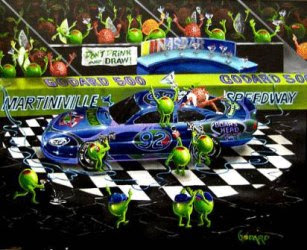
Bad Art - Michael Godard's Olive Paintings


Michael Godard is that quintessential quantity, a bad artist--the kind who succeeds by appealing to the lowest aesthetic instincts imaginable. Arising from the milieu of Southern California, Godard was typically unsuccessful in other occupations--engineer, illustrator, caricature artist, and allegedly had a difficult childhood, and a troubled family life (a chronically ill daughter who died young). His signal success in creating cartoon-like canvases of high contrast polish and comic thematic content has redeemed an outlaw personality and brought him into the mainstream of successful pop art.


Is it possible for an artist to be so successfully "bad" that the work flips over into genuine quality--in effect, transcending the usual categories and genres to occupy a place that has integrity because of its honest, straightforward meretriciousness? It may be so.


I'm not a serious art critic, and I often think I'm on uncertain ground when trying to estimate the value and quality of modern art. Was Rothko a genius, or a charlatan? Was Warhol great, or just an audacious advertising executive? I don't have any clear ideas about that. I often despise bad art--for instance, the work of Norman Rockwell, which makes me feel I've been drenched in sewer water every time I see one of his canvases--probably for the right reasons, but then I encounter an artist who breaks all the rules, and still manages to communicate something to many people.


Godard, mind you, is no golden-hearted, modest craftsman, toiling away in obscurity and proud indignation. He's a no-holds-barred self-promoter who pushes himself and his work forward with undisguised vanity and ambition. In America, cartoonists have often attained the rank of serious artist. Charles Schultz, for instance, or Walt Disney built very lucrative careers, veritable marketing empires, out of a few simple comic strip narratives. We certainly don't measure the aesthetic quality of them against the yardsticks we use to judge, say, Monet, or Winslow Homer, or Lucien Freud.


Everyone acknowledges that various media entertainments may, through their popular appeal, achieve a degree of recognition that tends to raise our estimation of their value to levels that rival "serious" art. It's not a new thing. And each new generation of avant garde artists routinely gets vilified for, in effect, dissing the traditions of devotion and quality and performance which set previous standards of taste.


Taste is a funny thing. In our nervously shifting world of art values, wayward or eccentric figures may appear briefly, their propulsive rockets filling the night sky with color and pizzazz, only to fizzle out after a few years of high sales and whipped-up excitement. Every so often, you'll see road-side stands of black velvet paintings, which people who travel in motorhomes seem to find enticing. Unsophisticated taste in art has a long and undistinguished history in America.


But what is it about the success of a minor cartoon artist, that should so offend our sensibilities? Colin David unburdens himself of a stern indignation in his undated "Michael Godard: Worst Artist in the World." Mr. David condemns Godard for his poor technique--getting the shadows wrong--and his showmanship. But when we're dealing with a generic art that admittedly doesn't aspire to higher values, what is the point of such criticisms? Is it all just sour grapes?


Few artists are able to make a living of any kind with their own work. Many teach, or hold day-jobs, or just scumble along, either hoping for a break, or imagining that someday their work will emerge from the obscurity of the quotidian to stand forth as hypnotic images of our epoch. But this seldom happens. So why should it bother us, when someone overcomes the large resistance to artistic acceptance, and actually manages to make a living selling pictures or objects to people for significant money?


It may be envy, or it may be genuine scorn--feeling as if the rewards of aesthetic effort ought to fit some higher standard of taste and function. But who shall decide what those standards of taste should be? Van Gogh may command prices in the hundreds of millions of dollars for individual canvases. But does this necessarily imply that all art, in any context, should aspire to this level of import? "People like what they like," and why not? What should prevent the ordinary householder from buying an oil painting at an artist's fair to place over his mantel? In what sense is this a desecration of the public's respectability?


I look at Michael Godard's works as a form of sophisticated cartooning. They probably belong in the lounges of Las Vegas, or in the livingrooms of the not very sophisticated Hollywood stars who "know what they like," and "don't give a damn what anyone thinks." I could imagine them in an animated state, and certainly the digital animation technology could do wonders with them--these little green olive characters getting into all kinds of mischief. The glorification of alcoholic beverages, which they clearly embody, seems to me merely a minor fetish, which is really unnecessary to the spirit they capture.


In what sense, then, are these works less ennobling or uplifting than a Ralph Steadman cartoon, or a Ronald Searle drawing, or a piece by Edward Gorey? Are we so categorical that we are only able to see humor if it is aimed at the correct target, or addresses the acceptable problem, or manipulates the permitted subject? Steadman may parody book collecting or wine tasting; Searle may satirize British public schools; and Gorey may vamp with the late Victorian Gothic. But woe be to the Los Angeleno biker stud who fantasizes about olives climbing out of cocktail glasses into the fantasy world of casinos, noir heists, and tropical getaways.

"The Straw That Broke the Camel's Back"

As probable substitutions for the things most people will never own, or probably never see first-hand, up-close, secondary art occupies an important niche. To imagine the world into art is a completely human aptitude, which is expressed all up and down the spectrum of class, education and interest. Who's to say Michael Godard is either worthless, or misguided, or unworthy? Most people got a good kick out of the dancing raisins singin' "Heard it on the Grape Vine" a few years ago on commercial television. And those little peanut M&M's diving into a chocolate swimming pool--they were fun too. I'm rootin' for these little olives in their inebriated escapades, but I have no illusions about quality. We'll leave that to the highbrow critics who roll their eyes and clear their throats.


Sunday, August 21, 2011

The Shortest Route


The shortest route between two points is a straight line.

But sometimes the shortest route is interrupted by obstacles.

In life, we often find we have to go around something which we can't scale or overcome initially. Patience may be in order, or simple common sense. Why knock yourself out if you have alternatives?

Other times, capitulating to the inevitable is the only choice. People who can't compromise will have difficult lives. But meeting challenges is crucial to success, too. You have to pick your spots.

Sometimes, taking a slight detour is the only way to overcome a larger obstacle which would be too circuitous to go around. There are different plateaus.


Calling something crooked has implications. I'd never call a drink "The Zig-Zag"--which implies an inherent contradiction. Tastes have to make sense on the palate. The shortest route in a concoction seems better. Consistency, alignment, forthright determination--the right mix.


Here's the combination--as always, by proportion (this would make one drink):


2 Parts bourbon of your choice
1 Part orange liqueur of your choice
2 dashes Fernet Branca
2 dashes Angostura bitters
1 small flamed orange peel

Shaken gently (or swished) and served up.

The shortest distance between two points may not always be a straight line. So kick back and enjoy a moment of reflection, and rest up for the next challenge. Decide upon the best strategy, and the best route to your destination. And when the time comes, be ready.

Wednesday, August 17, 2011

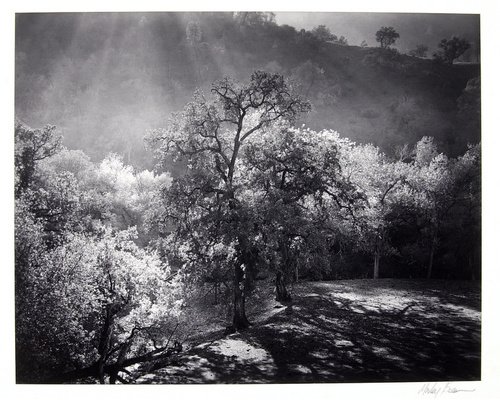
Morley Baer and the Shrug of Earth


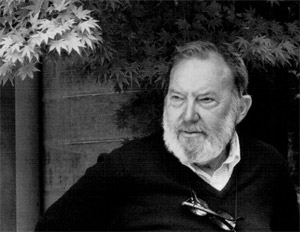
Morley Baer [1916-1995] was a Bay Area resident and professional photographer for fifty years. I first became aware of his work in the early 1980's. His black and white landscape photographs were being published in monographs, and he had achieved notoriety for his color work in Painted Ladies--San Francisco's Resplendent Victorians [Dutton, 1978], which recorded the garishly repainted late Victorian--post-earthquake--architectural follies, in vivid Kodachrome (or Ektachrome). Baer had begun his professional career as an architectural photographer in the late 1940's. Like Brett Weston, he'd done a turn in the military working as a service documentarian, before finally settling in the Bay area in the early 1950's. Baer eventually established a reputation as one of the top architectural photographers, working with William Wurster, William Turnbull and many other notable regional designers. His images of the built environment are widely published in that field.


Concurrently with his architectural work, Baer was also interested in landscape imagery. He early connected with Edward Weston, and fell in love with the same West Coast scenery which had inspired the Westons (Brett, Edward and Cole) , and many others during the immediate post-War period. Baer assisted in the printing of the limited original Edward Weston print portfolios. As his interest in artistic landscape work increased, he was drawn to the Central Coast area around Carmel, and in 1965 he moved into a beautiful stone beach mansion on Garrapata Beach--designed for him by Wurster. Baer, using the beach house as a base of operations, lived there until 1979, when he sold it to resume living with his wife at another house in the Carmel Valley, where they lived for the rest of their lives. In his later years, Baer taught workshops, and saw his reputation grow along with the recognition of the West Coast photography movement of which he had been a major figure.


Preferring an 8x10 view camera for most of his serious work, Baer established a personal style that derived in part from Edward Weston's and Ansel Adams's landscape work, but he brought to it a certain elegance and finish that set it apart. Aside from his straight architectural commissions, Baer was interested in the architecture of barns, the rolling oaky hills, and spent time in Spain and Italy working on classical subject matter as well. I've always loved his studies of the coastal foothills, which though not being entirely "heroic" (in the manner of Adams) nevertheless have a dignity and austere picturesque quality I find very attractive.

He also worked in the Southwest, exploring the native pueblo and church architecture, seen here in this gaunt, metaphysical study of an adobe wall and curved ladder arching into an eerily empty sky.
The same kind of aesthetically discrete approach characterizes this study of a Spanish colonial architectural detail of a chimney, door and roof-line. Keeping the roof-line level with the point-of-view allows the composition to be neatly divided between the shadowed wall underneath the overhang, and the slightly darker grey sky above.


There's a sculptural purity about this study of another Southwest structure, the high contrast hard sunlight emphasizing the heavy solidity and mass of the battered stone construction.


One aspect of the dramatic West Coastline is the foam and spray which rise into the atmosphere around the crashing surf and rocky shingle. Baer captures this coastal "fog" or mist interposed against the distance shoulders of land, heightening the effect of the glittering droplets of sparkle and fizz. You can really feel the wet and coolness of the interaction.


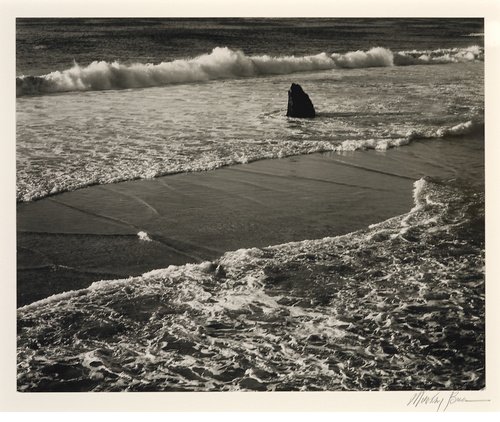
The effect here--of opposing surf waves--possible where a fresh-water stream meets the oncoming waves, creates a christening quality, where the two currents will intersect and merge into one. It's a delicacy for the eye, like sunny lace curtains in the breeze. The rock, meanwhile, anchors the composition. We're looking at a diagonal vantage to the scene, so that rock sets up a perspective definition that keeps the eye level and oriented.


In the course of his architectural work, Baer often ventured into the agricultural valleys and canyons of the coastal mountains. Here he captures a well-known adobe ranch spread, with characteristic preciosity, the whitness of the buildings and drive contrasted against the dark shapes of the mountain ridge.


It's clear that Baer felt a sense of earthly power in the California landscape. Many of his studies have a strong, masculine apprehension of forces implacably set in opposition to man's appropriation, the movement of great forces under the earth, or from the sky, which contend in a scene at once majestic, and somewhat frightening. We stand in awe of the earth's (or nature's) capriciousness, though its movements and adjustments may be as quiet and satisfying as the slow movement in a Bruckner symphony.


Bringing out these senses of scale and awesome range is often what Baer's prints seem to be about. This is achieved through the contrast between a delicately rendered (and perfectly clear) foreground, and a yawning background fortuitously back-lit or highlighted with cloud windows.


This study of rock and water is not an unusual subject--indeed, most of Baer's images aren't about finding the most peculiar or strained vantage from which to view a landscape scene--but its quality is like a brunt or shrug of geologic gesture. The rock flows, while the water seems icy, and still. The interposition of states of matter uses the deceptive contrast between kinds of textures to disorient the eye, and give interest. As with all Baer prints, there's a strong "interlocked" composition, founded and fixed.

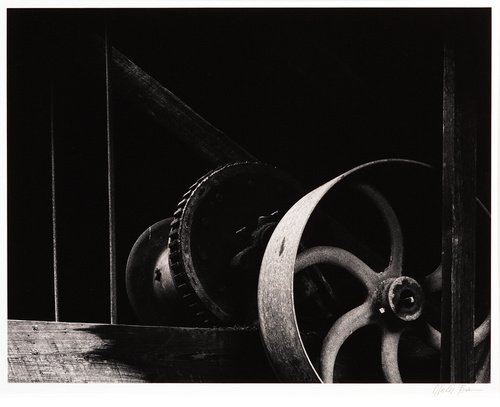
Though most of Baer's work in architecture is straightforward, occasionally he liked to make images of odd dilapidation or decay. The disappearing rural architecture of the West captured his imagination. This storehouse structure has a weird "high-rise" effect which is completely disorienting in the context of its placement and construction. Baer was fond of dark skies, and this one undoubtedly was burned in deliberately to emphasize the heavy, overbearing quality of the ghostly presence.


Baer's work along Garrapata, Big Sur, Carmel, and the Monterey Bay region may be the best examples of this genre. The combination of high contrast blacks with feathery light grey distances, is always used to create drama, and mystery.


These compositions may seem easy and available, but it takes great patience, lots of work in the darkroom, and some luck as well, to make pictures like this. The light and clouds and wind seldom cooperate. Once, photographing along the Garrapata Creek area, I picked up a terrific case of poison oak that plagued me for a month. I'm sure that Baer must have known about this, and taken steps to protect himself. In my case, just handling the spikes at the end of my tripod was enough to infect me from head to toe!

These aren't the usual tourist shots--because the "nature" they portray isn't welcoming and cheerful. They seem to be telling us that this country may be over-run, may be spoiled and defaced and polluted and poisoned, but it will never be tamed. That's the message with a lot of Baer shots: There's an ephemeral fragility which we can see here, but underneath that there are forces and movements which command our respect, as well as our appreciation of their inherent beauty and charm.

Baer's images are contemplative and refined, serious and dry. But despite their classical balance and studied counterpoint, they're hardly reassuring or inert. The dizzying forces and poised relationships they capture are held in place by the shrewd augmentations of his art. You can feel Baer's character in all his images--he manages to define his purpose and convey his program with confidence and fullness of intention.
This power of purpose has metaphysical persuasiveness which I find convincing, though this isn't the only kind of photographic style I admire, or enjoy.

Baer's a "heavy" artist--rather in the manner that Ansel Adams often is. This muscular insistence can be very powerful, visually, like listening to Beethoven. No one likes Beethoven all the time, but we'd be poorer if we'd never known it. Baer's influence is apparent throughout the following two generations of print-makers. We all have our favorites, but there's no question that Baer's approach to landscape has tended to dominate the field. In many ways, he's the fulfillment of the movement which began with the f64 Group in the 1930's, and chronologically he stands in direct descent from that time, to this.
Much of the landscape he's explored no longer exists, and his work thus occupies an elegiac position with respect to the progress of western expansionism and development. The post-cards of yesteryear become the nostalgic flashbacks of the future.


As we use up the remaining unspoiled lands which men first discovered centuries ago, it's important to have records of what was lost in the process, even if the ultimate message is a sad one. This is what you had, and this is what you lost. Shame on you for ruining it. Even if your busy manipulations and "improvements" will someday be swept away by some conflagration or inundation of nature.


___________________

All Photograph(s) seen here by Morley Baer.

©2012 by the Morley Baer Photography Trust, Santa Fe.

All reproduction rights reserved.  Images used by permission.  

Tuesday, August 16, 2011

Buffett's Cautionary Remarks


Warren Buffett [1930- ] is undoubtedly the most famous American investment guru in the last century. I, among the millions of sensible small private investors, have enjoyed his brilliant investment/financial acumen, by investing in his Berkshire Hathaway mutual fund.

Buffett is famously unassuming and modest, depending on his common-sense approach to evaluation of old-fashioned strong dependable-product-oriented companies, to generate returns which have been the standard on Wall Street for three generations. Buffett's personal worth, or assets under his direct control, place him, at any given time, among the top 4 or 5 individuals on the planet.

Buffett would be the last person in the world to expect anyone to take his advice on political matters, but he's never been shy about offering opinions about what might make our domestic economy healthy, or healthier.

On Sunday, the New York Times published Buffett's opinion piece on Federal Tax policy, "Stop Coddling the Super-Rich."

Gore Vidal remarked once that in America, we have welfare for the rich, and laissez-faire capitalism for everyone else. This isn't what we usually hear, of course, since our media has traditionally been controlled by the rich and the corporations. In the old days, "yellow journalism" focused on the peccadillos of the well-to-do, but since World War II, the Fourth Estate has been under the control of capital in this country. If the business of America has been business, the business of media has been to protect the privileges of the wealthy and powerful.

Today, you will seldom see any opinion critical of corporate interests, or of the "super-rich." Let's be fair: Buffett is so rich, he can "afford" to be honest about the corruption of our tax system--even if he were paying ten times what he currently pays, he'd still be making out like a bandit. He's approaching his dotage; he's been responsible for more charity and good works with a flick of his little finger, than 99% of the rest of his countrymen. In short, he has the cred and the privilege to offer an opinion. He's not running for office, and he no longer has a vested interest in protecting his own little corner of the market, even as recreation.

Buffett informs us that he paid a total of $6,938,744 in federal income taxes in 2010. Given that Buffett is worth an amount just south of 100 billion dollars, in rough terms, that means he paid somthing like 2/3's of 1 percent of his total net worth to the Feds. If Buffett had contributed less to charity, he doubtless would have paid more, but how much more would be "fair"? No doubt the libertarians are shivering with discomfort at this point. Why should self-made men of distinction pay one dime of their earnings to support the general governance?

People who "work" for a living, trading their time and energy for fixed or variable rates of remuneration, won't have trouble understanding the inequitable imbalance of this situation. My wife and I pay fully 42% of all our income in taxes--Federal, state, local, fees, licenses, sales, penalties, etc. What this means in real terms, is that as middle-class householders, the claim that government can make on our income is at least 7 times what it can demand from someone in Buffett's situation. It doesn't take a genius to see that any income distribution scheme which dilutes the income generated by our society into proportionately larger segments of the population, would yield a considerably greater tax revenue than is realized through our present tax system. By concentrating the wealth of our economy among the top 1/10th of 1 percent of the population, and taxing them as if they "needed" this income to maintain their well-deserved wealth, is a recipe for a drastic truncation of entitlement.

Most people agree that the promises we've made to ourselves through exaggerated expectations of retirement or pension income cannot be sustained in an atmosphere of a tightening economic outlook. But we also know that the capital presently being held in private hands is unlikely to be invested in America, and even if it is, it's unlikely that it will generate significant increases in solid middle-class jobs (that is, a decent wage, plus health insurance and some modest pension program). Employment may grow, but the loss of real wealth among everyone below the $200,000 annual household income level, will continue, and probably even be accelerated. Our new "service-oriented" economy will mean that 2.3 wage-earners per household will earn less than their grandparents did with a single full-time wage-earning head of household in the 1950's or 1960's. That transformation has occurred in an environment of carping conservative bitchiness which demands more "shared sacrifice" from everyone but the defined well-off upper margins. The super rich today are four times richer than they were in 1990. The real tax burden of the rich (and super rich) has been steadily declining in real (as well as adjusted) terms for five decades. The corporate tax rates today are less than 30% of what they were in 1960.

The old wives' tale about discouraging jobs with higher capital tax rates is cited by Buffett: "I have worked with investors for 60 years and I have yet to see anyone — not even when capital gains rates were 39.9 percent in 1976-77 — shy away from a sensible investment because of the tax rate on the potential gain. People invest to make money, and potential taxes have never scared them off. And to those who argue that higher rates hurt job creation, I would note that a net of nearly 40 million jobs were added between 1980 and 2000. You know what’s happened since then: lower tax rates and far lower job creation."

The Tea Party members of Congress swore that they'd hold the line against any tax "increases"--even if that threatened the full faith and credit of the U.S. Treasury. Putting aside for now the issue of the credit rating assigned by Standard & Poor, it's clear that these wild-eyed young arrivistes, had no real interests in the immediate effect their ideological position could, and will, have on everyone's economic interest. Were they simply stupid, or did they like the idea of staging a tantrum which could have no favorable outcome, for anyone? It's unclear from all the poles we hear about, what Americans actually think about the tax inequities presently in effect. Do they like the idea that our society is becoming increasingly top-heavy, while the rest of us keep losing ground? Statistics prove that the separation between the rich and very rich, and everyone else, is widening at an alarming rate. What this means in real terms is that the distribution of income is steadily driving the middle class into the lower echelons. Families which once could own homes, will now rent. Families which once could afford to buy an automobile on a three year loan, will now have to take out a long term "mortgage" to pay for it, or drive a used one. Aggregate savings balances by Americans continue to sink to all time lows.

Buffett was careful to add that raising the tax rates on the rich and super rich won't by itself solve the deficit problem we've gotten ourselves into. Practical solutions WILL involve shared sacrifice across the economic spectrum. Tax reform will not mean large tax cuts for the middle class, but it will involve addressing the inequities which Buffett, and others in his class, enjoy. Concentrated capital typically exerts an influence far in excess of its human numbers. Our country may never have been truly representative, in the sense that the Boston Tea Party gang originally understood it to mean. Our Congressional proxies in Washington now mostly defend the privileges of capital. We have the best government that money can buy, as the saying goes. Taxation without representation.

But if we continue to sink into further debt, everyone stands to lose, even those coddled rich. "Pay me now, or pay me later." Americans have been pretending for about 30 years that things are getting better, but the figures don't support that. Things have been getting better for the top one percent, despite the fact that inflation has been moderate to insignificant for decades. Given the actual costs of living in America--which includes health care--middle class people are living less well, and have fewer assets, on balance than they did a generation ago. Our schools, our infrastructure, our services are all worse than they were before. We can "afford" to mount expensive foreign wars, and to give the rich and the super rich big tax breaks, but we're less prosperous, as a population, than we were before.

This is the reality which Buffett acknowledges. It's time we all shared the sacrifice. He may be a traitor to his class, but we know in our hearts he's telling the truth.

Sunday, August 14, 2011

Walls


The wall of sound.

The wall of silence.

The wall of darkness.

The wall of sleep.

The wall of glass.

The wall of mirrors.

The wall of the night sky with the Andromeda Galaxy.

The wall of incarceration.

The wall of wanting in.

The wall of wanting out.

The wall around the Warsaw Ghetto.

The wall blocking the Lost Dutchman Mine.

The wall around the self.

The wall of ice.

The wall of fire.

The wall of the endless plain.

The wall of the tallest building.

The wall of confusion.

The wall of fear.

The wall of madness.

The wall of the border between two warring nations.

The wall of barbed wire.

The wall of words.

The wall of water.

The wall of books.

The wall of paper.

The wall of the screen looming above us.

The wall of knowledge.

The wall of resistance.

The Wailing Wall.

The wall of piled stones.

The mausoleum wall.

The curved wall of Hoover Dam.

The wall of grass.

The wall of reflections.

The wall of echoes.

The wall of sand.

The wall of grafitti.

The walls of the maze.

The wall of rubble.

The Chinese Wall.

The Israeli Wall.

The Iron Curtain.

The wall of the sound proof room.

The wall of the interrogation room.

The prison walls.

The wall of the Cave at Altamira.

The wall of the bank punctuated with an ATM.

The wall of the sacred inner city.

The wall of the page.

The wall of information.

The right angled wall at the corner of First and Main Streets.

The moving walls of change.

The wall of blindness.

The wall of feeling in total darkness.

The wall of the doom of outcomes.

The wall of tiles in Pompeii.

The floor you’re standing on.

The floor of Fred Astaire dancing upsidedown.

The door in the wall.

The window.

The hole.

The eye.

The wall of the brain pierced by the eye.

The wall of death.

The wall of the future, continuously receding.

The wall of forgetfulness.

The wall of hope.

The wall of time.

The wall of consciousness.

The wall of six-sided cavities of bees wax.

The wall of gold-leaf.

The wall of ignorance.

The wall of absence.

The wall that is not there.

The wall of wind.

The wall of the tsunami.

The wall of ivy.

The wall of the map of the world.

The security of walls.

The walls of the body.

The wall of carelessness and envy.

The wall of confidence and vanity.

The wall of boredom.

The wall of truth.

The wall of lies.

The immovable wall.

The wall of free association.

The wall of determinism.

The translucent wall of the egg at the moment of conception.

The moment of consciousness.

The black wall of the curtain coming down on the final act.

The rising wall of freedom.