Disappearing. reappearing poinT
Monday, March 5, 2012


Sunday, March 4, 2012
No Exit

No Exit
Men die every day for the lack of what is in poems.
If I say so, birds tip over. These beautiful first editions
Under bright glass in cases are like blocks of ice that
Won’t melt. Men die every day while these books
Gather dust. Why don’t we just burn them?
Tonight the moon is so bright you could read
A book by its light. You know what you can do
With your goddamn romantic moon. The moon
Won’t melt, it’s not a round slice of stinking French
Cheese, either. If I say so, the moon melts. Words
In a poem aren’t just words, but a poem. One two
Three four. This is a poem for Jack Spicer. One
Way to tell is to test it. Maybe I have the formula
Backwards. If I say so, birds tip over. Every day,
Books get tossed into dumpsters because there are
Too many of them. Toss out the birds and bring back
The moon, I say. You know what you can do with your
Goddamn first editions. This poem is dedicated to
No one.
Friday, March 2, 2012
Stalking the Wild Ass-Burgers
When Conservative ikon Ronald Reagan assumed the Presidency in 1980, he appointed James G. Watt as his Secretary of the Interior. The Republican strategy, since the mid-1960's, has consistently been to undermine Federal agencies, by appointing avowed enemies of departments they occupy, who use their power to "eat the host from the inside out"--and then use the record of the agency's "failure" as "proof" that "government doesn't work."
Watt, like the administration that hired him, "hit the ground running." He immediately set about turning over Federal lands for mining, timber harvest, oil & gas development. He fought attempts to create new national parks, and even resisted private donations for preservation! Before his appointment, Watt had created the Mountain States Legal Foundation, an organization designed to promote and defend the rights and privileges of extractive industries and private owners on public and private lands. Watt was, in effect, the wolf invited into the hen-house, to feast on his former opponents. It would be as if the U.S. were to hire a Muslim Al-Quaeda terrorist to run our domestic security programs. Watt himself, always the loose cannon, eventually was fired by making intemperate comments about affirmative action. For those of us who wanted to be rid of him, it was like getting Al Capone for tax evasion. It didn't matter what strategy you had to employ, as long as the culprit was nailed.

I was reminded of Watt this week, reading about the embarrassment suffered by California Fish & Game's head Daniel Richards, who posted a picture of himself posing--Hemingway-style--over his fresh-kill mountain lion on a dude ranch in Idaho, grinning from ear to ear with pride and ghoulish delight. Richards was appointed by former Republican Governor Arnold Schwarzenegger. The "Governator" was using the same tactic as Reagan had two decades before, to appoint an avowed enemy of conservation and wildlife preservation, to a position of trust, to an office whose primary purpose was diametrically opposed to his views. It was Mr. Watt all over again.
Have you ever met one of these gun-happy "wild-life management" types in the flesh? They're really brave souls. They like to stalk their prey in little bands, mowing down helpless mountain lions with high-calibre rifles from a safe distance. Dude ranches are their playgrounds, and they get off pumping lead into "targets." They look on nature as a game-board in which humankind gets to "control" animal populations through eradication or sport.
Once upon a time, the North American Continent was full of game, and it existed in a fine ecological balance within the context of it geographical limits. The native indian populations respected its resources, for the most part, and might have gone on doing so for centuries, had not the Europeans come to lay claim to this bounty. As populations have exploded, humankind has pushed much of the wild kingdom into extinction, and many of the surviving populations are endangered. Corporate energy and extraction industries oppose all preservation and regulation, and they've teamed up with the hyped-up hunters and gun-freaks to hold the line against animal rights activists and "tree-huggers."
Watt said he wanted to open up all the Federal and private lands to exploitation, "mine more, drill more, cut more timber." He always grinned when he said this, openly defying his enemies, provoking them with cheek. "Screw you," he always seemed to be saying. Discussing his theory of environmental management before the Congress, he testified "I do not know how many future generations we can count on before the Lord returns, whatever it is we have to manage with a skill to leave the resources needed for future generations."
As an environmental steward, Mr. Richards is shoulder to shoulder with James Watt. Comrades-in-arms in the struggle to ravage the earth in the most efficient manner, for the benefit of corporate shareholders and hysterical gun-nuts. State legislators have called for Richards's head, as well they might. But Richards, true to his type, is standing firm: "my activity . . . [to hunt mountain lions in Idaho] . . . is none of your business." Richards isn't stupid; he knows his constituency admires his crack-brained tenacity in defying public indignation. It's just what they like about him. Preservation of wild-life?--to hell with it! Shoot the bastards!
Beside the beautiful wild feline he has just killed, Richards looks like a pipsqueak. He might as well be jacking off in a skin parlor, or stumbling around in a padded cell. There's nothing admirable, or noble, or dignified about what he's done. He's just another pathetic jerk playing with a dangerous toy, perpetrating sanctified mischief at the world's expense, an environmental terrorist getting his jollies by offing endangered species.
Monday, February 13, 2012
IHO - The American Bar at The Savoy - a New Painted Lady
The America Bar in the Savoy Hotel in London is among the oldest surviving cocktail establishments in the world. I stayed in the Hotel briefly in the 1990's, but didn't venture into the Bar. Alas, I had other errands to run. It, along with the rest of the hotel, underwent a refurbishment (beginning in 2007) which apparently took years to complete (2010). Much of the original memorabilia and furnishings were sold off. The American Bar itself is supposedly nearly unchanged.
The American Bar was in operation before the turn of the 20th Century, but it became famous during the 1920's when the cocktail craze was at its height. Britain had no Prohibition, so the place remained open right through the bootleg era in America [1920-33]. In 1930, Constable published The Savoy Cocktail Book by Harry Craddock, who was the bartender at The American Bar between 1925 and 1939. The book is a collector's item today, with copies in decent shape rising to above two grand per. With nifty Art Deco designs by Gilbert Rumbold, it sports 750 recipes. It's remained in print ever since, though newer versions aren't as stylishly turned out. Health experts and teetotalers undoubtedly would be scandalized today by its original cover illustration of a lurid green drinker, being jolted by a jagged electric streak piercing his black heart! For those desiring the inebriating thrill of alcohol, such an eye-popping design was considered more than naughty in 1930, but today it's regarded as politically incorrect, instead of just devilish.
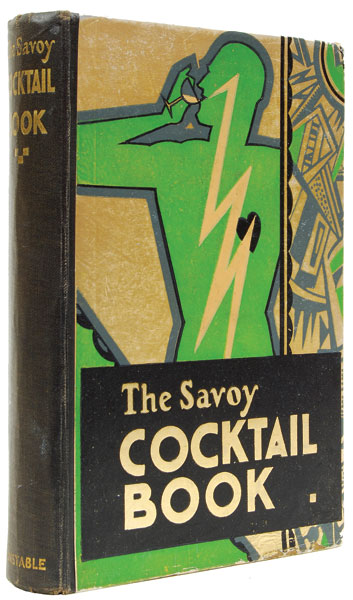
The original Savoy Cocktail Book
Part of the fun of drinking cocktails once involved the atmosphere of the places where they were consumed. A classy speakeasy was a place where people went to have illicit fun. Jazz was played, there was dancing, and certain kinds of illegal goings-on might occur, like prostitution or gambling. After Prohibition was repealed, this shady aura was perpetuated for many years, but eventually the shine wore off, and today, most fancy nightclubs and cocktail lounges don't command the respect or interest they once did, and are really glorified watering-holes for alcoholics. Drinking itself isn't glamorous. It's what people make of their mild inebriation that determines the atmosphere that surrounds it.

A later incarnation (edition) from 1999
Alcohol doesn't affect everyone in the same way. Some people become ill. Some become morose, or even angry when drunk. But most people just become a little light-headed, or light-hearted, and tend to lose their surface inhibitions. Drinking can even enhance performance by removing anxiety, though the more you take, the more its influence tends to make you less coordinated and mentally alert. But one or two ounces of alcohol generally are not going to hurt you, and unless you're a very small specimen, it won't even make you legally inebriated.

The latest incarnation of the Savoy Cocktail Book
In honor of The American Bar at The Savoy Hotel in London, here's my own concoction called The Painted Lady. There have been other drinks with this appellation, but none so suavely rich and seductive.
The Painted Lady
As usual, the ingredients are by proportion--
1 parts Tennessee bourbon
1 parts brandy (i.e., Korbel)
1 parts Aperol aperitif
1/2 part cherry liqueur
Shaken or swirled in ice and strained into a cocktail glass. No garnish, unless you desire a sweet cherry.
This one is potent, but very caressing on the taste buds. The smoky quality of the bourbon is offset by the spice in the Aperol, while the sweetness of the brandy and cherry liqueur brings out the smoothness in the bourbon. Starting with the bourbon and brandy combination, a number of different minor variations can be considered. A whole range of aperitifs could be substituted, or fruit flavors introduced, though any of these might change the essential fluidity and suavity of this particular combination. Cocktails can be constructed using fruit juices as a starting point, but the classic cocktail begins with a basis of "goods", to which is added certain combinations or augmentations. Drinking liquor straight usually suggests that its flavor is satisfactory alone. True cocktail appreciation, however, isn't about the "goods"--even though better ingredients makes better cocktails. Great cocktails can be made out of "ordinary" standard goods, simply through the manipulation of flavors. Some might say that adding enhancements to liquor makes the poison more palatable, and, once upon a time, that was probably much truer than today. Cheap goods are like anything else--you get what you pay for.
Here's to The American Bar at The Savoy in London. Long may it survive, into the 21st century and beyond!
Thursday, February 9, 2012
Nature & The Contemplative Life

Mendocino Coast 1986 [Silver Gelatin Print, 8x10 Contact Print]
In the 19th Century, Romantic poets idolized Nature (with a capital N), thinking to invest it with generative and salubrious meanings for humankind. The Industrial Revolution set man at odds with nature, as scientific advances promised an actual perfection of human life through the taming and subduing of a raw cosmos. But science also brought destruction, and the deeper apprehensions of our real place in the universal scheme, one in which we were but one minute piece in a gigantic puzzle, beyond our ability to control or even to comprehend. And the production system was dehumanizing, putting man into a subsidiary position with respect to work, and the fruits of labor.
An idealized Nature has been at the heart of a number of pantheistic visions of the world, and of man's place in it. In the East as in the West, men of discernment have sought to find in a steady, careful observation and consideration of natural phenomena, a consoling interconnection between our higher mental faculties, and the diversity and persistence, the fragility and strength, the mystery and simplicity, and the complexity and unpredictability of the natural world. Nature was the expression of primary structure and force. But our sense of it, beyond the intuitive, was limited by our ability to codify our understanding through language, and to find adequate means to synthesize and summarize our knowledge. Higher kinds of language, such as mathematics and symbolic logic, might provide more accurate versions, but tended towards the formulaic. Formulae are human shorthand models of principle, and can be so difficult to understand that the real audience for them is tiny.
On the intuitive level, where our complex brains perceive and comprehend phenomena on a non-rational or supra-rational platform, language fails completely to provide us with a handle on our sensations. Brain research suggests that our consciousness is a very complex affair in which the suspended self is surrounded by millions of impressions and memories and incoming flows of data, constantly in flux and continuously adjusting to influences of many different kinds. In other words, being in our brains, which is literally where human consciousness resides (in a body), constitutes an (internal) environment at least as complicated as anything we "perceive" in the "external world." The mind is an analogue for the world's density and buzz, which is what enables us to sense its mysterious qualities.
I'm not religious, but what religion habitually attempts to address is, at least in principle, the same problems faced by higher physics and mathematics. Organized religion often serves the purpose of providing less curious and inquiring minds with convenient forms of universal definition, since the average person has neither the need nor the desire to know more about the meaning of life beyond a few simple prayers (or mantras), and a consolation for death and suffering.
Nature by and large isn't comforting and helpful, as the Romantics liked to imagine. It's cold, and empty, and immense, and filled with danger and competing agency. Life perseveres in its various manifestations through aggression, defense, and busy reproduction. One may assign happy significances to bravery, careful planning, and love, but these fictions beg the case.
Light falling on a gnarled trunk in a quiet corner of a coastal forest on a sunny day in Spring may suggest in its quotidian aspect a restfulness and inviting shelter, but all of the forces which determine the formal unfolding of time, of life evolving and subsisting, are present, because those principles apply everywhere. Man isn't separate from nature, though he may like to believe that at times. We can construct a sense of our custodial husbandry of the natural world, based on an altruistic vision of a perfectible human paradise. But that's not what ecology, as a purposeful pursuit, reveals. Responsible attitudes toward the environment are mediations between what is, and what ought to be.
Nature once seemed limitless and foreboding. We now find that that sense of it, a provisional reaction in the face of its extent and power, may have been truer than the one we now pretend, of having superior leverage over the natural world. No matter how efficient our manipulations, no matter how far our understanding of the universe may penetrate, we're still dwarfed by its larger significance. Acceptance and capitulation may be spiritually convenient, but they're only makeshift strategies.
We still have to get up in the morning and hunt for a meal, if only by opening the icebox. The universe itself is one very big icebox, just how big we don't really know.

Tuesday, February 7, 2012
Anecdote #11904T

Then there was my TA for the introductory course in Physical Anthropology, which consisted primarily of memorizing all the bones in the human body--all 206 of them. Sections of the large lecture class were broken up into groups of about 12, which met once or twice a week during the term, in small classrooms. The TA's were graduate students, earning tuition money by practicing on freshman. Our TA was Christina Milner--not a name known to me at the time. Our section included most of the varsity defensive line--very big chunky guys with crewcuts, whose claims to academic proficiency were pretty flimsy. Each one had a "handler"--another student assigned to assist him with his course-work, so he didn't flunk out. They were fun-loving guys who enjoyed getting drunk and generally making merry. Classes bored them. But the first section meeting changed all that.
Milner and her husband Richard were working on a book--perhaps an expansion of their graduate thesis projects--devoted to the world of prostitution. They carried on their "research" in San Francisco, along Columbus Avenue--notorious for its "Barbary Coast" strip clubs and street action. The book they eventually published, Black Players, purported to be a serious sociological study of the African American pandering which took place in the North Beach area.
Milner was a tall redhead, and in order to facilitate her research from the inside, she worked as a stripper in one of the clubs, billed as "Montana Red." Never having visited a strip club in my life, I presume this must have meant that she performed nude, or at least topless, since "topless" was the big draw on North Beach in those days.
In any case, at the first section meeting, Milner appeared in a skimpy pink mini-dress and net stockings, with a big handful of necklaces around her shoulders. Was she wearing a feather boa? She might have been. Long red curls. Sashaying walk. Meaningful smile. She introduced herself, then proceeded to walk around to the front of the desk, taking a position before the front row of seats. She got up on the desk, crossing and re-crossing her legs, not more than five feet from the four huge linemen who sat before her. Grunts of surprise and approval. She had definitely gotten their attention.
Our sessions in the following weeks were hilarious theatre. I suspect that the linemen had been assigned to Milner's section deliberately, since it was felt they'd pay more attention to her discussions than to another dry-as-dust graduate student. Red Milner thoroughly appreciated the exhibitionistic innuendos she created in those section meetings, as did the linemen.
Two years later, the Milners published Black Players, the pop exposé they'd been working on. Not long after this, the Milners parted, and pursued somewhat different paths. Mr. Milner nowadays performs his "musical" version of Charles Darwin, while Christina teaches anthropology at Santa Rosa Junior College, while working as a singer and dancer on the side.
The college lineman probably giggle when they recall their anthropology TA.
I, however, wasn't much interested in bones in those days, though I did manage to memorize the 206 names. I was taking the class pass-fail, so I didn't put much effort into it. Milner threatened to flunk me, but if she was passing the linemen, she could hardly have justified that.
Wednesday, February 1, 2012
Anecdote #11526G

Then there was the story—apocryphal but supposedly true—of the British poet who’d had a fetish for nylon panties during the 1960’s, and later had published a limited edition of a book of his poems, each bound in a pair of the purloined lingerie of past conquests. This was the era, remember, of Peter Max and Milton Glaser, of the Flower Generation and the Psychedelic Age.

Subscribe to:
Posts (Atom)
