Thursday, October 20, 2011

R E F L E C T I O N S


If a poem is a function of the way we respond to a given set of phenomena, then mathematics is the precision of the formula for describing the linkages and forces which govern them. Mathematics is a language, whose terms are narrowly defined, and denote very exact factors of something.

Consider, for a moment, the function of the light and the angles which could describe the distortions created by the undulating surface of this image of water. What, exactly, are the dimensions and shapes of the object/or objects being reflected towards the viewer?

The image is only static for a fraction of a second. As the water continues to undulate, there may "never" be--at least in reasonable time--another moment in which this exact template of light is reflected in exactly this pattern, again. But change is another aspect of the problem.

There should be a way of "untangling" the distorted imagery so that we could "construct" a reasonable facsimile, or recognizable version, of the object which exists above the water at the angle of reflection across from our view. I have no idea what such an equation or set of equations might look like. But I believe there must be such an equation, which would express the distortion in such a way that would enable one to trace it back to its source.


Words don't give us that kind of exactitude. When we use ordinary conversational speech, or poetic speech, or the jargon of disciplines, etc., we're using a crude tool to handle a very slippery, or complex object. How difficult would it be to convey the peculiarly beautiful and dazzling quality this color image projects? Part of the pleasure, I'd argue, is our sense of the accuracy with which our eyes perceive the changing patterns of the light. That accuracy is another way of expressing the precision and complexity of the process we can deduce from just this momentary glimpse.

We've all seen water glittering in the sun, and it's a familiar sight. We know that geometry and calculus and trigonometry can offer a language with which to make a mathematical diagram, a recipe for a phenomenon. Is such a formula or equation any more "real" than a poem might be to describe the "feeling" we can have about an experience such as this? Mathematics describes experience, after all, in the same way language does, but with considerably greater finesse.

In religion, words fail us. In art, they do too, though we may sometimes have the feeling that words aspire to, and attain, high levels of formulaic complexity. As humankind progresses in its ascent to higher plateaus of description and empirical confirmation, we may feel that we grow closer to grasping the inherent riddles of matter, time, origin, purpose. But no matter how sophisticated our languages become, they are all still languages, with greater or lesser degrees of power to describe, convey, solve, or evoke.

Language is what we have. There is this image of undulating water, and the light reflected off of tangent objects dancing in our eyes. We, and it, remain locked in a perfect quandary of mediation. Words bridge the gap between what is happening, and how we respond to that.

Street Art


The picture below was taken this afternoon across the street from my office on 4th Street in Berkeley. Can you copyright a building facade? Probably. Before this lettering pattern appeared, I would have ventured to observe that the building itself was vacant. Behind the ranks of uniform glass panes is a lot of two- or three-story high permanent heavy hydraulic equipment--thick gauge pipe, valves etc. God knows what went on in there in its heyday. Buildings like these in the last couple of dozen years in the Bay Area have been appropriated for low-tech small businesses or converted/subdivided office-spaces. Lots of artists have studios or work-spaces in them. I have no idea who's occupying this place now, but there's no evidence of human activity from the outside. Perhaps someone simply got permission to perform this appliqué as a project. . . ?


Clicking on the picture will render a much larger image, enabling you to read the words formed by the letters in the panes. The "message" is as follows:

HEAVENS
EARTH
ENERGY
PROPHET
MEANING
MISSION
DESTINY
CRUDE
ORE
FARM
FACTORY
WIFE

SKILLET
LABOR
CLASSES
MADE
MAN
HOUR
BASEBALL
ROBOT
LOOM
ROOSEVELT
JUST
WAR
AMERICA

AUTO
EXURBIA
JAZZ
UNION
PEACE
OWN
POOR
GUERILLA
JOBS
PAID
INHERITS
TECHNO
GAIN
CHANGE

I haven't tried very hard to decipher this, but it's possible there are some acrostic messages here. Maybe it's a coded transmission lurking behind the quotidian word-list? Or maybe it's just a light-hearted art project to make passers-by ponder for a moment. If so, there isn't much that I'm able to make out of it that would cause me to spend much effort meditating it.

Anyway, pay attention when you walk the streets. There are always surprises. Especially in a place like Berkeley. An open mind, and an open eye can get you into trouble, but also might open up doors. Who knows what awaits you around the corner?

_________________

Addendum [12/2/11]. Clarification of last four words of the window display. INHERITS/TECHNOGA/INCHANGE, or INHERITS TECH/NO GAIN CHANGE. I inquired with a tenant in the building who told me the landlord had authorized someone to make this installation, but knew no more about it. -CF

Capone


This is a photograph of Al Capone's prison cell at Eastern State Penitentiary in Philadelphia, Pennsylvania, where he was held for eight months in 1929-30. Eastern State was closed in 1970, and is now run as a public attraction by a non-profit, with tours and exhibits, including the Capone cell above. You can see some paint or plaster accummulating on the red fabric--is that a bed, or a blanketed storage box? There's something very surreal about this space.

Ken Burns's expose on the Prohibition Era has just been aired on PBS. There was a lot about the Chicago Gang wars, and Capone's crime empire there during the 1920's. Capone, as everyone knows, was eventually imprisoned on income-tax evasion, though the real motivation behind his incarceration was the violent activities he had engaged in to preserve and promote his various elicit business-activities, including illegal alcohol distribution, gambling and prostitution. His gang's annual income at its height has been estimated at 100 million dollars a year. Even today, money on that scale would be impressive, but that amount today would be worth between 10 and 100 times that amount, depending upon what indexing formula one uses.


Capone was not a very attractive man--in several senses. He had a very unpleasant Sicilian face, with dark-ringed eyes, and fat lips.


Capone was transferred to Alcatraz Island prison in August 1934. Here he was denied the privileges which had been accorded him at Eastern State. He lived only eight years after being released from prison in 1939, and they were not good ones.


His health had begun to decline, partly from a case of syphilis. By 1946, his doctors estimated his brain capacity to be that of a 12 year old. He died the year I was born [1947]. He was only 48.

Wednesday, October 19, 2011

The Cul-de-Sac - New Champagne Cocktail


I grew up on a dead-end street. Also known as a cul-de-sac. The neighborhood had been developed during the 1920's or 1930's, so there was no cutesy grid pattern as became common during the 1950's and 1960's. The street simply abutted an empty field, which had been at some point--probably as late as the decade before WWI--agricultural land. There was an old chicken shed at one end of the field, and there was a real barn at the back of the property where we lived, though a cement floor had been poured, and the stalls covered over. Eventually, the county declared it open space, and made a park out of it, but that was decades after I left home. As kids, we played sandlot baseball there, or (earlier) games of cowboys and indians, or, inspired by the WWII movies we'd seen, lobbed dirt-clods (tufts of turf grass) at each other like mortar shells. More than once, arriving home late in the evening after a dirt-clod fight, I was made to take all my clothes off and head straight for the shower, by-passing the kitchen and dining-room, until I had become "civilized" once more. I doubt anyone plays much in this "park" now--maybe someone stretches for a morning run, if that.


Dead-end streets are recognized as being less well-traveled, and consequently more peaceful, and safe. Hence their popularity in planned development street designs. In memory of the "dead-end" street where I grew up, here's a new champagne cocktail to whet your palate. Champagne cocktails tend not to be too popular, largely because they require the opening of a bottle of champagne. Once a bottle of bubbly is opened, it quickly becomes flat, so ordering a champagne cocktail in an establishment that doesn't routinely serve it usually doesn't work.

Nevertheless, if you happen to have enough glasses to fill, or are attending a dinner at a restaurant where the fare is high-class, give this one a try.


The proportions (as usual):

2 parts prosecco, or cava, or French dry
1 part neutral vodka
1 tea-spoon orange spirits (triple sec or equivalent)
lemon twist (with zest, if desired)

Swirled gently in an ice-filled shaker and poured into a chilled cocktail glass. You could use a champagne glass, but it's really unnecessary.

This one has a very "clarified" quality that you don't get in ordinary citrus mixes with vodka, gin or tequila. They go down very easily, and two are better than one.


Thursday, October 13, 2011

Jeanloup Sieff


JeanLoup Sieff

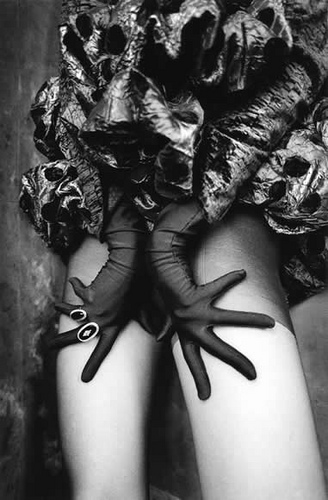
Jeanloup Sieff [1933-2000] was a Polish-French-American photographer concentrating on fashion. Like others in the field (Irving Penn or Richard Avedon), his creative drive could not be confined simply to taking pictures of women in outfits, and he developed a portfolio devoted equally to fashion, and to other kinds of subject matter (landscape, candid photojournalism, celebrity, abstraction etc.). In Sieff's case, though, the fashion seemed to inspire him to conceive of situations or settings which challenged the stiff, stereotypical tradition of fashion photography, and he became a leader in the trend towards naturalistic backdrops, location shooting, and weird, disorienting contexts.


What are the implications of our growing relaxation of inhibitions and moral standards over the last 200 years? I've written before about the implications of nudity, in my post The Lolita-Complex in the Work of Jock Sturges. In a pre-historic, pre-"civilized" state, humankind must have gone through a very long period during which nudity, or semi-nudity, was our natural condition. As our human ancestors developed genetically, gradually losing body hair, the choice to wrap the body in a covering material would probably have begun as a way to retain heat. As our brains became more sophisticated, the tendency to regard the physical aspects of sexual difference would eventually have led to primitive ideas of self-consciousness, embarrassment, and symbolic objectification.


In primitive societies, the idealization of the feminine principle vied with that of the male as expressions of power or control. In Christian iconography, there is the feminine principle of the idealized virgin as the ultimate vehicle for divine transmission. With the development of the fashion system in 20th Century media, conceptions of the idealized feminine principle were diverted into a denial of fertility--after WWII, the proto-typical body type would become thinner and thinner, until in our time anorexic stick-figures dominate the runways of the great cities of fashion (New York, Paris, Milan).


Sieff, of course, functioned within that system for decades, and became a leader in the evolving interpretation of the ideal feminine look, utilizing the mannikin waif to augment a vision of women as trophies of chic--impotent, dependent and starved.

Mia Farrow

Like Ralph Gibson, though, about whom I wrote on October 3rd, Sieff's interest in the nude was not restricted to the acceptable settings of the advertising/fashion sphere. He saw them as related to the natural world, in the context of landscape (wild).


In his monographs, he integrated images of fashion out-takes and female studies with stark, desiccated or lonely (isolated) landscapes, or put models directly into them. The resulting surreal disorientation emphasized the improbable nature of the fashion system itself. Rather than putting models into cocktail party scenes or under bridges along the Seine, he took the location shoot to its logical extreme, emphasizing its implausibility by paring it down to its essence.


In Sieff's nude/landscape studies, he isolates the sexual feminine in a pitiless, barren context, in which the merely decorative aspect of the model's attire, of her trim, decorative body-type, is rendered absurd.


The suave, emptied-out urban moment--deserted but for a single, hurrying, anonymous figure--seen from an otherwise unremarkable café vantage, combines the alienated (but liberating) condition of the modern city, with the vicarious, vacant deadpan--a setting for anything, the viewer's identity a receptive emptiness.

In Sieff's landscapes, the overbearing thematic pathway through desolation towards a mysterious destination implies an existential despair--like walking on the moon.


Images such as these aren't about formal structure as much as they are metaphorical narratives navigated through a pristine, washed-out dystopian fantasy-land. The world presents as a stark series of priorities or limited options.


Primitivistic license poised over vicarious permission. Does modern luxury and facility trump mere instinct? Or are our root tendencies more powerful than conditioning? The two models below are held in perfect tension, unresolved diagonals bizarrely conflated, the meubles of commodity stretched thin.


When Sieff photographed celebrities, some unforeseen revelation always seemed close-at-hand. No doubt Yves Saint Laurent was delighted to have his physical body memorialized by the master of the torso (Derrieres, Torses Nus), emphasized with a back-lit halo. Since fashion's ulterior subtext has always been sex, and/or the modal enhancement of the torso, the purest form of of the ideal would be nudity itself. The Saint Laurent portrait makes that point.

Yves Saint Laurent

Catherine Deneuve

When we photograph ourselves, we're defining our identity through a range of possible versions. Fashion is about the extremes of idealized desirability, but in the modern age, actual sexual content has been methodically removed from the object, leaving the frustrated alembic of impotence. Hence fashion and pornography remain discrete precincts with little or no cross-fertilization.


In Gibson's work, sexual imagery passes over from desire into obsession, and from obsession into abstraction. In Sieff's work, the inert mannikin writhes in distracted discomfort or remote (re-)pose, unable to escape into a metaphorical paradise of pure joy or fertile interaction.

What makes the shot below effective isn't the model's vulnerability, in a fantasy of predatory monsters--which, in a way, she is, in the modern world of capital extraction and mass manipulation. Dinosaurs and people never shared the planet, the reptile era having passed into extinction long before we evolved from the apes. The Age of Dinosaurs suggests a carnivorous free-for-all in which larger and larger animals consumed more and more exigent flesh, an epoch of blood-lust. The truncated conflation of the refinement of fashionable decoration, with the violent potential of untamed carnality (and greed), only emphasizes the anal barrenness of the Puritan conscience, spinning viscid smut out of the bowels of frustration and pent-up sensuality.


Wednesday, October 12, 2011

My Ping-Pong Years


I was never much of an athlete as a child or teenager. But I made the high school baseball team, yet didn't letter. In my junior year, the coach emphasized winning, and played only the seniors. In my senior year, few of the previous year's players returned, so he instituted a "re-building" program, and played all the juniors. By year's end, I still hadn't gotten in enough innings to qualify for a letter, so I quit. Mr. Sugiyama, wherever you are, that's embittered me for almost fifty years. You did me wrong. Although I played a lot of "sand-lot" basketball, touch football, and some tennis, I was never very good at any of them. If I'd played on teams instead of pick-up hoops, I might have become a decent forward, but I never had any training. Serious basketball always seemed almost "violent" to me, a lot of struggling and shoving and blocking going on--so I tended not to feel comfortable at it.

One sport I did excel at was table-tennis, or ping-pong. We had a ping-pong table in the barn, and there was a lot of playing in the neighborhood. The next door neighbor, Mr. Parker, was a devotee, and pushed us all to compete harder. In those days, we all held the racket in the "Western" fashion--as a "handshake"--and the speed of play was relatively slow. Occasionally, we'd smash one, but in general we just tried to keep the opponent moving from side to side and back and forth, in order to force defensive errors. We served "illegally"--hiding the ball in our hand instead of tossing it in the air as the rules stipulate. I was pretty good, then, but not in a professional sense.

When I got to college, in the late 1960's, my first dormitory roommate was a skinny little guy, but he was a better player than I was, at least at first. When he washed out after his freshman semester, I traded roommates, and began to compete with other guys in the rec room under the cafeteria complex. These were Chinese boys, who'd come to America to study engineering. They were quiet, didn't speak much English, and kept pretty much to themselves. But they loved ping-pong, and they were very good at it.


When I first tried playing against them, I was usually skunked 7-0. They were impatient with me, because I was an inferior player, held the paddle incorrectly (they held it in the correct manner, with the paddle pointing down from their fingers), and served illegally. But I was determined. I tried holding the paddle their way, and serving by tossing the ball up, but it was slow going. But I kept at it. By the second year, I was making strides. I'd still get beaten badly, 21-5, or 11-1, etc. But I was managing to keep the volleys going some, and I was increasing the "english" (or spins). Eventually I was able to put a little pressure on them. There were three guys who regularly played in the evenings, and one, a shorter fellow, who was the best.

One evening, he challenged me to a five game set. He beat me the first game 11-1, but I stayed with him in the second game, carrying a lead at match-point. We traded leads for five rounds, before I beat him with a wicked back-spin shot which twisted off the edge of his paddle. It was the first time I had ever beaten any of them, and it really surprised me. And them too. After than, I was more accepted, and we became friendlier with each other. I'd passed a test, and was allowed to be considered an equal on their turf.


Years later, I bought a table for our family, and my son took it up. He probably had more potential than I ever had had. He had a natural finesse. He could juggle balls, was a hacky-sack champion, and a star little league pitcher. But he lacked determination, and didn't play after he left home in the late 1980's. The old table is still in our garage, folded up and covered with dust. My wife now has tunnel carpal syndrome from too much mousing (she's a software engineer). I tell her the best thing she could do would be to play a few rounds of ping-pong, but we never do. She used to be pretty good herself, though didn't like to move her feet very much.

Competitive ping-pong is not the casual diversion. You have to be fit, have lightning reflexes, excellent eyesight, and great manual dexterity. Things happen very fast. Once you get over the shock of the speed of play, you can concentrate on building a little subtlety into your shots. That's when it gets really fun. There have been attempts recently to change some aspects of the traditional game: Making the ball bigger, shortening the games by reducing the point totals, and the design of rackets keeps on changing. I remember when the pimpled rubber paddles came onto the market. They were expensive, but you could put a lot more english on the ball with them, than you could with the older "sand-paper" paddles.

At one point, I made a larger than normal sized paddle for myself out of ply-wood. This trick was tried by professional tennis players, a decade or two later. I'm not sure a larger paddle gives you any advantage, but it does increase the area of impact. I'm not sure what percentage of errors occurs as a result of edge-hits or sheer misses, but it can't be great.

Table-tennis is now a world class sport, and has been an Olympic competition since 1988. Unlike some contests, it's really more fun to play than to watch. I don't get much stimulation from watching good players, but put a paddle in my hand, and I'm in heaven.


Sunday, October 9, 2011

Armantrout's Money Shot


[Money Shot. Rae Armantrout. Middletown, Connecticut: Wesleyan University Press, 2011.]

In the world of pornography, "money shot" refers to the crucial moment when a male actor ejaculates, either on or inside the partner, usually at the conclusion of a session of oral copulation. The origin of the term appears to have come from film-making, either in reference to the expense of setting up, or the anticipated value ($$$) of, a specific scene, or even the premium pay due the male actors who do it.

Variance among "hard"- and "soft"-core kinds of representation may denote degrees of verisimilitude or taste. In any case, the term (or phrase) has entered the language, and is now routinely heard in other contexts in which any important event or situation may be defined through its emphatic use.

From a critical point of view, the act (and the term) may be said to express a misogynistic attitude towards women, for whom the submission to degradation and/or belittlement constitutes a depersonalization, a submission to male power, or eroticized male hatred. The flip-side of that take is that the oral-genital sublimation may symbolize the passive submission of the male, or that the fetishization of semen as the pay-off of the sexual bargain signifies the growing irrelevance of men in reproductive contract.

In Armantrout's poems, the term appears to have been conceived as a metaphorical handle to define the contemporary climate of exploitation and greed which have characterized our attitudes about the purpose and function of work, material acquisition, and social status. It may have powerful negative connotations, but in a broader sense, it serves a poetic function as a generative inspiration for the elaboration of themes of suspicion, irony, indignation, revelation and grace--all the range of feelings one might have about the infection and proliferation of betrayal, menace and manipulation as experienced in the arena of public media and intercourse (or language). In other words, language is both the measure and the playground of this discourse.



The poems in Armantrout's new book aren't about pornography in the literal sense. But they work off of the sleazy undercurrent of contempt and lazy petulance which one sees, or reads and hears expressed everywhere these days. The underlying quest of Armantrout's critique of our language is to identify and tag those elements which threaten to compromise our potential for goodness, or fulfillment, or ease. Her poems are criticisms of life, but they address or confront her demons by worrying the coinages and currencies of familiar speech, turning them over and over, playing them off against each other, and wringing them out for their dry turns, the partial, provisional verdicts she offers. Alertness is required.


Money Talks


1

Money is talking
to itself again

in this season's
bondage
and safari look,

its closeout camouflage.

Hit the refresh button
and this is what you get,

money pretending
that its hands are tied.


2

On a billboard by the 880,

money admonishes,
"shut up and play."


Armantrout's sentiments usually fall either towards mild, guarded curiosity, or sardonic disgust. In the grand complexity of capital exchange systems, money itself may be a mystic, malevolent spirit which passes through situations and people autonomously. Money wants what people want it to be, to flow and surge and accelerate through the organs and pathways laid for it, in a pressured anxiety of increase. "Don't think about it too long," the salesman argues, "or the opportunity will get away from you." Seize the moment, enter the flow, shut up and play. The bet, the bargain, the risk. All about us lie futility and the temptation to indulge. If the marketplace is a metaphorical jungle, safari fashion may be the ultimate camouflage. The mind's refresh button effaces the expedient cost of doing business, which turns people into ciphers--consumers of their own greed. Money talks. It talks to us. It talks to itself. In the era of hysterical commoditization, mouth feel commands shelf space.

Armantrout's poems function off of flippant juxtapositions which treat the hip phraseology of slick tech speech and crass slang as exhibits in the case against implication--literally turning the language against itself in a mock pitched war-game of competing clichés, official-babble, and straying presumptions. "Gotcha!" her poems often seem in effect to be exclaiming. "Thought you could hide behind that mild little politically correct phrase? Guess again." In the world of Armantrout's poems, what we want is a fidelity which passeth understanding, seeing clearly and without unconscious bias what's happening right in front of us; scrubbing sentiment of its clinging detritus of the fake, the phony, the naive. It takes a limber sensibility.


The Given

Given potassium enough
and time,

the bougainvillea explodes

into pink
papier-mache boxes.

*

Availability bias.

*

"The risk
of a bubble bursting

should be reflected
in the price . . . "

The bubble in question seems to be the financial bubbles we've all experienced at ground zero. Stock jockeys and policy wonks prognosticate over cocktails at The Four Seasons. Oscar Peterson and Vivaldi float in on digital wings. We're just getting started.

I read once that the best way to deal with excess radioactive waste was simply to disperse it in the most efficient manner--so that it would become the baseline "environmental" median everywhere. After all, we're constantly being bombarded with radiation from "outer space"--and mutations can occur as easily this way as they can from the man-made stuff. Is it possible to become too blasé about the end of days? Bottom line: Your 401k, your household equity, your tax burden, your health insurance premium, are all teetering in the balance.

Ad writers and product researchers study the language to measure "spin" and "shading" in public speech. You can read a culture through its hot button words and phrases. It hardly matters where such words originate, or who came up with them. They're symptomatic avatars, created to fill a need. Words thus entering the language may be appropriated by arrogant forces and enemy factions to manipulate, defend, attack, implicate, etc. Meanings attaching to such words or phrases have great power and suggestiveness, but they can be dangerous to use out of context, since they have connotations and auras which make them too "hot" to handle. One of the methodologies of Armantrout's work is employing such language, as specimens of how we tend to think (or think about something). The "voices" speaking such language are otherwise anonymous--the dialectic between the "blind" quotation, and Armantrout's own authorial voice is usually clear, though she frequently implicates herself--and us--in the process.

Structurally, the poems usually are set in three or four sections, set off by numbers or asterisks. A preliminary statement is offered, which is then augmented or contracted or contradicted in the next section, and finally there is a twisting irony or deflation which summarizes or unsettles the assumptions or motivations behind the earlier parts. The poems are narrow, allowing the dramatic unfolding of separate words and phrases, and withholding the tendency towards a musical rhythm; most of the music comes from the sing-song-y quality of the spinning chime of the cliché, the language she wants us to consider. Like Oppen--clearly one of her masters--she usually "comments" through imagery or indirection. She's more interested in how an underlying sentiment contained in the public language involves both you (the reader) and her, than in any gains she might make in taking a partisan shot. The argument in any poem traditionally involves an intention or an ulterior motive; but in Armantrout's poems, the point seems to be to undercut motives, rendering them moot. The objectification of language used as an aesthetic tool, forces some of her poems into little ouroboroses, turning inward upon themselves in a self-consuming agon. This kind of relativity of point of view makes many of her poems feel untethered, as if floating on a sea of wry elaboration.

"There are so many voices in the air. Sometimes they become the voices in my head—voices from the media, or a tone of voice from my mother. All of those voices go into who we are, and are distinguishable from us too. My beginning point is to separate myself from them, or throw them off by putting brackets around them."


Spin

That we are composed
of dimensionless points

which nonetheless spin,

which nonetheless exist
in space,

which is a mapping
of dimensions.

*

The pundit says
the candidate's speech
hit
"all the right points,"

hit "fed-up" but "not bitter,"
hit "not hearkening back."

*

Light strikes our eyes
and we say "Look there!"


Peggy Noonan, a Conservative Republican speechwriter for George A.W. Bush, had proposed the "thousand points of light . . . spread like stars throughout the nation." Noonan had apparently found this reference in a book of juvenile Fantasy, The Magician's Nephew, the sixth book published in C.S. Lewis's The Chronicles of Narnia series. Lewis converted to Christianity in 1931 and became a devout Anglican for the rest of his life, and died of renal failure on the same day that President John F. Kennedy was assassinated in Dallas, 22 November, 1963. Lewis was a popular apologist for Christian dogma throughout his life, though his perspective was as a skeptic, with an intellectual bent. His peculiar combination of imaginative fantasy and pragmatic "universal morality" is a source of much of the arch-conservative agenda we've heard and seen played out in the last 40 years in American politics and our foreign policy adventures. Noonan, who now works as a columnist for the Wall Street Journal, is an odd hybrid, a sort of combination of Doctor Laura, Donna Reed and Margaret Thatcher, dispensing practical advice about how to cook liberals over the witches' flame, and concocting media-image enhancement for corporate think tanks.

But there is no comfort in thinking that Armantrout's poems are about winners and losers. Nothing seems easy in Armantrout's world. Nothing can be trusted. Nothing is quite what it seems. Consciousness may play tricks. It's elusive, coy. There's a secret you're trying not to hide. The universe cannot be known except in glimpses. The big picture has too many sides. Closure as a poetic strategy exerts a powerful influence on people: But Armantrout's poems rarely cash themselves in for an easy win. She's interested in edges, where the friction of one surface interacts (contacts) with another, upping the ante of jeopardy for the self, and pulling the reader's security out from underneath him like a rug. Selfhood is a quality of coherence we associate with familiarity, the sound of one's voice, an habitual way of addressing the given. The words (the language) we use are assumed from the common pool of the race, but they (the words) become us, and we become it (the language). We are most aware of this separate self-hood (our specific nature, our individuality) when we're at or near crisis. Armantrout's recent bout with a dangerous form of cancer clearly brought a new intensity and gravity to her poems.

Ground

Custom content feed.

Let me tell you something personal.
As a child, I worried about quicksand.
I don't know why I mention this.
I feel no connection
to the child who had that fear,
instilled, as it was,
by '50s films about explorers,
hokey
and tainted now.

I hold out my hand.

*

Brownian motion;
primal shudder.

The way it's hotter

to go to bed with someone
while imagining

yourself
to be another person.


The poem functions not as an autobiographical report designed to elicit a moral or experiential point. It's not advice, not a phenomenal experiment, not a dialogue between youth and age or self and soul. Expanding outward from the exampled terror of her own childhood, she reverses the expectation by proposing the vicarious sexual role of the imagined stranger--the very quality of doomed surrogate--of autonomy versus volition (will)--which characterizes her quest for meaning.


Autobiography: Urn Burial


1

I could say
"authenticity"

will have been about trying
to overtake the past,

inhabit it
long enough to look around,

say "Oh,"

but the past is tricky,

holds off.

So are we really moving?

Or is this something
like the way

form appears
to chase function?


2

I might hazard that my life's course
has been somewhat unusual.
When I say that, I hear both
an eager claim
and a sentence that attempts to distance itself
by adopting the style
of a 19th-century English gentleman.
The failed authority
of such sentences is soothing,
like watching Masterpiece Theatre.

When I recount my experiences,
whatever they may have been,
I'm aware of piping tunes
I've heard before.
Or jumbled snatches of familiar tunes.
The fancy cannot cheat
for very long, can it?
In the moment of experience,
one may drown
while another looks on.

___________

Hypocrite lecteur.

I've been reading Armantrout's work for a long time, going all the way back to her first appearance in Clayton Eshleman's Caterpillar Magazine in the early 1970's. Her work has remained amazingly consistent--she's apparently never been influenced to speak or write in a voice other than the one she began with (i.e., her "own"). This in itself is phenomenal. Perhaps this is because she imagined her literary persona as being outside the body of the language which she employed. This kind of alienation poetics is what connects her, in my mind, with any of the other so-called Language Poets, who have consistently claimed her as one of their number. Aside from her social connections, she shares little else with them, in my view, and deserves to have her work considered outside the context of any group or movement. Her work seems now to have entered a reflective phase, one in which the time remaining can be devoted to the incremental, piecemeal consolidations of precise, provisional, measures. Though the world may seem to be on a kind of collision course with disaster, our greatest insight may be the cool objectivity with which we can calibrate that process. Extinction (our armageddon) was always there, in the cards, the deck stacked, the outcome certain. Sex and death--the great currencies of art.